Water, morning light, caffeine timed to your cortisol curve, and instrumental sound you've chosen on purpose. That's the real list. Everything else people tell you to "take" for focus — nootropics, fancy supplements, a bigger coffee — is either unproven, overhyped, or solving a problem you don't have. The four things above are boring because they work on mechanisms your body already runs: hydration and attention, light and alertness hormones, caffeine and adenosine, sound and the nervous system's arousal level.
The four things worth taking, and why
Even mild dehydration, around 1-2% of body weight in fluid loss, shows up in attention and short-term memory tasks. Most people are mildly dehydrated by mid-morning without feeling thirsty yet. A glass of water before a work block isn't a health fad, it's closing a gap you didn't notice you had.
Bright light in the first hour after waking helps set your circadian rhythm, which in turn affects when you feel naturally alert versus foggy later in the day. You don't need a lightbox for this in most climates — ten minutes outside, even on a cloudy day, delivers far more lux than an indoor room. This is also why afternoon focus often collapses: you spent the morning under 300 lux of office lighting instead of 10,000 lux of daylight.
Caffeine works by blocking adenosine, the molecule that builds up through the day and makes you feel sleepy. The timing trick most people get wrong: drinking coffee the moment you wake up, when cortisol is already high, means you're adding stimulant on top of a system that's already alert. Waiting 60-90 minutes after waking lines caffeine up with your natural dip instead of stacking redundantly on your peak.
What most focus advice gets wrong
Most lists of "focus supplements" lean on ingredients with thin or mixed evidence — certain amino acids, specific vitamin stacks, exotic mushroom extracts. We're not going to pretend any of that is settled science, because it isn't, and we're not qualified to make medical claims either way. What's better supported, and far less glamorous, is removing friction: fewer open tabs, one notification-free hour, water within reach, and sound that matches the task instead of fighting it.
The other thing overlooked constantly: silence is not neutral. A quiet room still has a fridge hum, a neighbour's bass, traffic. Your brain spends a small but real amount of attention monitoring unpredictable sound even when you're not aware of it. Replacing unpredictable noise with steady, structured sound removes that background monitoring job entirely. That's the whole case for music for focus and study — it's not about mood, it's about giving your auditory attention something constant to settle on.
The sound you take with you matters more than people expect
Tempo and structure matter more than genre. Instrumental tracks around 50-70 bpm, without lyrics or abrupt dynamic swings, tend to sit underneath concentration rather than compete with it. Lyrics are the real problem for most people — the language centres of your brain process sung words whether you're paying attention or not, which is why focus music is almost always instrumental, and why a film score works better for deep work than your favourite album.
This is also where layering beats a single track. A steady low synth pad plus a thin layer of rain or distant static gives your ear texture without introducing anything unpredictable enough to pull your attention.
That clip shows what we mean by building your own sound rather than picking someone else's playlist: three separate levels, nature sound under music under a second nature layer, each one nudged independently while it plays. Most apps give you one fixed mix. Here you set the balance yourself and it stays saved for next time.
Building a focus stack with the mixer
In practice, a 90-minute deep work block might start with a water refill, two minutes of light stretching by a window, and then a sound stack: a 60bpm piano or ambient synth track at full volume, light rain underneath at maybe a third of that level, and nothing else. No voice, no melody with obvious hooks, nothing that resolves into a chorus you'll start half-humming.
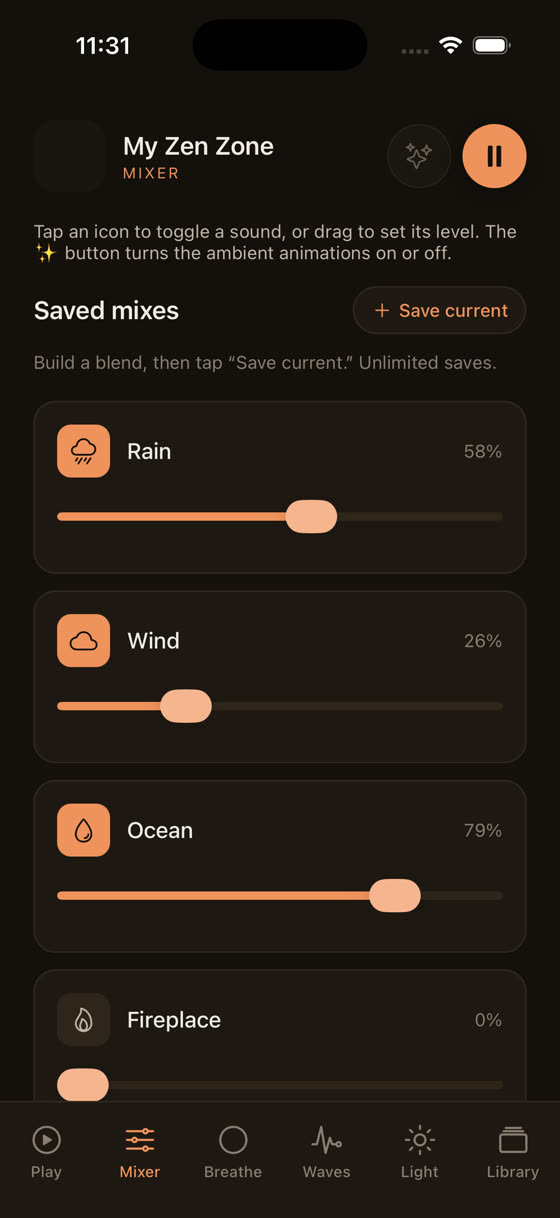
That's the mixer screen itself — three sliders, three different sounds, each independently controlled. The point isn't more options for their own sake. It's that your ideal focus sound depends on the room you're actually in. Someone working in a noisy flat needs more masking underneath the music; someone in a quiet home office might need almost none. A fixed playlist can't adjust for that. A mixer can.
Breathing before the work starts, not during it
One thing worth "taking" that costs nothing and isn't a supplement: ninety seconds of slow breathing before you open your laptop. A 4-6 pattern, four counts in through the nose, six counts out, shifts your nervous system slightly toward parasympathetic before you start, rather than trying to calm a racing mind mid-task when it's already too late.
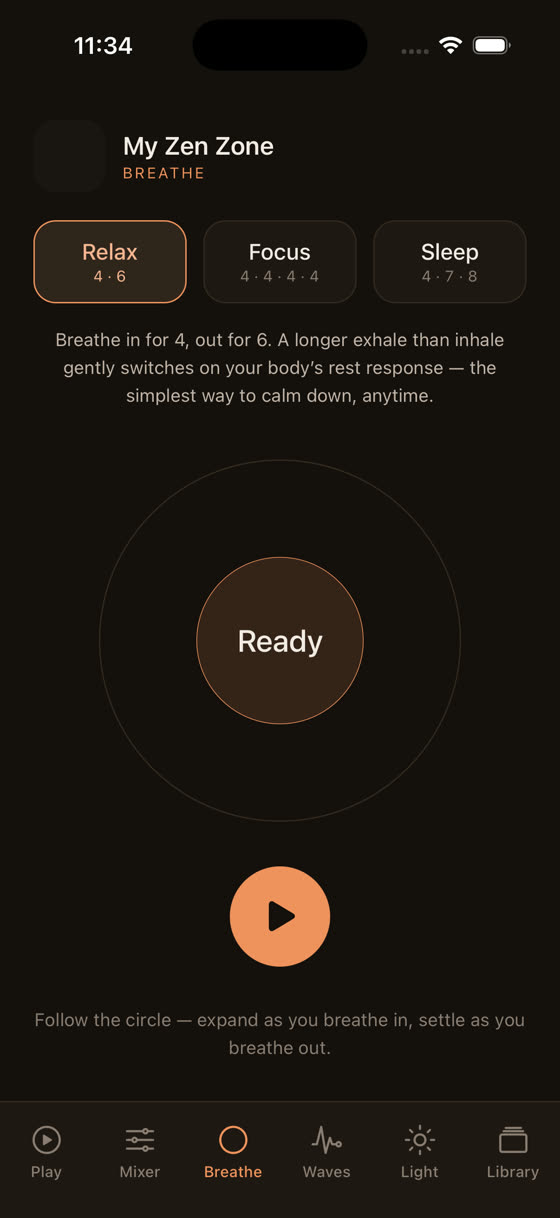
That's the breathing screen with the 4-6 pattern paced visually, so you're not counting in your head while also trying to think about work. Three or four cycles is usually enough. It's a small ritual, but small rituals that mark the start of a work block do something caffeine can't: they tell your brain the context has changed.
What to actually avoid taking
A few things undo all of the above quietly. A sugar-heavy breakfast gives you twenty minutes of alertness followed by a crash that feels exactly like a focus problem but is actually a blood sugar problem. A second or third coffee after midday pushes into afternoon sleep pressure and often costs you the evening instead of buying you the afternoon. And background video — anything with a face talking, even muted with subtitles — pulls visual attention away constantly, far more than ambient music ever does, because faces are specifically what human attention is wired to track.
Timing it against your own day
Most people have one, sometimes two, genuine high-focus windows per day, often mid-morning and sometimes early evening. The rest of the day is workable but not peak. Matching your hardest task to your actual window, rather than to whatever's on the calendar, does more for output than any single thing on this list. If you don't know your own pattern yet, track energy hourly for three days — it's unglamorous but it's the most useful data you'll ever collect about yourself.
Evening is a different problem entirely, and worth separating from daytime focus — if you're trying to wind the same brain down after a long work day, that's covered properly in our piece on music for sleep, since what helps you concentrate at 10am can be the wrong thing at 10pm.
Making it a habit rather than a one-off
None of this works as a single morning you got right once. The value is in having the same few tools available every time you sit down to work, so you're not reinventing the stack daily. New instrumental tracks get added to the library roughly every two weeks, which matters more than it sounds — the same loop for months stops being background and starts being noticeable, and noticeable is the opposite of what you want from focus music. A subscription also opens the whole library in a browser, so the same mixer setup follows you from a phone on the train to a laptop at a desk. You can see the full range, including the focus and sleep worlds side by side, at myzenzone.app, or go straight to the app if you'd rather start building your own stack tonight than keep reading about it.
Common questions
Do nootropic supplements actually improve focus?
Evidence is thin and mixed for most of them. Some ingredients have small, inconsistent study results; others have almost none. We're not making medical claims either way. The things with clearer support — hydration, morning light, sensible caffeine timing, reducing noise and notification interruptions — are less exciting but better backed.
Is instrumental music really better than music with lyrics for focus?
For most people doing reading, writing, or coding, yes. Lyrics engage the brain's language processing even when you're not consciously listening, which competes with tasks that also use language. Purely instrumental or ambient sound avoids that overlap, which is why film scores and ambient tracks outperform favourite albums for deep work.
How much caffeine is too much for focus?
It varies by tolerance, but jitteriness, a racing mind, or a crash within two hours are signs you've overshot. A single moderate dose, timed 60-90 minutes after waking rather than immediately, tends to work better than a larger dose taken all at once early in the day.
What's the best time of day to do focused work?
Most people have a natural high-alertness window mid-morning, sometimes a second smaller one in early evening. It's individual though — track your energy hourly for a few days if you're not sure, and schedule your hardest task into whichever window actually shows up consistently for you.
Can background nature sounds help even without music?
Yes, for some people nature sound alone — rain, light static, distant wind — is enough, with no music at all. It still does the job of replacing unpredictable background noise with something steady. The mixer lets you try that alone or layered under music, which is worth testing both ways.