The short answer
Music that puts you to sleep sits at 50 to 65 beats per minute, keeps a narrow dynamic range so nothing jumps out at you, and avoids melody you can hum along to. Think slow piano with long sustain, soft pads, or a drone with almost no attack on each note. The goal isn't to entertain you into unconsciousness, it's to give your nervous system nothing to track.
That's the mechanism in one sentence. Everything below is the detail that decides whether the track you choose tonight actually works, or just plays quietly in the background while you stay awake anyway.
Why slow tempo actually works
A resting heart rate for most adults sits somewhere between 60 and 80 beats per minute, lower if you're relaxed and lying down. There's a loose phenomenon called entrainment, where a rhythm your body hears tends to pull your pulse and breathing toward it. It's not instant and it's not guaranteed, researchers haven't proven a strong causal link, but the direction makes sense: a steady 55 bpm pulse gives your body a slower rate to sync toward, instead of the 110-120 bpm of most pop and even a lot of "relaxing" instrumental playlists on streaming services.
The exception worth knowing: tempo alone won't do it if the track still has sharp transients, a string section that swells, or a melody with real movement. A slow song can still be a busy song. What matters more than the number on the metronome is whether your brain has to do any work to listen to it.
The mistake almost every sleep playlist makes
Most "sleep" playlists are built by an algorithm matching tempo and mood tags, not by someone who has actually tried to fall asleep to them. The result: a 15-track mix where track 4 has a key change, track 9 has a vocal sample, and track 12 suddenly gets several decibels louder because it was mastered for a different purpose. Each of those is a small wake-up call. You don't consciously notice it, but your attention gets pulled, and falling back into a drowsy state takes another ten minutes.
This is the actual argument for purpose-built sleep music over a generic streaming playlist. We've written more on the mechanics of this in our guide to the best music for sleep, but the short version is: consistency across an entire track list matters as much as the qualities of any single song.
Instruments that help you drift, and ones that don't
Piano and soft pad synths do most of the work in good sleep music, but not any piano and any pad. A piano with a hard attack, the kind used in a ballad to make a note land, keeps you listening. A piano with the attack softened and the sustain stretched out, more like a bowed note than a struck one, disappears into texture. Pads work the same way: a slow filter sweep is fine, a pad that builds into a swell is not.
What to avoid: anything with a vocal, even wordless "oohs," because the brain is wired to track a human voice whether it wants to or not. Anything with a strong stereo pan that moves left to right. And anything in a major key built around a rising melodic line, which your ear naturally wants to resolve, keeping a small part of your attention waiting for the next note.
Loudness, mastering, and the 3am problem
A track that's fine at 11pm can wake you at 3am if the whole album isn't mastered to the same loudness. This is the single most overlooked part of sleep music. If every track sits within a tight loudness window, maybe 2-3 dB of variance across an hour-long playlist, you never get startled by a sudden jump when one song ends and the next begins. If it isn't, you will, eventually, on a night when you're already a light sleeper from stress or travel.
This is also why a sleep timer matters more than people think. Set it for the length of your usual time to fall asleep, not for the whole night, so the music stops rather than looping into a track that was mastered a touch louder three hours after you dropped off.
Nature sound layering beats a single mix
One flat sound, however calming, has an edge. A single rain recording on a loop has a predictable rhythm your brain can start to count, and after thirty minutes it becomes a thing you notice rather than a thing that fades. Layering two or three sounds at different levels, a low rain bed, a distant thunder rumble further back, a thread of music under both, gives your brain more texture to settle into and no single repeating pattern to latch onto.
This is the part most sleep apps skip. They give you a fixed "rain" track or a fixed "sleep music" track, full stop. My Zen Zone's mixer lets you set three sounds at three separate levels, so you can push the rain down, bring a low drone up, and drop the thunder almost out of earshot, then save that exact balance.
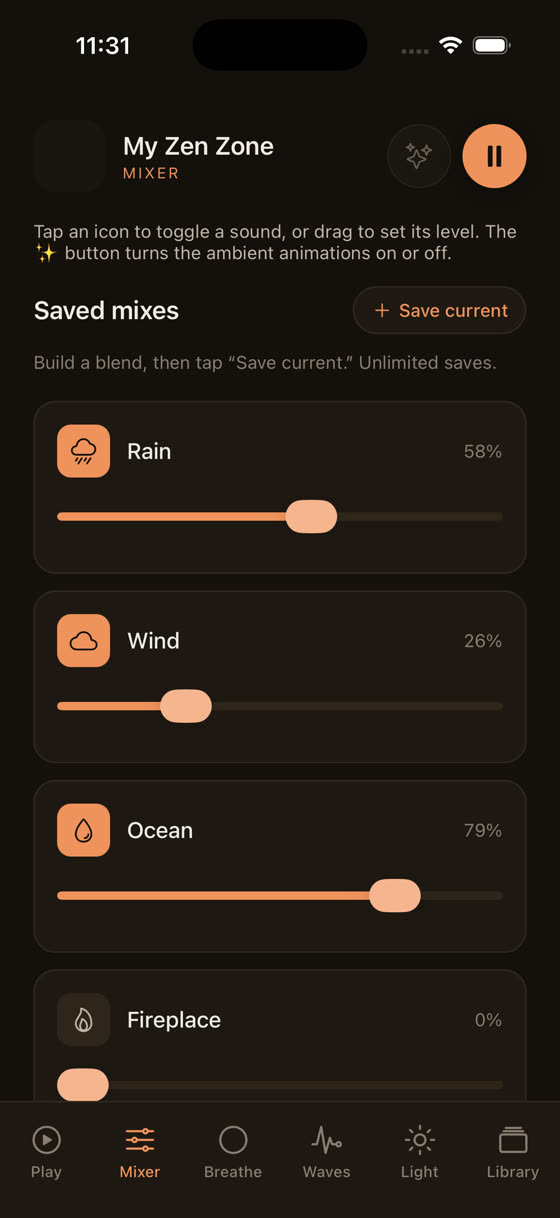
If you've never tried this, the difference is immediate. A single sound asks your brain to either accept it or notice it. A blended layer with no one element dominant just becomes room tone, and room tone is far easier to sleep through than a loop with a beginning and an end you can hear.
Building the last twenty minutes before lights out
Music helps most when it's not the only thing changing. Lowering the light in the room, slowing your breathing rate deliberately, and keeping the same handful of tracks night after night so your brain starts to associate them with sleep, all of this does more collectively than the perfect track by itself.
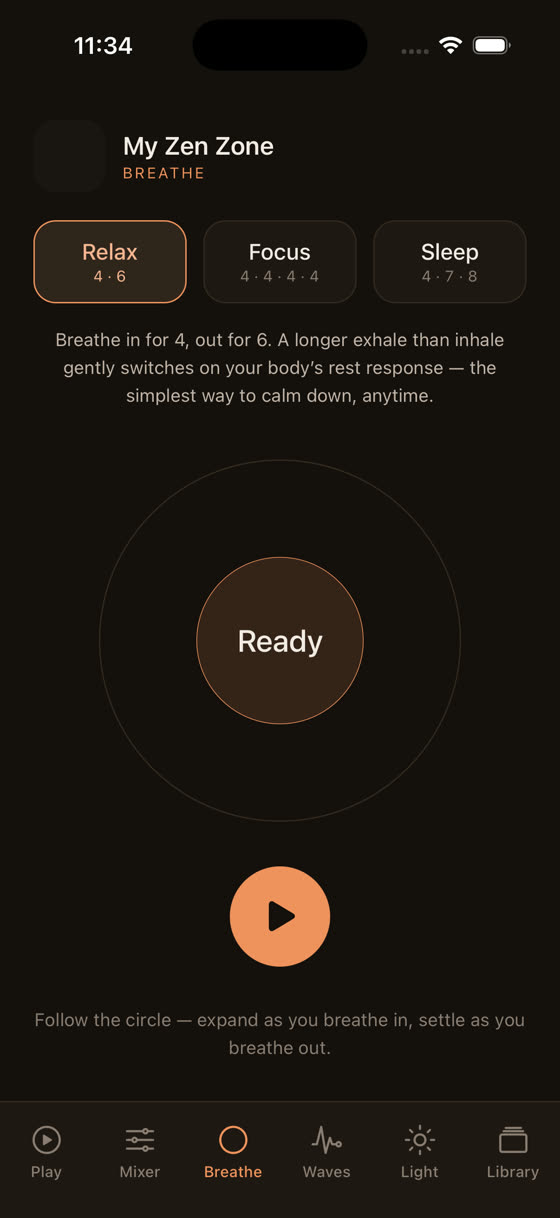
A simple breathing pattern, four seconds in, six seconds out, done for two or three minutes before you press play on music, lowers your baseline heart rate before the music even has to do any work.
Dimming the light on your phone or device matters too, both because blue light delays melatonin and because a bright screen is one more thing keeping part of your brain alert.
None of this is a guarantee, and if you deal with ongoing insomnia, music is a tool, not a treatment, which is worth saying plainly so nobody reads this as medical advice.
What to actually press play on tonight
If you're starting from nothing: pick a single track or guided session around 55-60 bpm, solo piano or a soft pad drone, no vocals, and let it run on a 30-45 minute sleep timer rather than all night. Add one nature layer underneath it, rain or a low ocean swell, at a level where you can barely separate it from the music. Keep the room dark or on a warm low light. Do this for a week before judging whether it works, because the association between a specific set of sounds and falling asleep is built over repeated nights, not one.
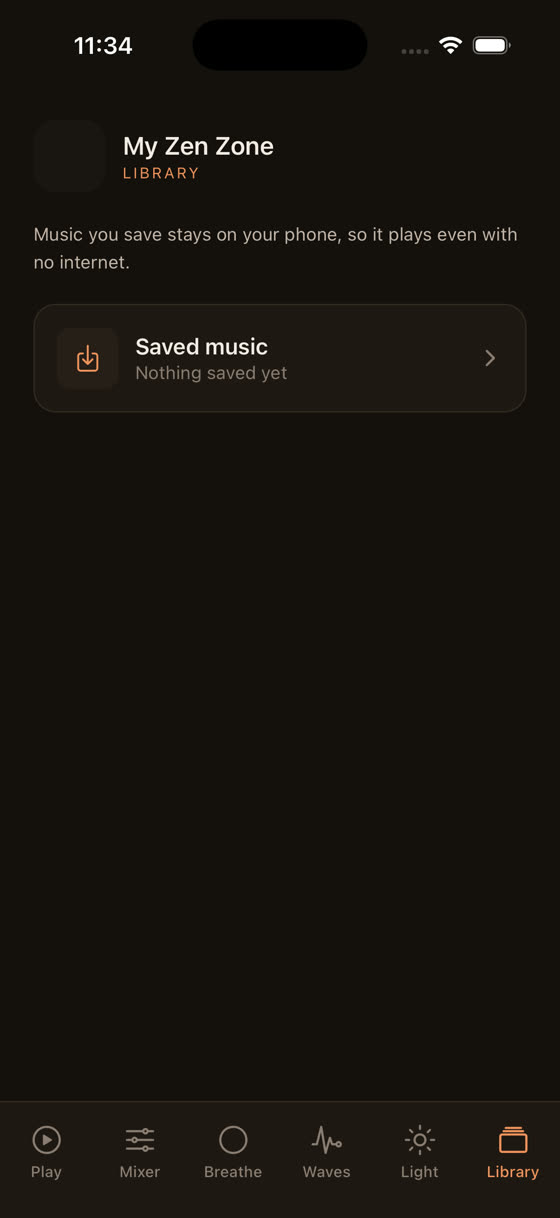
The library inside My Zen Zone is built around exactly this logic, one musician composing and recording everything in-house rather than a stock catalogue stitched together by mood tag, with new tracks added every two weeks so the same handful of songs don't wear thin over months of use. You can browse the whole thing from the home screen, download tracks for offline listening so a patchy connection at midnight never interrupts a loop, and if you want to compare how this differs from music built for staying alert rather than drifting off, our piece on music for focus and study covers the opposite end of the same idea. If sleep is the actual problem you're solving tonight, the app is free to start and the mixer alone is worth the five minutes it takes to set up your first blend.
Common questions
Does the key of the music matter, major vs minor?
Less than people assume. Minor keys are often tagged as sadder and major as happier, but for sleep what matters more is melodic movement, not key. A minor piece with a strong rising line can keep you alert just as easily as a major one. Flat, static, low-movement pieces work in either key.
Can music with lyrics ever help you fall asleep?
For some people yes, usually a familiar song tied to a calm memory, but generally no, because the brain processes language even at low volume, pulling attention toward words and meaning. If you want a voice in the mix, music in a language you don't speak strips out meaning while keeping the texture.
How long should I let sleep music play?
Long enough to cover your usual time to fall asleep, not the whole night. Twenty to forty-five minutes on a sleep timer is typical. Letting a full album loop for eight hours risks a volume shift or loop point waking you once you're already asleep, which is worse than silence.
Is brainwave or binaural audio proven to help sleep?
The evidence is thin and mixed, and small-study results don't reliably hold up at scale. Some people find low-frequency tones genuinely calming as background texture, which is reason enough to try them, but treat specific claims about brainwave entrainment or sleep stages with caution rather than certainty.
Should I use the same sleep music every night or change it often?
Repetition helps more than variety here. Your brain starts to associate a specific track or playlist with falling asleep, the same way a bedtime routine works for a child. Rotating through new tracks occasionally is fine, but a core set you return to most nights will usually work better than constant novelty.