Walk into most spas and you will hear some combination of piano, soft string pads, a flute or two, singing bowls, and water. That is the short answer. But the instrument list is the least interesting part of why this music works, and most articles that cover this topic stop exactly where it gets useful.
Piano and keys: the backbone of most spa tracks
Piano does more work in spa music than any other instrument, and it is usually the first thing a composer sketches. Not a grand concert piano hammering out melody, but something closer to a felt piano, where a layer of felt sits between hammer and string, softening the attack so each note arrives rounded rather than struck. Played slowly, with wide spacing between notes and a lot of sustain pedal, it gives the ear something to follow without demanding attention. Rhodes and other electric keys show up too, especially in warmer, slightly more organic spa tracks, because their tone decays gently rather than cutting off.
What most people miss is the register. Spa piano tends to sit in the middle of the keyboard, avoiding the very low end, which can feel ominous, and the very top, which can feel glassy or thin. Middle register reads as safe. That is a deliberate choice, not an accident of taste.
Strings, pads and synthesisers
Underneath the piano you will usually find a string pad or a synth pad holding a single chord for eight, sixteen, sometimes thirty-two bars. These are not violins sawing away. They are long, slow-moving textures, often built from sampled strings stretched and softened, or from analogue-style synths with a slow attack so the sound fades in rather than starting abruptly. The job of a pad is to remove silence without adding information. Your ear registers warmth and continuity, not a tune.
This is also where a lot of modern spa music quietly uses synthesis rather than real instruments. A warm analogue pad, a touch of reverb, a low-pass filter rolling off the harsh top end: that is enough to create the sense of space people associate with a treatment room, without a single string player involved.
Water, wind and the sounds that aren't instruments at all
Spa music leans harder on field recordings than almost any other genre of relaxation music. Rain, a slow stream, waves arriving and receding, distant birdsong. These are not decorative. They do real work, filling the frequency range above and below the musical instruments so the whole mix feels fuller without getting louder. A good water recording also has its own natural rhythm, usually slower than you would compose on purpose, and that slight irregularity is part of what makes it feel calming rather than mechanical.
This is where the fixed-playlist approach falls apart for a lot of listeners. One person wants heavy rain and no birds. Another wants birds and no rain at all. A single rendered track cannot answer both.
Being able to raise rain, lower birdsong, and bring in a stream at your own level, independently of the music underneath, is a different experience from pressing play on someone else's mix. We built the My Zen Zone player this way on purpose.
Singing bowls, bells and chimes
Tibetan or crystal singing bowls appear constantly in spa music, partly because they sound genuinely relaxing and partly because they have become shorthand for the genre. A struck or rubbed bowl produces a long, complex tone with several overtones ringing at once, which is acoustically interesting in a way a single synth note is not. Used sparingly, maybe once every sixteen bars, a bowl strike gives the ear a small event to notice, which actually helps attention settle rather than wander looking for something to focus on.
Small bells and wind chimes do something similar at a smaller scale. They are rarely rhythmic. They are placed almost at random, which mimics the way wind actually moves a chime, and that irregularity reads as natural rather than programmed.
Flute, woodwinds and the occasional voice
A breathy flute, sometimes a pan flute, sometimes a shakuhachi-style wooden flute, often carries whatever melody exists in a spa track. The key word is breathy. The sound of air moving through the instrument is left in rather than filtered out, because that texture reads as human and unforced. Wordless vocals, a single sustained hum or a simple phrase with no lyrics, show up for the same reason. No language to process, just tone.
These melodic elements are usually the sparsest part of the whole arrangement. A flute phrase might appear once a minute. That restraint is deliberate; a constant melody is more stimulating than most people actually want while winding down.
Tempo and production matter more than the instrument list
Here is what most pieces on this topic get wrong: they treat the instrument list as the whole answer, when tempo and production choices do more of the actual work. Most spa music sits between 50 and 70 bpm, close to or below a resting heart rate, and there is some research suggesting slower tempos are associated with a calmer physiological state, though the evidence is not as strong or as settled as wellness marketing often implies. Reverb is used generously, which pushes sounds slightly further away and softer. Harsh transients, anything with a sharp attack, get smoothed in the mix. You could swap the piano for a harp and the flute for a cello and, if the tempo and production stayed the same, it would still read as spa music.
This is also why genre labels like spa, sleep, or ambient overlap so much. The instruments are similar across all of them. What changes is pacing, arrangement density and how much silence is left between phrases.
How we use this when building the library
Every track in My Zen Zone is written and recorded by one composer, which means the instrument choices are consistent rather than licensed from a dozen stock libraries with wildly different production styles. New tracks go in every two weeks, so the piano-and-water palette described above keeps getting rebuilt in slightly different combinations rather than repeated on a loop.
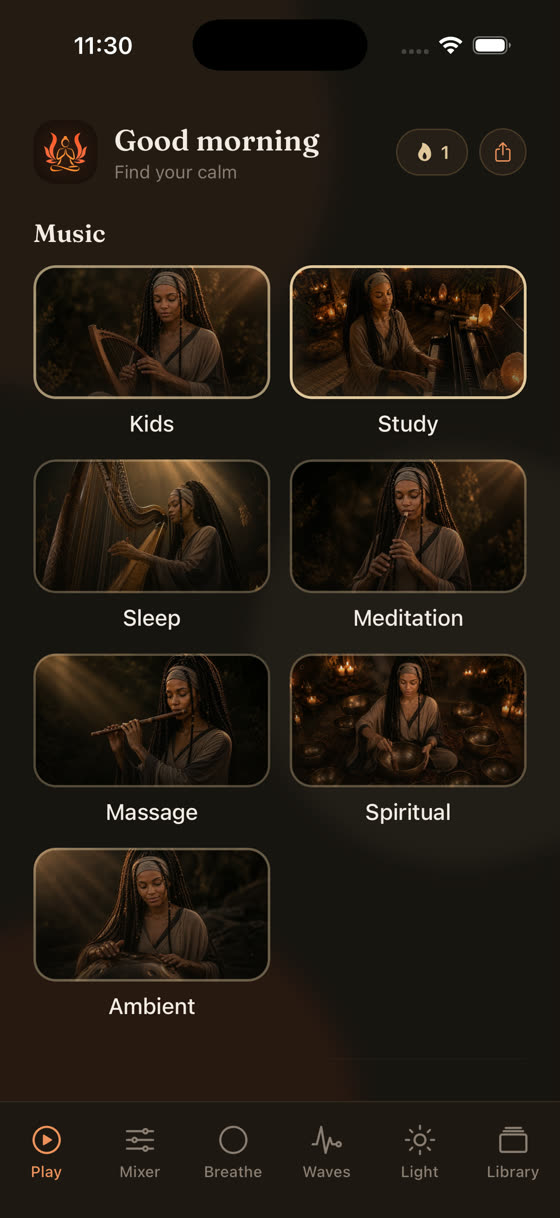
Sleep, Focus, Meditation and Calm each sit as their own space in the app, because spa-style instrumentation gets used differently depending on what you actually need it for. If you want the mechanics of why slow, sparse arrangements help with falling asleep specifically, that is covered in more depth in our piece on music for sleep. If you are after something with a bit more rhythmic structure for working, this one on focus music gets into why spa-style pads are usually too sparse for concentration and what works better instead.
Combining instruments with a guided session
A lot of spa-style tracks get paired with a guided relaxation voice, and most apps handle this by ducking the music down whenever the voice speaks, which flattens both. We treat the voice as its own layer instead.
You can bring a guided body-scan voice in over a piano and water track and set your own balance between voice, music and nature sound, rather than accepting whatever mix someone else rendered. It is a small difference in theory and a noticeably different experience in practice, especially if you find most guided meditations either drown the music or bury the voice.
What to actually listen for tonight
If you want to test any of this yourself, put on a spa track and listen specifically for three things: how low the piano sits in its register, how long the pad chord holds before it changes, and whether the water or rain sound has a slight irregularity to its rhythm. Once you notice those three, spa music stops sounding like a vague genre and starts sounding like a set of deliberate decisions. You can try the full library, including the parts built around exactly these choices, through My Zen Zone.
Common questions
Is spa music the same as meditation music?
They overlap heavily but are not identical. Spa music tends to be slightly more melodic, with piano or flute carrying a loose tune, while a lot of meditation music drops melody almost entirely in favour of a single sustained drone or tone, so attention has less to latch onto during practice.
Why does spa music always seem to include water sounds?
Water recordings fill frequency space above and below the instruments without adding volume, and their natural irregular rhythm feels less mechanical than a looped musical phrase. It is also become a strong cultural association with relaxation and treatment rooms, so it signals the genre instantly.
Can I use spa music while working?
Some people can, but the slow tempo and sparse arrangement that make it relaxing also make it a poor match for sustained concentration, since there is not enough rhythmic structure to anchor attention. Music built with a steadier pulse, covered in our focus music piece, tends to work better for actual work sessions.
Are singing bowls real instruments or synthesised?
Both exist in commercial spa music. Many tracks use recordings of genuine Tibetan or crystal bowls because their overtone-rich tone is hard to fake convincingly, while others use sampled or synthesised versions layered with reverb to get a similar effect more cheaply and with more control over tuning.