Most of what you find under "rain sounds" on YouTube falls into three buckets: a single field recording looped to fill 8 or 10 hours, several field recordings layered together and re-exported as one file, or a synthetic rain sound built from filtered noise in software like Audacity or a DAW. None of them are actually 10 hours of continuous rain. That's the short answer. The longer answer is more useful, because knowing which kind you're listening to explains why some tracks feel soothing for exactly six minutes and then start to grate.
The three types you'll actually find
A genuine field recording is a microphone left out in real weather, capturing rain on a roof, leaves, a tent, or a window. These have the most texture: gusts of wind push the rain around, a car passes somewhere in the distance, a gutter drips at an irregular interval. That irregularity is what makes real rain pleasant. Nothing repeats.
The problem is that almost nobody has 10 hours of usable field recording sitting around, so the uploader takes a 3 to 12 minute clip and loops it. You'll sometimes hear the seam if you listen closely, a tiny hitch or a change in air pressure every few minutes that shouldn't be there in real weather. Most people never consciously notice it, but it's part of why long loops can feel subtly "off" by hour three of a sleep session.
The third type is generated, not recorded. Someone runs white or pink noise through a band-pass filter and a bit of amplitude modulation to mimic the frequency shape of rain, then adds occasional synthetic thunder. These can sound convincing on a phone speaker and less convincing on headphones, where the lack of natural micro-variation is easier to hear.
Why rain sound works on the brain in the first place
Real rain sits close to what audio engineers call pink noise: energy spread across frequencies but weighted slightly toward the lower end, unlike the harsher, evenly-spread hiss of pure white noise. This broadband, gently sloped spectrum is good at masking sudden environmental noises: a door closing, traffic, a partner turning over. Your brain has less of a sharp new sound to react to because the rain is already filling that frequency space. That masking effect, more than any calming quality of rain itself, is probably doing most of the work. It's the same principle behind our own guide to what actually makes music good for sleep: consistency and a lack of sudden peaks matter more than genre.
Worth being honest about here: the research on rain sound and sleep specifically is thin. There are small studies on white noise and infant sleep, and broader work on noise masking in general, but nothing that proves rain sound improves sleep quality for adults in a rigorous way. What we can say plainly is that a steady, predictable sound is easier for most nervous systems to tune out than an unpredictable one, and rain happens to be steady and predictable in a way a ticking clock or a snoring partner is not.
The parts of the YouTube experience nobody mentions
Here's where it gets practical. A 10-hour rain video on YouTube comes with a phone that has to stay awake, a screen that stays lit unless you fumble with settings, and an app that was built to keep you engaged, not to help you disengage. Autoplay can jump you into an unrelated video the moment the rain track ends, sometimes with no rain at all, sometimes with an ad at full volume at 3am. Buffering happens the second your connection dips. And plenty of "calming" rain videos bury a loud thunderclap in there for atmosphere, which is the opposite of what you want at midnight when you've just drifted off.
There's also the ad problem itself. Free rain videos are monetised, which means pre-roll ads, mid-roll ads, and a channel that's incentivised to keep you watching rather than keep you asleep. None of this is a criticism of the people who upload rain videos; many of them are genuinely trying to help. It's just a mismatch between the platform's design and what you're actually trying to do, which is stop paying attention to your phone.
How to tell a good rain track from a mediocre one
If you're going to keep using YouTube for this, a few things to listen for. Play the track at a slightly higher volume than usual and listen for a loop point, a moment where the texture seems to reset. Shorter loops (under 5 minutes) tend to be more noticeable once you know to listen for them. Check whether thunder is present and how loud it gets; sudden low-frequency booms are more likely to wake a light sleeper than the rain itself. And be wary of anything advertised as "binaural" rain unless you're specifically using headphones, since the effect does nothing over phone speakers.
A cleaner way to use rain sound for sleep or focus
This is where we'd rather show you than argue with you. Instead of a single fixed rain recording, our library treats rain, and every other nature layer, as an instrument you control alongside the music, not a video you press play on and hope for the best.
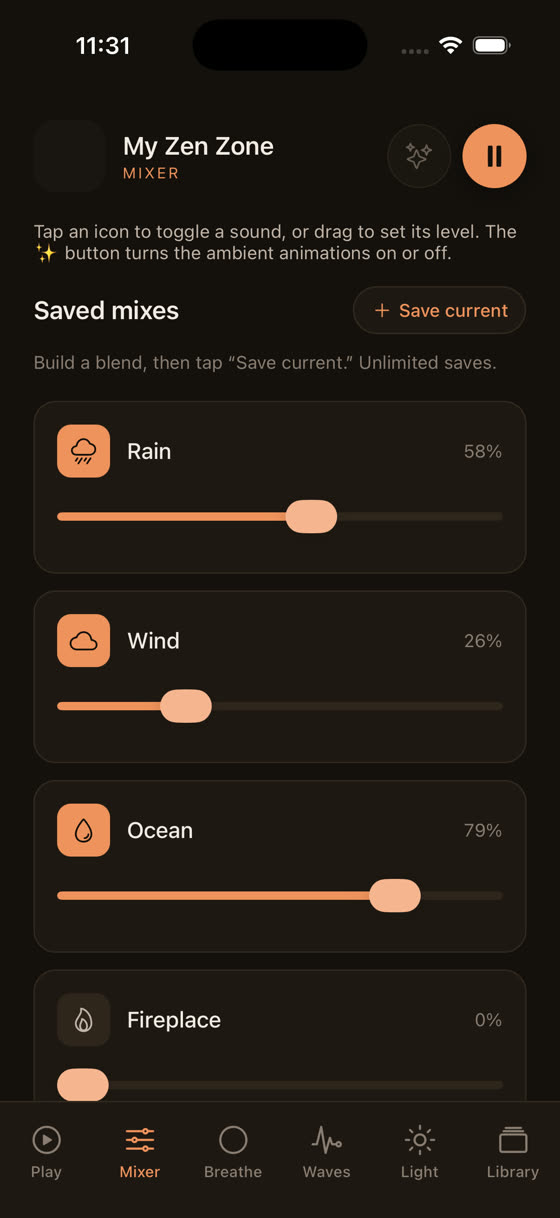
That's the mixer: rain at one level, a low pad or a second nature sound at another, each with its own slider. You can bring rain up and drop it back down without touching the music underneath, which is something no YouTube video lets you do. Watch how the balance actually shifts in real time.
Because it's original, composed material rather than a recorded loop, there's no seam to notice and no thunderclap dropped in for atmosphere unless you want one. Everything is built by one musician working specifically for sleep, focus and rest, which means the rain textures are shaped to sit under the music rather than compete with it. If you're building a wind-down routine rather than just chasing a sound, our piece on what makes music good for sleep goes into how layering like this compares to a straight ambient track.
What this looks like for focus rather than sleep
Rain gets treated almost entirely as a sleep aid online, but plenty of people use it during the day to mask an open-plan office or a noisy street while they work. The same masking principle applies, though the ideal loudness and texture shift: for focus you generally want something steadier and quieter, without the drama of thunder or wind gusts pulling attention back to the sound itself. If that's your actual use case, it's worth reading music for focus and study, since a rain layer under the wrong kind of music can undo more concentration than it protects.
Practical changes to make tonight
If you're going to stick with YouTube rain videos for now, a few small changes help: download the video where the app allows offline playback so buffering doesn't cut in, use a real sleep timer rather than relying on the video length, and turn autoplay off entirely so you don't wake to an ad. If you want to skip that entire workaround, the app runs entirely offline once downloaded, has a proper sleep timer built in, and adds new tracks to the library every two weeks rather than leaving you to search for a better rain video every few months. You can see the full range of sound worlds, rain among them, from the home screen, or just go straight to get the app and try the mixer for yourself tonight.
Common questions
Is real rain sound better than synthetic rain sound?
Neither is objectively better; it depends what you notice. Real field recordings have more natural micro-variation, which some people find more calming, while synthetic rain is more consistent and won't include odd background noises like traffic or wind gusts. If seams or sudden background sounds pull you out of sleep, synthetic or composed rain tends to be steadier.
Why do rain videos on YouTube sometimes have loud thunder?
Thunder gets added for atmosphere or realism, but it's rarely mixed with sleep in mind. A sudden low-frequency clap can be loud enough to wake a light sleeper, especially through headphones. If you're using rain sound specifically to sleep, look for tracks that either omit thunder or keep it very quiet and infrequent.
Can I use rain sounds and music together?
Yes, and this is generally more effective than either alone, since the rain masks sudden noises while the music gives your mind something gentle to settle into. The tricky part on YouTube is that you can't adjust the balance between two separate videos. A mixer that lets you set rain and music to independent levels solves that directly.
Do rain sounds actually help you fall asleep faster?
There's no strong evidence proving rain sound speeds up falling asleep specifically. What research does support is that steady background noise can mask disruptive sounds like traffic or a partner moving, which may make it easier to stay asleep once you're there. Treat it as a masking tool rather than a guaranteed sleep aid.
Why does YouTube autoplay ruin rain sound videos for sleep?
Autoplay is designed to keep you watching, not to protect your sleep, so it can jump to an unrelated video, a louder track, or a mid-roll ad the moment your rain video ends. Turning autoplay off helps, but the more reliable fix is an app built around a sleep timer and offline playback, so nothing plays past the point you actually fall asleep.