The best way to fall asleep on a plane is to mask the cabin noise with something steadier than engine drone, slow your breathing on purpose rather than waiting for tiredness to do the work, and start the whole process before boarding, not after the seatbelt sign switches off. Cabin noise at cruising altitude sits around 80-85 decibels, close to a hairdryer running for six hours straight. That is why forcing your nervous system down to resting pace matters more in the air than almost anywhere else you will try to sleep.
Why planes fight you harder than your bedroom does
Most sleep advice assumes a quiet, dark, pressurised room at sea level. A plane gives you none of that. Cabins are pressurised to the equivalent of 6,000-8,000 feet, which lowers blood oxygen saturation slightly and leaves some people feeling wired even when exhausted. Humidity drops to 10-20%, compared with the 30-60% your body is used to, which dries out airways and nudges heart rate up. You are sitting upright, so the postural muscles in your neck and back stay switched on in a way they would not if you were lying flat. And underneath all of it is a noise that never settles into a rhythm: engine rumble, air vent hiss, trolley wheels, a baby two rows back, the seatbelt chime. Your brain keeps half an ear open for the next irregular sound, which is precisely what stops you dropping into deep sleep.
Why generic white noise isn't enough
Most noise apps give you one fixed track on a loop. That works fine in a quiet room, but a cabin is not one frequency, it is several stacked on top of each other: a low rumble around 100Hz from the engines, a thin hiss from the air vents, and sudden spikes from the crew cart or someone coughing. A single flat noise track masks the rumble but does nothing for the spikes, so you still flinch awake.
What actually works is layering two or three sounds at different levels, so the low end buries the engine drone and a higher, softer layer smooths over the sudden stuff. This is the whole idea behind the mixer in the app: you are not picking one track, you are building a sound environment with independent levels for each layer, something like rain sitting low under a steady brown-noise drone.
Watch how the balance shifts live and you will see why one fixed loop rarely survives a full flight. You want the mix quiet enough not to fight your headphones' volume limit, but present enough that a sudden noise doesn't cut through it. If you want the fuller case for why layered sound beats a single loop at night generally, not just in the air, it's laid out in our piece on the best music for sleep.
Slow your breathing before you even put headphones in
Music helps, but it works faster if your breathing is already slower when the track starts. A simple pattern used in a lot of sleep and anxiety work is 4-6: inhale through the nose for a count of four, exhale for a count of six. The longer exhale is the part that matters, it is what nudges the vagus nerve and brings heart rate down a notch at a time. Do this for two or three minutes with your eyes closed before you press play on anything.
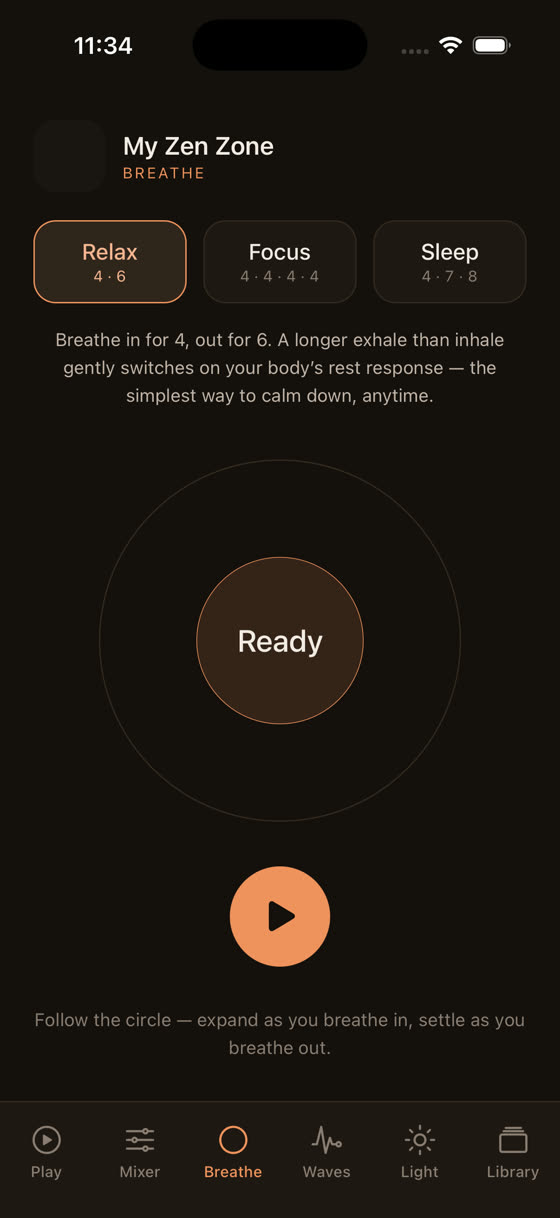
The breathing screen in the app runs this exact 4-6 pattern with a moving shape to follow, which is useful on a plane specifically because you don't have to count in your head while also trying to ignore the seatbelt sign. Two minutes of that, then straight into the sound mix, is a far more reliable sequence than scrolling your phone until your eyes get heavy.
Set your sleep timer against the flight, not the clock
This is the part most travel advice skips entirely. You are not trying to sleep for eight hours, you are trying to sleep for the length of the flight minus the bit at the end where the cabin lights come up and breakfast trays arrive. On a seven-hour flight, set a sleep timer for around five and a half hours so the sound fades out naturally before descent starts, rather than waking abruptly to a stewardess asking about tray tables.
Short-haul red-eyes, anything under three hours, are a different problem. There isn't enough time for a full sleep cycle, so chasing deep sleep will just leave you groggy. On those, aim for a lighter doze: a shorter, calmer track with no expectation of actual sleep architecture, more like a 40-minute wind-down than a night's rest.
What to actually skip the night before and during boarding
Alcohol is the big one people get wrong. It feels like it helps you drop off, but at altitude it dehydrates faster and fragments sleep more than it would on the ground, so you wake more often even if you don't remember doing it. Caffeine has an obvious cutoff, but less obvious is your phone screen in the boarding queue. Bright light that close to your face delays melatonin release exactly when you want it rising.
A gradual dim, like the light screen built for winding down, is a better use of those last twenty minutes at the gate than checking email one more time. It gives your eyes something to do that doesn't tell your brain it's daytime.
The physical setup that makes the audio actually work
Inflight wifi is unreliable and often paid, so download your tracks before you leave the house, not at the gate. Offline access matters more here than almost anywhere else the app gets used. Over-ear headphones, even basic ones, mask noise better than earbuds because they cover more of the ear and block some sound physically before the audio layer even starts. Pair that with an eye mask and a neck pillow that actually stops your head rolling forward, since a slumped neck wakes you up on its own regardless of how good the sound mix is.
A worked example: the overnight transatlantic
Say you're on an 8pm departure, seven hours in the air. Download two or three tracks at home on wifi. At the gate, dim your phone using the light screen instead of scrolling. Once you're at cruising altitude and the seatbelt sign goes off, do two minutes of 4-6 breathing, then open the mixer and build a low drone with a thin rain layer over it. Set the sleep timer for five and a half hours. Eye mask on, neck pillow adjusted before you press play, not after. That sequencing, dim light, slow breath, layered sound, timer matched to the flight, is the entire method. None of the individual pieces is unusual, the order and the layering are what make the difference.
What most plane sleep advice gets wrong
Most of it treats
Some people use it for jet lag adjustment on long trips, but evidence for it improving in-flight sleep specifically is thin. It won't counteract an upright seat, dry air, or irregular noise. If you try it, test it on a normal night first, not for the first time mid-flight. It depends on the flight direction and length. Eastbound red-eyes often suit sleeping on the plane since you're trying to shift your clock forward. Westbound daytime flights sometimes suit staying awake and sleeping on arrival instead. There's no single rule, it genuinely depends on your route. Light sleep stages, which is most of what you get sitting upright, are far more easily disrupted by sudden movement than deep sleep is. A layered sound mix helps mask the noise that often accompanies turbulence, but a bumpy ride will still interrupt lighter stages more than a flat night's sleep would. Both together work best. Noise-cancelling handles the constant low engine rumble physically, before any audio starts. The sound mix then covers the irregular spikes, like trolleys and announcements, that noise-cancelling alone doesn't fully remove.Common questions
Does melatonin help with sleeping on a plane?
Is it better to stay awake and sleep later to beat jet lag?
Why do I wake up every time the plane hits turbulence?
Should I use noise-cancelling headphones or just the sound mix?