The best spa music sits at 50 to 70 beats per minute, roughly resting heart rate, with no lyrics, no percussion attack, and long reverb tails so nothing ever feels like it's starting or stopping abruptly. Most Spotify playlists tagged "spa" get close to this but don't hold it, because a playlist is a list of separate tracks made by different people at different times, and the seams show. If you've ever had a good ten minutes of calm interrupted by an ad, a key change, or a track that's suddenly twice as loud, you already know the problem.
What Actually Makes Music "Spa" Music
There's a specific sonic recipe behind the genre, even if nobody writes it down. Tempo sits low, usually 50 to 70 bpm, because music faster than a resting heart rate tends to pull your attention forward rather than let it settle. Instrumentation leans toward warm, sustained textures: soft pads, handpan, kalimba, singing bowls, sometimes a distant piano with the sustain pedal held down longer than feels natural. There's rarely a hard attack on any note. Reverb tails are long, so notes bleed into each other instead of stopping cleanly, which is part of why the genre can feel like it has no real beginning or end.
Water and air sounds do a lot of the actual work. A track with rain, a stream, or wind woven under the melody reads as calmer than the same melody alone, partly because those sounds are unpredictable in a soft, non-threatening way, unlike a metronomic drum loop. This is one reason a fixed playlist struggles: it can give you the melody, but it can't give you control over how much water or wind sits underneath it on a given night.
Why Spotify's Spa Playlists Rarely Hold Up
Spotify playlists, even the well-curated ones, are built by stitching together tracks from different catalogues, often licensed on a rolling basis. Tracks get swapped in and out. Mastering levels differ from one to the next, so you get sudden loudness jumps that undo twenty minutes of settling in. Free tier means ads, and an ad breaking into a spa playlist is about as far from relaxing as audio gets. Even on premium, algorithmic playlists are built to keep you listening and discovering, which is the opposite goal of a spa session, where you want the same trusted thing to keep going without demanding a decision from you every four minutes.
There's also a licensing reality worth naming plainly: streaming services aren't set up to guarantee a track stays available, or that its replacement will match the mood. A playlist that felt perfect last month can feel patchy this month for reasons that have nothing to do with your taste.
The Missing Piece: A Mixer, Not Just a Playlist
The fix isn't a better playlist. It's control over the layers that make up the sound. Rain at one level, a low drone at another, a handpan melody sitting just above both, each adjustable on its own, so you can turn the water down when it's distracting and bring the melody forward when you want something to actually listen to rather than just sit in.
Watch how the balance shifts in real time in that clip: the same three elements, but the mood changes completely depending on which one leads. That's the piece most spa playlists can't offer, because a streamed track is a single fixed file. In the app the mixer treats each nature sound and each music layer as its own fader, so a spa session becomes something you shape rather than something you press play on and hope holds.
Building Your Own Spa Session at Home
Context matters more than most guides admit. A spa session at 7am before work needs to be quieter and slightly more alert than one at 10pm, or you'll end up sluggish rather than calm. Midday, ten minutes with water sounds and a slow melody can reset a stretch of back-to-back calls without making you sleepy for the 2pm meeting. In the evening, the same instruments at a slower tempo and lower volume start doing the work of sleep music rather than daytime calm, and the line between the two genres is really just tempo and volume, not a different set of instruments.
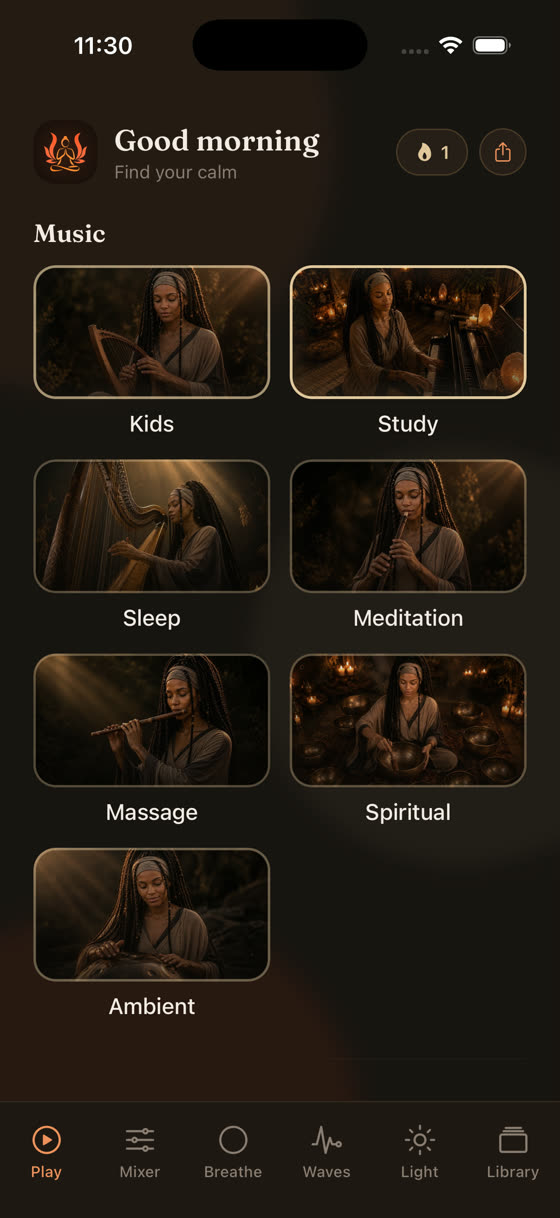
Having sleep, focus, meditation and calm as separate spaces, rather than one long undifferentiated feed, makes it easier to match the music to the hour rather than scrolling through a single playlist hoping something fits.
Guided Relaxation Without Killing the Music
A lot of relaxation apps treat guided sessions and music as an either/or: press play on a guided breathing exercise and the music either stops or gets shoved so far back it might as well not be there. That's a real loss, because a voice with nothing underneath it can feel clinical, and it removes the option to keep the same calming bed of sound running from the guided part into the unguided part that follows.
That recording shows a guided session playing over the music rather than instead of it, voice, music and nature sound each with its own level and its own play button. You can bring the voice up while you're following the instruction, then fade it out and let the music and water carry on once the guidance ends, so there's no jarring silence or sudden re-entry into a different track. It's a small structural difference but it changes how a guided spa or breathing session actually feels from start to finish.
The Practical Tools That Actually Change the Experience
A few unglamorous features do more for a spa listening habit than the music itself. A sleep timer that fades out rather than cutting off mid-phrase matters if you're using this to wind down before bed. Offline downloads matter if your spa moment is a bath with no signal, or a flight, or a hotel with bad wifi. A light screen that dims gradually alongside the music gives your eyes and your body the same signal at once, rather than staring at a bright phone screen while trying to relax.
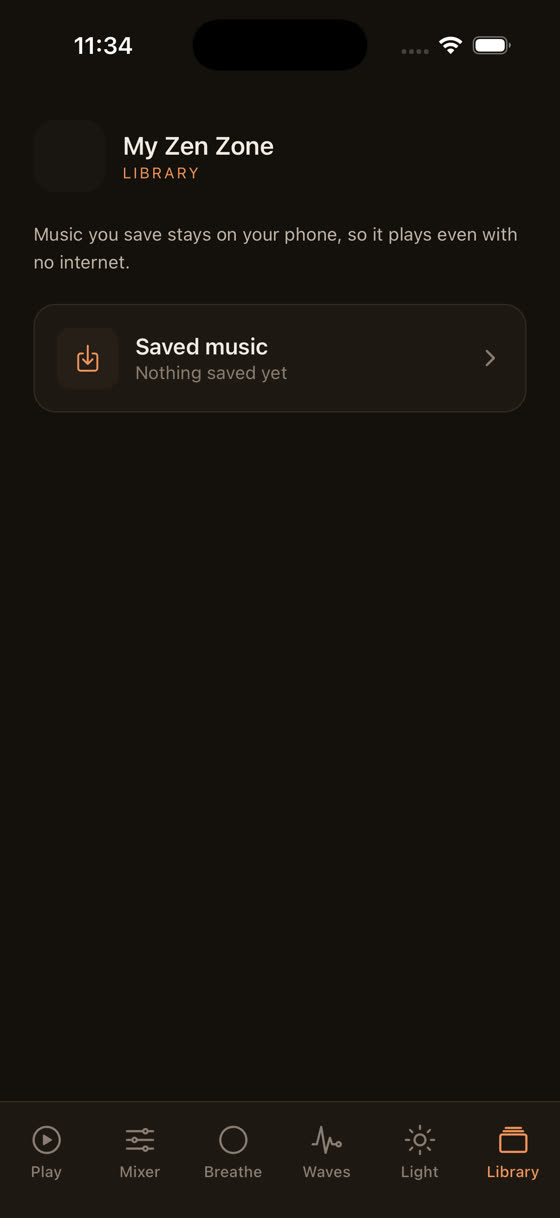
New material every two weeks also matters more than it sounds like it should. Spa music, like anything else, becomes wallpaper if you hear the exact same forty tracks on rotation for a year. A library of hundreds of tracks, refreshed regularly, means the sound stays a genuine reset rather than something your brain has learned to tune out.
What To Actually Play Tonight
If you're winding down after a stressful day, start with something around 55 to 60 bpm, water sound low, melody instrument no louder than the water, and let the sleep timer fade it out over 30 to 45 minutes rather than stopping it yourself. If you're using spa-style music at your desk between calls, keep it closer to 65 to 70 bpm with no water at all, since a room that's too watery can be sleep-inducing rather than clarifying, a distinction covered in more depth over on music for focus and study. Either way, the honest advice is to stop treating this as a search for the perfect fixed playlist and start treating it as a mix you adjust to the ten minutes you actually have. That's a genuinely different way of using relaxation music, and it's worth trying for a week before deciding a playlist app was ever going to be enough. You can see the full library and try the mixer for yourself at myzenzone.app/get, or read more about how the app is put together at myzenzone.app.
Common questions
Is spa music the same thing as sleep music?
They overlap heavily but aren't identical. Spa music tends to sit around 55-70 bpm and is meant for a waking, relaxed state, like a massage or a bath. Sleep music is usually slower, quieter, and designed to fade rather than hold attention. Same instruments often, different tempo and volume envelope.
Can I just use a Spotify spa playlist during an actual massage or facial?
You can, but expect inconsistency: volume jumps between tracks, occasional ads on free tier, and playlists that change week to week as licensing shifts. For a treatment room, a fixed offline set with matched mastering avoids the mid-session surprises a streamed playlist can introduce.
What instruments show up most in good spa music?
Handpan, kalimba, singing bowls, soft piano with long sustain, warm synth pads, and water or wind field recordings underneath. The common thread is no hard attack on any note and long reverb tails, so nothing feels like it starts or stops abruptly.
Does adding nature sounds actually make music more relaxing, or is that a myth?
There's no strong clinical evidence proving it, but the mechanism is plausible: soft, unpredictable sounds like rain or wind don't demand attention the way a rhythmic beat does, so they sit under a melody without competing with it. Whether it helps you personally is worth testing rather than assuming.
How long should a spa music session be?
There's no fixed rule. Ten minutes between tasks is enough to lower tension noticeably for most people; a full evening wind-down often runs 30-45 minutes with a gradual fade at the end rather than an abrupt stop, which is why a fade-out sleep timer is worth using instead of just closing the app.