The short answer
The sleep sounds people search for most on Spotify are rain, brown noise, white noise, ocean waves, and the odd eight-hour fan-noise playlist with a million saves. They work, up to a point, because they mask the sharp, unpredictable noises that pull you out of light sleep. But Spotify was built to play songs, not to run a sound environment through the night, and that gap matters more than most "best sleep sounds" lists admit.
Why Spotify struggles with sleep sounds
A playlist is a sequence of tracks, not a continuous environment. Every track change is a tiny edit: a fade out, a beat of silence, a fade in, sometimes at a different volume because the source file was mastered differently. Your brain doesn't consciously register this at 2am, but the auditory system does, and a change in a masking sound is exactly the kind of thing that can nudge you toward wakefulness. Add autoplay recommending something unrelated after your chosen sound ends, or an ad breaking in on a free account, and the whole point of the sound, an unbroken, boring signal, gets undermined by the platform underneath it.
There's also the volume problem. Spotify gives you one fader for the whole track. Real sleep sounds work better layered, rain a little louder than distant thunder, a fan sound sitting just under both, and you can't build that inside a single audio file. You're stuck with whatever balance the person who uploaded it chose.
What actually makes a sound work for sleep
Sleep researchers who've looked at this generally point to masking rather than relaxation as the mechanism, sound that's steady enough to cover sudden noises, like a door, a car, a partner turning over, without itself being interesting enough to hold your attention. Brown noise, which is heavier in low frequencies than white noise, tends to feel less harsh through the night. Rain works for similar reasons: it's random at the micro level but statistically constant, so your brain stops flagging it as new information.
What most lists get wrong is treating this as one-size-fits-all. Someone in a quiet bedroom needs a very different level than someone under a flight path. The fix isn't a better single sound, it's control over levels, which is the one thing a fixed playlist can't give you.
The layering problem no playlist solves
This is where a mixer changes the experience rather than just the source. Instead of one file at one volume, you set rain, a soft drone, and something like distant waves each on its own slider, and adjust them independently as the room, or your mood, changes.
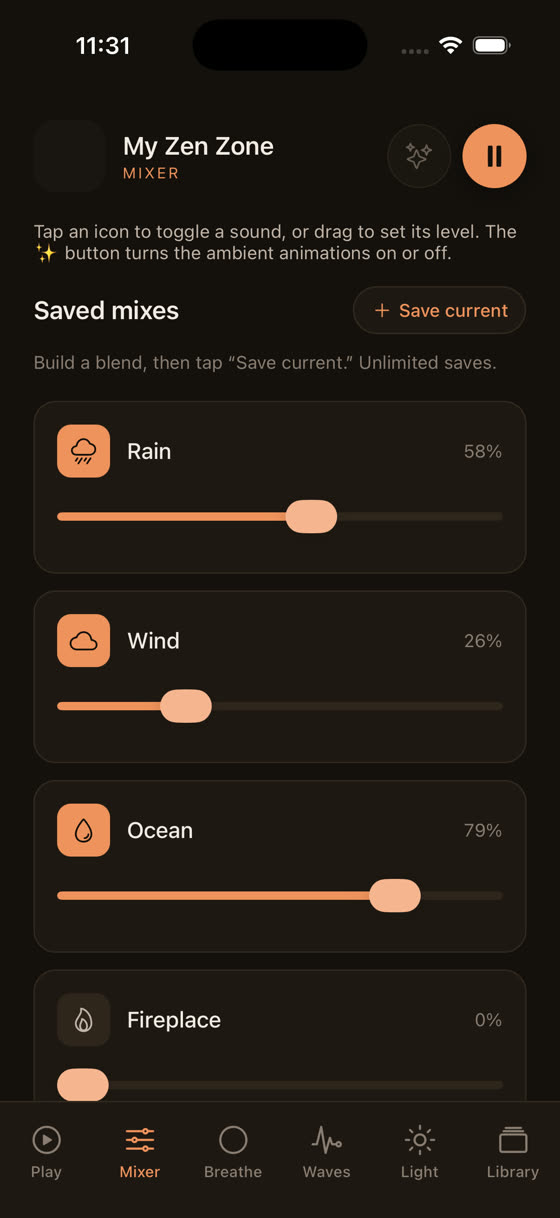
Watching the levels move live makes the difference obvious in a way a description can't.
This is also where composed music has an edge over field recordings. Because every track in the library is written and recorded by one musician rather than licensed from a stock catalogue, the tempo and instrumentation are deliberate, usually 55 to 65 bpm, under a resting heart rate, with no key changes or dynamic swells that would spike attention. You can read more about how tempo and structure are chosen for sleep specifically in this piece on the best music for sleep.
Guided wind-down, without stopping the music
A lot of people don't just want sound, they want ten minutes of guidance before lights out: a body scan, a slow breath count, something to occupy the part of the mind that's still running the day's to-do list. On most apps this means the music stops and a voice takes over completely, which can feel jarring if you were settling into a sound.
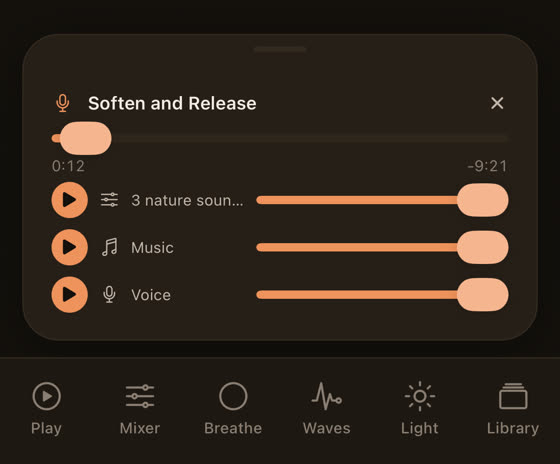
Here the voice is its own layer, sitting over the music and nature sound rather than replacing them, so you can bring it down low or mute it once you're drowsy and let the music carry on alone.
Pairing that with a simple breathing pattern, in for four, out for six, tends to help more than people expect, mostly because it gives the mind one slow, boring thing to track instead of several fast ones.
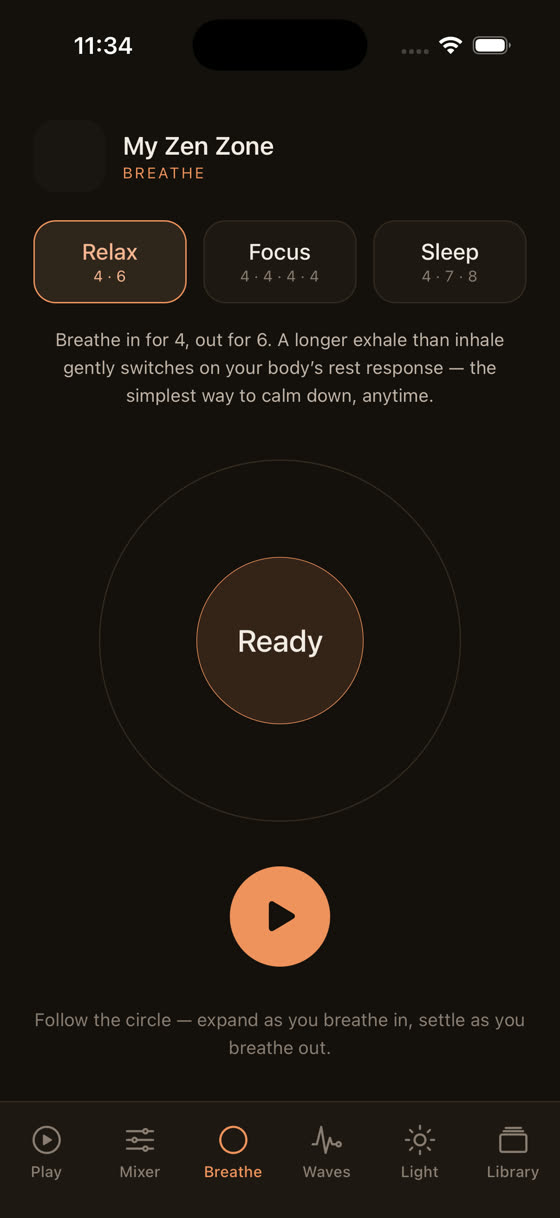
Building a better wind-down routine tonight
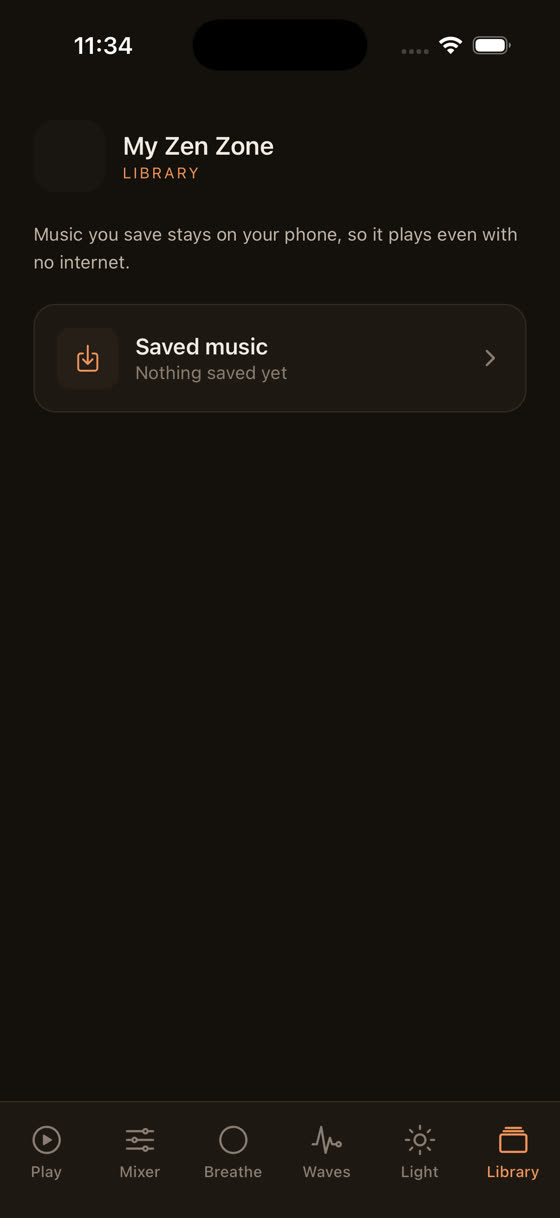
Start with the sound bed, not the volume knob on your phone. Pick two elements that don't compete for attention, rain and a low drone, or waves and a soft pad, rather than three or four fighting each other. Set the sleep timer for somewhere between 45 and 90 minutes rather than letting anything run all night; most people are asleep well before that, and a sound that's still playing at 4am can actually cause a lighter, more fragmented stretch of sleep than silence would. Download the mix for offline playback if your phone's data or wifi cuts out overnight, since a dropped stream restarting itself is precisely the kind of disruption you're trying to avoid.
If you also use your evenings to wind down from screens, a dimmed, warm light screen running alongside the sound can help signal that the day is actually over.
If you're sticking with Spotify tonight
Not everyone is ready to switch apps, and that's fair. If you're staying on Spotify, a few practical adjustments help: turn off autoplay so it doesn't chain into unrelated tracks, use an eight-hour-plus version of whatever sound you like so you're not relying on a loop restarting every 45 minutes, and set your phone's own sleep timer rather than Spotify's, since Spotify's in-app timer options are limited. Brown noise tends to outperform white noise for most people over a full night, and a single artist's continuous mix will usually sound more consistent than a crowdsourced playlist stitched together from a dozen different uploaders.
Where this app picks up
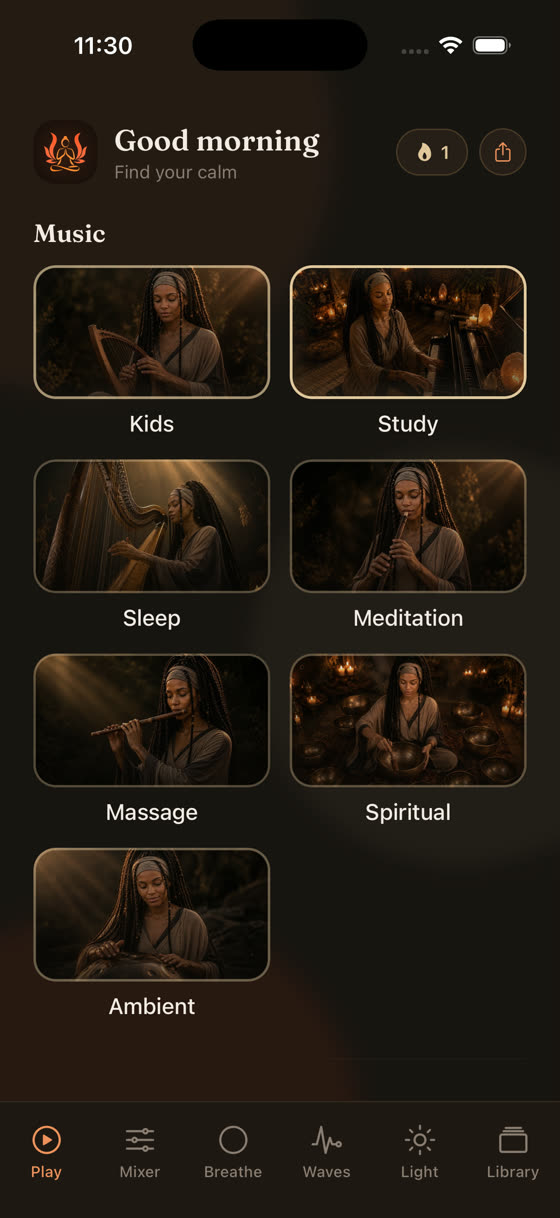
The gap between a streaming playlist and a purpose-built sleep environment is really about control: over levels, over what layers on top of what, over how long anything plays, and over whether you need a connection at all. My Zen Zone is built around that gap specifically for sleep, focus, meditation and calm, with a library that's grown to hundreds of original tracks and adds new ones every two weeks, so the sound bed doesn't go stale the way a fixed playlist does.
If focus rather than sleep is the actual problem some nights, restlessness that comes from an unfinished task rather than noise, it's worth looking at what actually helps concentration during the day, covered in this piece on music for focus and study, since the two often trace back to the same overstimulated evening. Whichever route you take, the app is available on iPhone and Android, with a subscription unlocking the full library in a browser too, so the same mix follows you from phone to laptop without rebuilding it each time.
Common questions
Is brown noise better than white noise for sleep?
For most people, yes, brown noise tends to feel gentler because it's weighted toward lower frequencies, similar to a distant waterfall or heavy rain, while white noise carries more high-frequency hiss that some find harsh over a full night. Neither is proven superior in strong research terms, but brown noise is worth trying first if white noise feels grating.
Should sleep sounds play all night or turn off?
Most people fall asleep well within the first hour, so a sound running all night isn't necessary and can occasionally cause lighter, more fragmented sleep later on if it changes or loops noticeably. A sleep timer set for 45 to 90 minutes covers the falling-asleep window without the sound lingering into deeper sleep stages.
Why do playlists on streaming apps feel disruptive at night?
Track changes involve fades, brief silences, and sometimes volume jumps between differently mastered files, plus the risk of ads or autoplay pulling in an unrelated song. None of this is loud, but it introduces small changes into what should be a steady, unchanging sound, which is the opposite of what a masking sound is meant to do.
Can I layer my own sleep sounds instead of picking one track?
Yes, and it usually works better than a single sound at a fixed volume. Combining something like rain with a low, steady drone at independently adjustable levels lets you cover more of the frequency range that causes disruption, without either sound becoming loud enough to draw attention on its own.