The best sleep sounds for deep sleep are low, steady, and low-information: brown noise, rain without thunder, and slow instrumental drones under 60 beats per minute. What they have in common matters more than what they are. They give your brain nothing new to process, which is the opposite of what a podcast, a playlist with choruses, or even a "relaxing" track full of swelling strings will do. Deep sleep doesn't need stimulation. It needs the absence of surprise.
What deep sleep actually asks of a sound
Deep sleep, the slow-wave stage your body leans on for physical repair, is fragile to arousal. Not loud noise necessarily, but change. A fridge compressor kicking in, a car changing gear outside, a song shifting from verse to chorus: these are the things that nudge you up toward lighter sleep even if you never consciously wake. The sounds that protect deep sleep are the ones with a flat, unchanging texture. That's why white, pink, and brown noise get recommended so often. They mask the unpredictable stuff in your environment with something predictable, so your brain stops flagging every creak and car door as something worth noticing.
Brown noise in particular tends to suit deep sleep better than white noise. It's weighted toward lower frequencies, closer to a low waterfall or distant thunder than to television static, and most people find it sits behind the ear rather than in front of it. Pink noise sits in between. White noise, the hissiest of the three, works for masking but can feel abrasive over a full night for some sleepers. None of this is universal. It's worth trying all three for a few nights each rather than assuming the one everyone recommends is the one that'll work for you.
Where composed music fits into this
Noise is a mask. Music is something else, and it does a different job. A track built at 55-65 bpm, roughly a resting heart rate, can encourage the body to settle in a way that flat noise doesn't, because there's a very old association between slow regular rhythm and safety. The instrumentation matters as much as the tempo. Felt piano, low string pads, a soft modular synth drone, these sit in a narrow frequency range with no sharp transients, no cymbal hits, nothing that makes your ear prick up. Contrast that with most commercial "sleep" playlists, which are often just slow pop songs or ambient tracks lifted from a streaming catalogue never made with sleep in mind. They still have builds, key changes, moments designed to hold a listener's attention. That's good songwriting and bad sleep architecture.
This is the gap we built the library to close. Every track is composed specifically for this, not repurposed from a Spotify chill playlist, which is also the subject of a longer piece on what actually makes music work for sleep if you want the deeper mechanics.
The mistake almost every sleep sound guide makes
Most advice stops at "pick one sound and play it all night." In practice, a single sound, however well chosen, tends to become noticeable precisely because it's the only thing happening. Your brain adapts to steady input and starts listening past it for texture. Layering two or three sounds at different levels avoids this. Rain at a moderate level, a low drone underneath it, maybe a distant thunder rumble at a very low level, gives the ear enough variation to stop hunting for it, without introducing anything sharp enough to cause arousal.
This is really the core of what our mixer is for. Instead of a fixed file, you get separate sliders for each layer, so you can run rain fairly high, a cello drone low, and almost no birdsong at all, or whatever combination actually works for your room and your ears that night. It's a different proposition to a looping mp3 of rain that competitors ship as one block of audio. You build your own mix and it remembers it.
Volume and placement, which almost nobody gets right
Deep sleep sound should sit at a level roughly equivalent to a quiet conversation in the next room, not loud enough to mask normal speech in your own room. If you can comfortably hold a conversation over it, it's doing its job. If you have to raise your voice, it's too loud and may itself become the thing disturbing you later in the night as your hearing sensitivity shifts between sleep stages. Phone speaker placement matters too: face-down on a nightstand changes the frequency balance noticeably compared with face-up, usually dulling the higher frequencies, which some sleepers prefer and others find muffled and odd. There's no universally correct answer here, only testing it for a week.
The habit that undoes all of it: autoplay and algorithm playlists
A lot of "deep sleep" trouble isn't the sound at all, it's what plays after it. Streaming autoplay doesn't know your sleep stage. It'll follow a 45-minute rain track with an upbeat recommendation at 3am, right in the middle of a slow-wave cycle, and that transition is exactly the kind of change the earlier section said to avoid. A sleep timer that stops everything, cleanly, after a set stretch, protects the back half of the night in a way autoplay structurally can't.
Building a wind-down, not just a sound
Sound chosen well handles the middle of the night. What determines whether you get to deep sleep in the first place is usually the twenty minutes before you close your eyes. Bright screens, bright rooms, and a racing mind all delay the drop into slow-wave sleep regardless of what's playing in the background. A short breathing pattern, four seconds in, six seconds out, done for even two or three minutes, slows the nervous system down in a way that's measurable and genuinely simple.
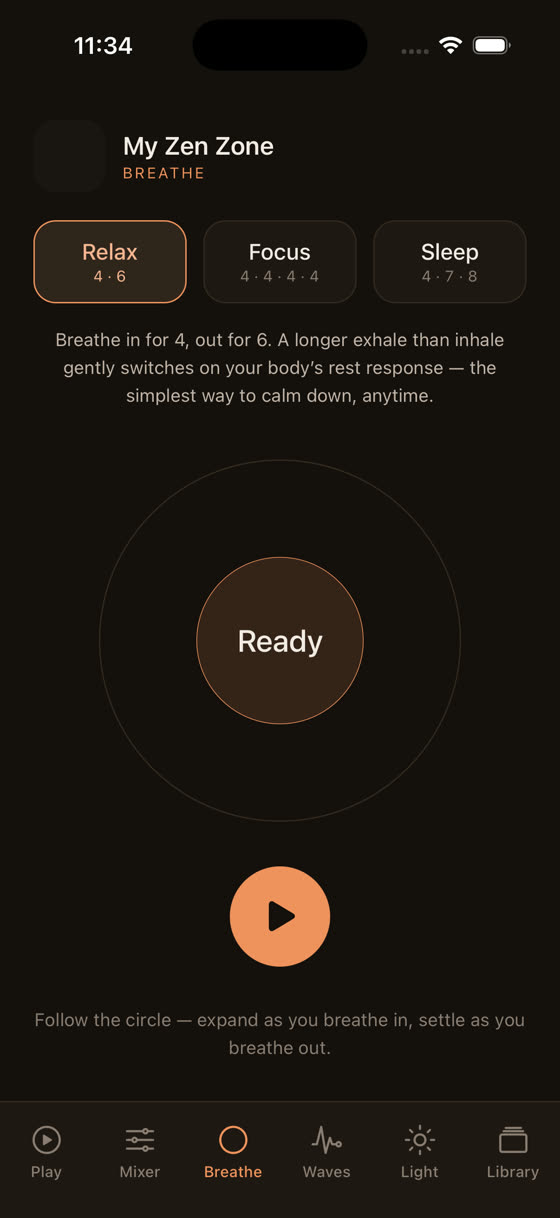
Paired with a dimming light screen rather than your phone's full brightness, this is a fifteen-minute routine, not a lifestyle overhaul. We built the app around that sequence deliberately: light down, breath down, sound on, timer set, in that order.
What the evidence actually supports, and what it doesn't
It's worth being straightforward here. There's reasonable, repeated evidence that steady background noise helps people fall asleep faster and wake less in noisy environments, largely by masking disruptive sound. There is much thinner evidence that any specific sound improves slow-wave sleep quality itself for people in quiet rooms who weren't being disturbed in the first place. Nobody should claim a track guarantees deeper sleep; the honest claim is that the right sound removes a common obstacle to it. If your room is already silent and you sleep fine, the search for the perfect sleep sound is solving a problem you may not have.
What to actually try tonight
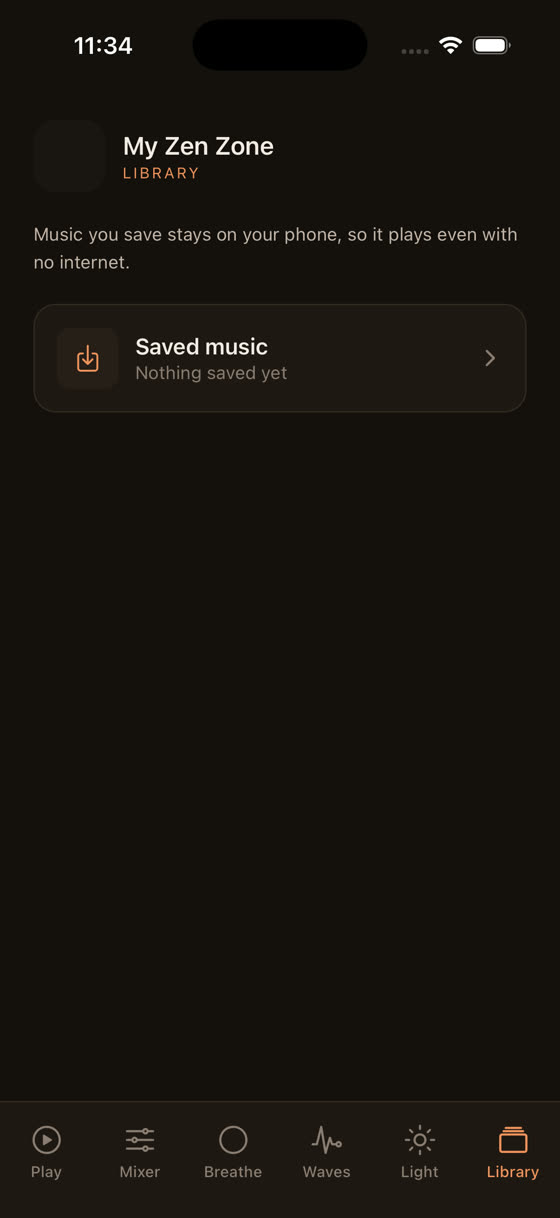
Start with brown noise or rain alone at a conversational volume for three nights. Then add one more low layer, a drone or distant thunder, and compare. Set a sleep timer for 90 minutes rather than looping forever; by then you're usually through the deepest early cycles and lighter sleep can take over without needing masking. Keep the room dim before you even open the app, and give the breathing screen two minutes before you hit play. None of this is complicated. It's mostly about removing variables, not adding new ones, and that's the whole philosophy behind the library we add to every two weeks: fewer surprises, better sleep. If none of this is on your phone yet, the full mixer and sound library are on the download page, with offline saving so none of it depends on your connection at 2am.
Common questions
Is brown noise better than white noise for deep sleep?
For most people, yes, though it's individual. Brown noise is weighted toward lower frequencies and sounds closer to a soft waterfall than static, which many sleepers find easier to sit with for hours. White noise masks more broadly but can feel harsher. Try both for a few nights each; there's no single correct answer that applies to everyone.
Should I use a sleep sound all night or just to fall asleep?
It depends what the sound is doing for you. If you're masking a noisy environment, running it all night with a sleep timer around the length of a full sleep cycle or two works well. If you just need help settling, 30-45 minutes is usually enough, since the early part of the night is when falling asleep matters most.
Can music actually improve deep sleep, or only help you fall asleep faster?
The honest answer is the evidence is much stronger for falling asleep faster than for improving slow-wave sleep itself. Slow, steady, low-frequency music can support the conditions for good sleep, but no track can promise deeper sleep stages. Think of it as removing an obstacle, not engineering an outcome.
Why does my sleep sound stop working after a few weeks?
This is usually habituation: your brain stops treating a familiar sound as worth monitoring, which is good, but it can also mean the sound no longer masks new, unfamiliar noises as effectively. Rotating between two or three different sounds, or adjusting layers slightly, tends to work better than looping the exact same file indefinitely.
Is it bad to sleep with headphones or earbuds in all night?
Comfort and ear health matter more than anything else here. Over-ear speakers or a phone placed away from the bed avoid pressure issues entirely. If you do use in-ear buds, choose ones designed for sleeping, keep volume low, and give your ears nights off occasionally rather than using them every single night.