The best music for focus is instrumental, sits around 50-80 beats per minute, and avoids sudden changes in volume or structure. That rules out most pop, most lyrics in any language you understand, and almost all commercial radio. It also rules out total silence for a lot of people, because silence has its own problems: every door closing, every notification buzz becomes the loudest thing in the room.
What's left is a narrower category than the term "focus music" suggests. Ambient textures, slow piano, drones, soft modular synth, some lo-fi without vocal samples. The goal isn't to entertain you. It's to occupy the part of your brain that would otherwise wander, without giving it anything interesting enough to follow.
Why lyrics are the real problem, not loudness
People assume loud music is what breaks concentration. Actually it's language. Your brain processes words automatically, whether you want it to or not. If a track has lyrics in a language you speak, part of your attention gets pulled toward decoding meaning, even at low volume. That's why a quiet song with vocals can derail a task faster than a loud instrumental one. This is also why film scores work so well for studying: composers write them specifically not to compete with dialogue, which means they're built from the ground up to sit underneath something else without stealing attention.
Repetition matters too. A track that keeps introducing new melodic ideas keeps asking you to listen. Music built on a loop, a drone, or a slowly evolving pad gives your brain a stable floor instead of a moving target. That's the actual mechanism behind so-called focus music: not that it's "calming" in some vague sense, but that it stops demanding anything from you.
What most focus-music advice gets wrong
Most lists just say "try lo-fi" or "classical works too" and leave it there. Two problems with that. First, a lot of lo-fi still has vocal chops, saxophone runs, or drum fills that spike every sixteen bars, which defeats the purpose. Second, classical music varies wildly: a Beethoven symphony has dynamic swings that pull attention exactly the way lyrics do, while a slow Satie piece doesn't. The genre label tells you almost nothing. What matters is tempo, dynamic range, and whether the structure repeats or develops.
The other thing most advice skips is that focus isn't one activity. Reading a dense report, writing code, and doing admin work each want something slightly different, and treating them as interchangeable is where a lot of people's playlists fall apart.
Matching the music to the kind of work
For deep, single-threaded work (writing, coding, problem-solving) you want the most neutral option: slow ambient, minimal piano, or a steady drone with no percussion. Anything with a beat you can tap your foot to is competing with your working memory. For administrative tasks (email, scheduling, data entry) you can tolerate more rhythm and a slightly faster tempo, because the task doesn't need the same depth of sustained attention. For creative work, something with a bit more harmonic movement can actually help, since the goal is loosening association rather than narrowing it.
We cover this task-by-task breakdown in more detail in our piece on music for focus and study, including what to use for exam revision specifically, where the stakes of getting distracted are higher.
The volume is doing more work than the genre
Here's something almost nobody says plainly: at the right volume, nearly any slow instrumental track will help a bit. At the wrong volume, nearly any track will hurt. Focus music should sit below your conscious attention, loud enough to mask sudden noises, quiet enough that you could forget it's playing. Most people set it once and never adjust, which is backwards. Noisy office, loud volume. Library-quiet house, barely audible. The number on the slider isn't fixed, it's a response to your actual environment.
This is where layering a background texture, not just a track, earns its keep. A single loop of rain or a low drone, under the music, raises the noise floor just enough to blunt sudden sounds without adding anything your brain has to track.
That's the idea behind the mixer in My Zen Zone: three independent levels, so you might run a slow ambient track at 40%, light rain at 25%, and a low drone underneath at 15%, building a floor that's custom to your room rather than someone else's studio.
Building a focus session instead of a focus playlist
A playlist assumes you'll hit shuffle and hope. A session assumes a shape: a short settling period, a long stretch of neutral music, then a clear end point. The settling period matters more than people think. Jumping straight from a stressful meeting into deep work rarely goes well, because your nervous system is still in the meeting. Ninety seconds of slower breathing changes that.
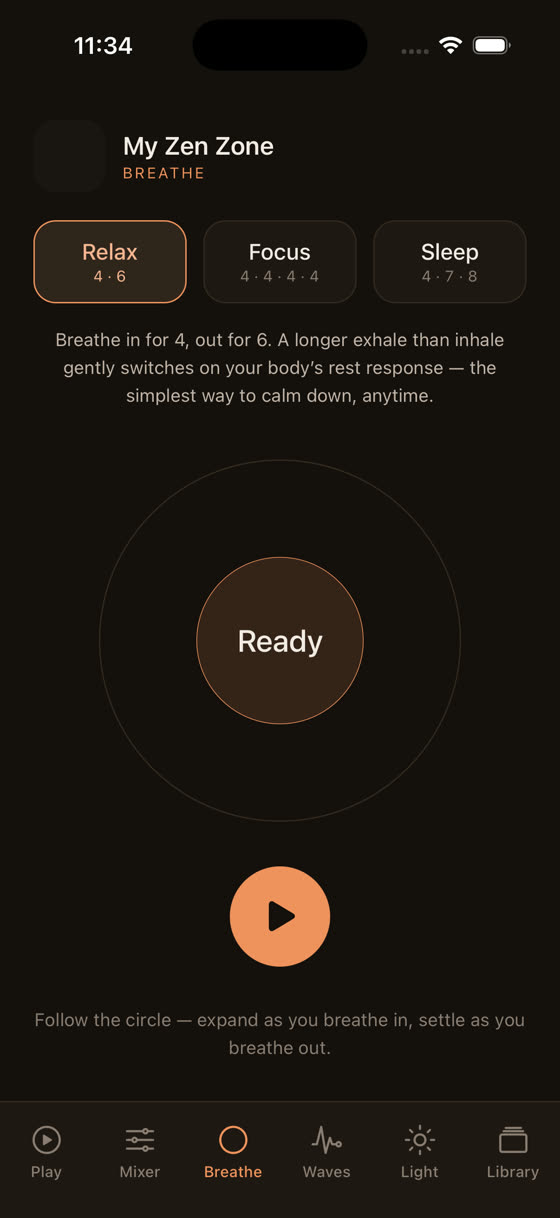
A short 4-6 breathing pattern, four counts in, six counts out, before you start the music, does more to prepare you for sustained attention than another ten minutes of browsing for the "perfect" track. It's a small habit but a real one, and it's why we built a breathing screen directly into the app rather than leaving it as a separate step people skip.
The end point nobody plans for
Most focus-music advice stops at "play this while you work" and ignores how the session ends. An abrupt stop, a track cutting off mid-phrase, a playlist running out and silence hitting suddenly, all of it can yank you out of a state you'd actually got into. A sleep timer that fades rather than cuts, set to the length of the task you're actually doing (25 minutes, 50 minutes, whatever your block is), closes the loop properly. It also stops you from working two hours longer than planned because the music never stopped, which happens more than people admit.
What to avoid even if it's labelled "focus music"
Not everything marketed this way earns the label. Watch for tracks with a bass drop or a build every thirty seconds, common in a lot of commercial "study beats" playlists chasing engagement rather than actually helping anyone concentrate. Watch for anything that changes key or tempo abruptly. Watch for vocal samples chopped up and pitched, which still register as language fragments even without full words. And be honest with yourself about whether a track is genuinely neutral or just something you personally enjoy, because enjoyment and focus-friendliness aren't the same thing, and the music you love to really listen to is often the worst choice for background use.
Where this fits with sleep and calm more broadly
Focus music and sleep music share more DNA than people expect: slow tempo, minimal dynamic range, no lyrics. The difference is mainly volume and intention. Focus music sits at the edge of attention to support work; sleep music is meant to be the last thing you notice before you're not noticing anything. If you already have a wind-down routine at night, the same instincts (steady tempo, no surprises, adjustable layers) apply during the day at your desk.
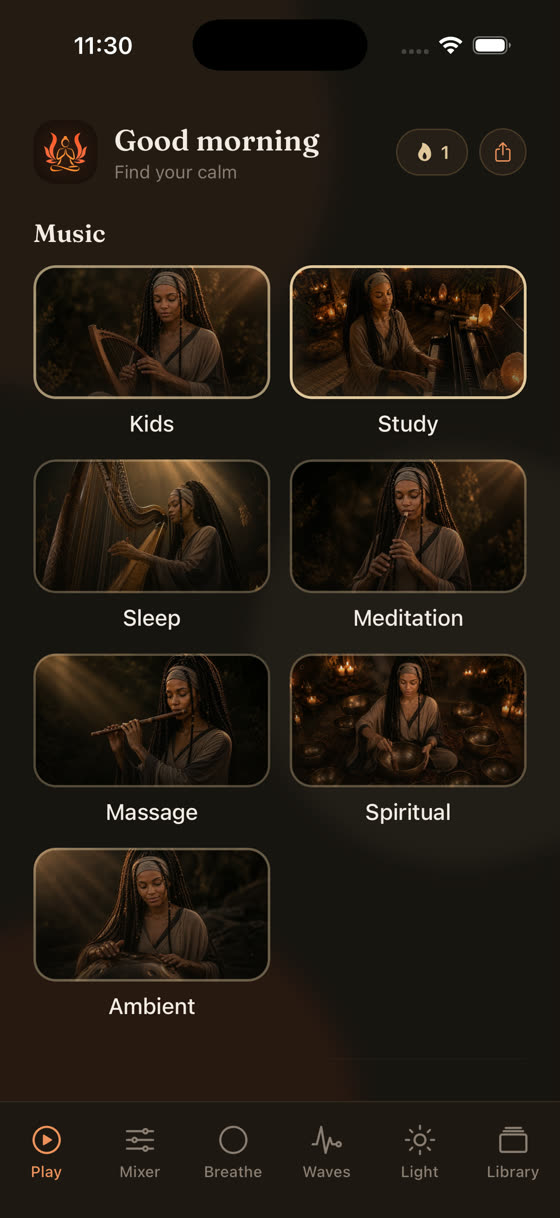
In the app, focus, sleep, meditation and calm are kept as separate worlds rather than one blended library, because the brief for a 10am work session is genuinely different from the brief for 11pm, even though both are built from the same instinct: music that holds steady so you don't have to think about it.
Building a library that doesn't go stale
One real risk with focus music specifically: familiarity breeds distraction. A track you've heard five hundred times stops being neutral background and starts being something you half-sing along to in your head, which defeats the point. New tracks matter more here than in most genres. The library adds new pieces every two weeks, composed and recorded by one musician rather than licensed in bulk, which keeps the catalogue coherent instead of a grab-bag of stock tracks. Worth cycling through a few different options rather than looping the same forty-minute track every single workday for a year.
If you want to try this properly rather than read about it, the app is on iPhone and Android, with offline downloads for anyone working somewhere the wifi can't be trusted, and a subscription opens the full library in a browser too, so the desk setup and the phone setup draw from the same place. You can also look at what's in the library right now before deciding.
Common questions
Does instrumental music actually work better than music with lyrics for studying?
For most people, yes, specifically because your brain processes language automatically even at low volume, pulling attention toward meaning. The exception is highly familiar lyrics in work you've heard hundreds of times, which can sometimes fade into background the way instrumental tracks do. New lyrical music almost always competes for attention.
What BPM is best for concentration?
Somewhere between 50 and 80 beats per minute works for most sustained, single-task work, roughly resting heart rate or a little above. Faster tempos (90-120bpm) can suit lighter admin tasks where full depth of concentration isn't needed. There's no single magic number, but very fast or very syncopated rhythm consistently pulls attention away from deep work.
Is binaural beats or brainwave music actually proven to help focus?
The evidence is thin and mixed, so treat claims cautiously rather than as settled fact. Some people find specific tones genuinely help them settle into a task, others notice no difference at all. If you're curious, it's worth trying as one option among several rather than relying on it alone.
How loud should background music be while working?
Quiet enough that you could lose track of whether it's playing, loud enough to mask sudden noise around you. This changes by room and by day, so it's worth adjusting rather than setting once. A noisy office needs a higher floor than a quiet house.
Should I use the same focus track every day?
No. Heavy repetition turns even neutral instrumental music into something familiar enough to half-follow, which undercuts the whole point of background music. Rotating through a handful of different tracks, or adding newly released ones, keeps the music properly in the background instead of becoming its own distraction.