Yes and no, and the honest split is about 70/30. Within your first ten minutes holding a handpan, you can play something that sounds intentional. Within your first ten years, you'll still be finding new things you can't quite do. That gap is the whole story of this instrument, and almost nobody explains it clearly before you spend $1,500 on one.
What makes it feel instantly playable
A handpan is tuned before you ever touch it. Every dent on the shell, called a tone field, is already set to a note in a scale that the maker chose, usually something like D Kurd or Celtic Minor. There are no frets to miss, no strings to tune, no chords to memorise. You tap a tone field with your fingers or the heel of your palm and it rings out, in key, every time. Compare that to a violin, where a millimetre of finger placement is the difference between a note and a wince. The handpan removes that entire category of failure. This is why a total beginner can sit down, tap out a simple four-note pattern, and have it sound like actual music rather than noise. That immediate payoff is real, and it's the reason handpan videos spread the way they do.
Where the real difficulty hides
The catch is that sounding pleasant and sounding good are different thresholds. Getting a clean, resonant note out of a tone field without a flat, muted thud takes a few weeks of just learning where and how hard to strike. Playing with both hands independently, keeping a steady pulse while your dominant hand carries melody and the other fills rhythm, takes months. And developing your own musical vocabulary rather than replaying the same eight-note loop you learned from a tutorial, that's the multi-year part. The instrument is generous at the start and demanding later, which is almost the opposite of how a piano or guitar works, where the first month is the hardest.
The physical technique nobody mentions
Your hands do most of the work here, and they need retraining. Most people's first instinct is to hit the tone field like a drum, flat palm, full force. That produces a dead, choked sound. The actual technique, often called a bounce or a bird-beak strike, uses mostly fingertips with a quick release, almost like you're flicking the sound back out of the metal. It feels wrong before it feels right. Players typically describe a specific week, somewhere around week three or four, where the sound suddenly opens up and starts to ring the way it does in recordings. Before that point, it's common to think you bought a faulty instrument. You didn't. Your hands just hadn't learned the release yet.
Cost and access are the quieter barriers
A playable handpan from a reputable maker starts around $1,200 and climbs past $3,000 quickly. Cheaper steel-tongue alternatives exist but have a noticeably different, more percussive tone and shorter sustain. Waiting lists for well-known makers can run over a year. This matters because it changes who actually gets to try the instrument hands-on versus who only hears it. A lot of people who search for handpan music online aren't looking to learn it at all. They've heard it in a meditation track or a film score and want more of that specific, bell-like resonance, without the cost or the years of hand retraining.
Why most people end up listening instead of playing
This is worth saying plainly: there's no shame in that, and it's actually the more common path. The handpan's tuned, overtone-rich sound happens to sit in a very similar register to the slow pads and soft percussion used in sleep and wind-down music, which is why it turns up so often in that genre. If what drew you to the instrument was the sound rather than the performance, recorded handpan pieces give you that resonance on demand, layered with rain, a low drone, or near-silence, without four years of calluses.
Inside the app, handpan-based tracks sit in a library that grows every two weeks, recorded by one musician rather than licensed from a stock catalogue, so the tuning and recording style stay consistent from track to track. You can hear exactly how that tone field resonance sits against other elements using the mixer, where handpan, rain, and a low drone each get their own independent level.
Pull the handpan up and the rain down, or the reverse, depending on whether you want something closer to a performance or something closer to background. That control is the one thing a fixed playlist or a YouTube loop can't give you.
A realistic first-month plan, if you do want to play
If you're set on learning rather than just listening, the actual timeline looks like this. Week one is about finding one strike technique that produces a clean tone consistently, and that's it, nothing else. Week two introduces a basic two-hand pattern, usually alternating a low note and a high note to build independence. By week three or four you should notice the sound opening up as your technique settles. Month two is where you start improvising short phrases rather than repeating memorised patterns. None of this requires reading music. It does require patience with a fairly boring first fortnight, which is the part most tutorial videos skip because it doesn't make good footage.
How the sound fits into a daily calm or focus routine
Whether you end up playing one or just listening to one, the handpan's long sustain and narrow scale make it well suited to background use rather than foreground attention, which is partly why it works for focus sessions as well as sleep. A slow, repetitive handpan pattern sits under a guided breathing or focus session without pulling attention away from the task, the way a melody with a strong hook would.
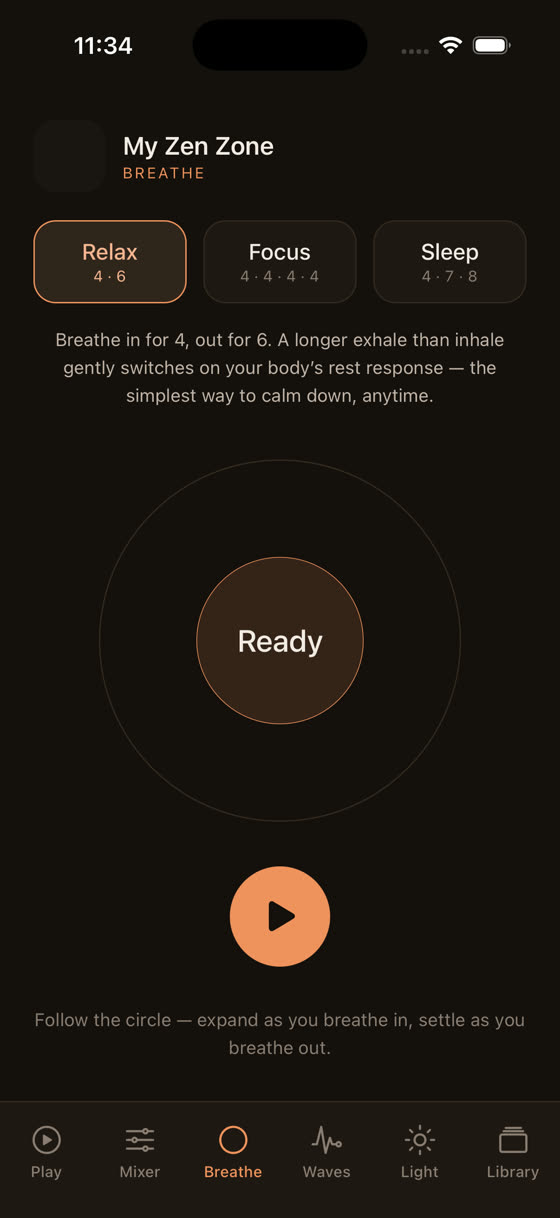
Pair a slow 4-6 breathing pattern with a sparse handpan track in the background and you get something closer to a held note than a song, which is exactly the point.
The honest verdict
So: easy to get a pleasant sound out of immediately, genuinely difficult to master, and expensive enough that most people who love the sound never own one. If that's you, the instrument's tone is still available to you every night, recorded properly and mixed the way you want it. You can hear the whole range of how it's used across sleep, focus, and calm categories at myzenzone.app, or go straight to the app and try the mixer against a handpan track tonight.
Common questions
How long does it take to learn handpan to a basic level?
Most beginners get a clean, consistent tone within three to four weeks of regular short sessions, and can play a simple two-hand pattern within two months. A genuinely confident, improvised style usually takes a year or more of regular practice. The early win is fast; the depth takes time, similar to most tuned percussion instruments.
Can you teach yourself handpan without lessons?
Yes, and most players do, largely through video tutorials and online communities. Because every note is already in tune and in key, you can't play a technically wrong note, which makes self-teaching far more forgiving than it is on guitar or violin. A teacher mainly speeds up hand technique and helps avoid bad striking habits early on.
Why do handpans sound so good in sleep and meditation music?
The metal shell produces long, overtone-rich sustain with very little attack noise, so notes bloom rather than strike. That slow decay sits naturally under a steady breathing rhythm or a quiet drone, which is why it's a common texture in ambient and sleep-focused tracks rather than upbeat or rhythmic genres.
Is a cheaper steel-tongue drum a good substitute for a real handpan?
It's a different instrument with a shorter, more percussive sustain and usually a smaller range of notes. It's a reasonable, affordable way to try the physical technique and scale-based playing, but it won't replicate the long resonant ring that defines a handpan's recorded sound.