The short answer
Yes, for most people, most of the time, with three conditions: the music has no lyrics, the tempo sits somewhere between 50 and 80 bpm, and you're doing a task that's repetitive or procedural rather than one that needs fresh verbal reasoning. Outside those conditions, music can just as easily get in the way. It's not a magic switch. It's a tool that works when matched to the task, and works against you when it isn't.
That's the honest version. Most articles on this topic skip straight to "studies show music helps concentration," which flattens a much more interesting and more useful answer.
What music actually does to a studying brain
Music doesn't make you smarter. What it does, reliably, is manage arousal and mask distraction. A quiet room isn't actually quiet: there's a fridge hum, someone's footsteps upstairs, a car outside. Your brain treats sudden, unpredictable sounds as things worth checking. Steady instrumental music gives your auditory attention something continuous to sit on instead, so the door slam three rooms away doesn't yank your focus sideways.
The second thing it does is nudge your physiological state. Around 60-70 bpm is roughly a resting heart rate, and there's some evidence that music near that tempo can help settle a slightly keyed-up nervous system before a task that needs patience, like reading dense material or working through a problem set. Faster tempo, above 100 bpm, tends to push arousal up, which is fine for repetitive admin work but usually wrong for anything that needs sustained, careful attention.
Where the research is genuinely thin
Be wary of anyone quoting a single fixed IQ-point boost from listening to a specific composer. That result never replicated cleanly and the original study wasn't even about studying, it was about a short-term spatial reasoning task. The honest state of the research is: background instrumental music helps some people concentrate on some tasks, and mostly by reducing distraction and stress rather than boosting cognition directly. Nobody has solid evidence that it improves memory formation or exam performance across the board. It's a comfort and a focus aid, not a cognitive enhancer, and any post claiming otherwise is overselling it.
The lyrics problem, and why it's bigger than people admit
Language competes with language. If you're reading, writing, or solving anything that involves internal verbal processing, lyrics pull directly on the same mental channel you're trying to use. This is the single most consistent finding across the research that does exist, and it's also the thing people ignore because they like their playlist. If you must have vocals, keep them in a language you don't speak, so your brain files it as texture rather than content. Otherwise, instrumental is the safer default for anything reading- or writing-heavy.
Rote or procedural tasks are the exception. Filing, data entry, flashcard drilling you've already half-memorized: lyrics are less disruptive here because there's less verbal bandwidth being contested. This is also where slightly faster, more rhythmic tracks can genuinely help you push through boring repetition without your mind wandering into email.
Novelty is the quiet enemy
A song you love, that you know every note of, is actually a decent study companion, because your brain isn't spending attention predicting what comes next. A new album, or anything with a surprising key change, a dramatic swell, a vocal hook you haven't heard before, pulls your attention toward itself precisely because it's new. This is why a curated, purpose-built focus library tends to outperform your regular playlists for studying, even when the genre overlaps. Predictability is the feature, not a limitation.
It's also why we release new focus tracks every fortnight rather than dumping a huge batch at once: it gives you time to let a track become familiar background before it's replaced, instead of constantly introducing novelty into a session that needs the opposite.
Matching the music to the actual task
Deep reading and writing want something closer to ambient or solo piano, minimal percussion, long unhurried phrases, nothing that spikes or drops suddenly. Problem sets and coding sit somewhere in the middle: a bit more rhythmic structure is fine, even useful, as long as it stays predictable. Repetitive admin, sorting notes, formatting a document, tolerates the most energetic music, since the task itself needs less protected verbal bandwidth.
Environment matters as much as genre. If you're in a noisy library or a shared house, the job of the music shifts from "aid focus" to "mask noise," and for that, layering a steady instrumental track under a constant texture like rain or a low hum often works better than music alone. You can build that combination yourself rather than hunting for the one perfect ambient playlist someone else made.
That's what a layered mixer actually looks like in use: a study track underneath, rain at a low level to smooth out room noise, and nothing competing for verbal attention. Most streaming apps give you one track at a time. Here you can dial in three separate sounds against each other until the noise floor in your specific room actually disappears, instead of hoping a single playlist happens to match it.
What to actually do tonight, or before your next study session
Pick the task first, then the music, not the other way round. If it's reading or writing, go instrumental and slower, somewhere in the 55-75 bpm range. If it's repetitive review work, faster and more rhythmic is fine, lyrics included if you like. Give yourself two or three sessions with the same track before judging it: the first ten minutes with any new music is always a bit distracting simply because it's new, and that's not the music failing, that's novelty doing what novelty does.
If your study room has unpredictable noise, layering matters more than song choice. A quiet piano piece under a thin bed of white noise or rain often beats either alone, because the combination smooths the noise floor rather than adding another single, isolated sound that can still be interrupted. This is the same logic behind the layering approach we use for sleep, just tuned for a task that needs you awake and alert rather than winding down.
How the app is actually built for this
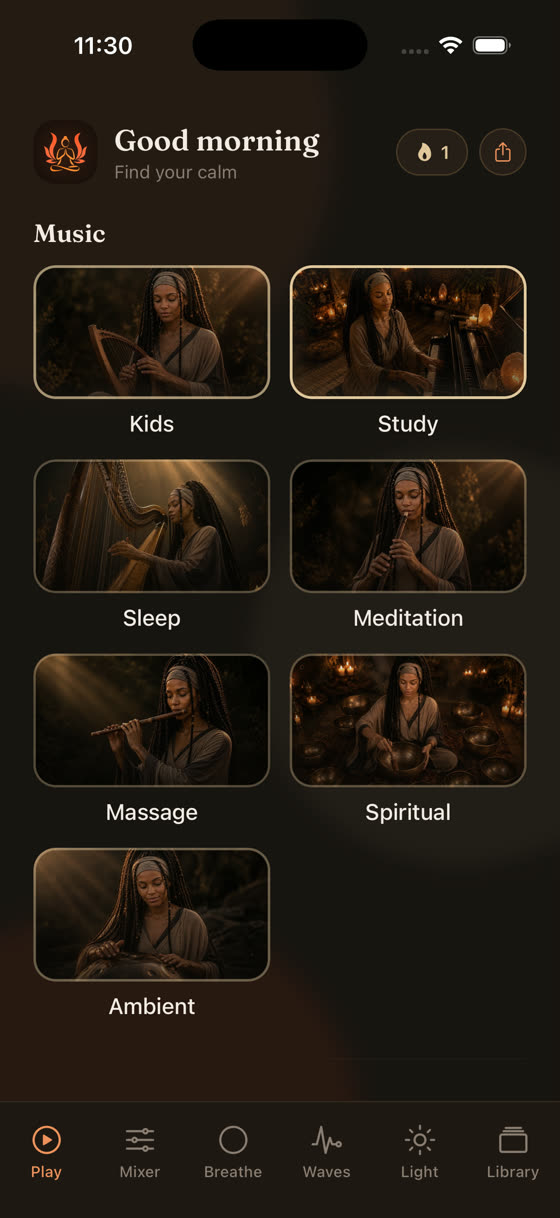
The focus section isn't a single algorithmic playlist. It's a library organised by the kind of attention you need, slow instrumental pieces for reading and writing, steadier rhythmic ones for repetitive work, all composed and recorded in-house by one musician rather than licensed stock tracks, which means the tempo and structure stay consistent instead of swinging wildly between songs the way commercial playlists do. You can read more about how we think about matching music to specific work in our focus and study guide.
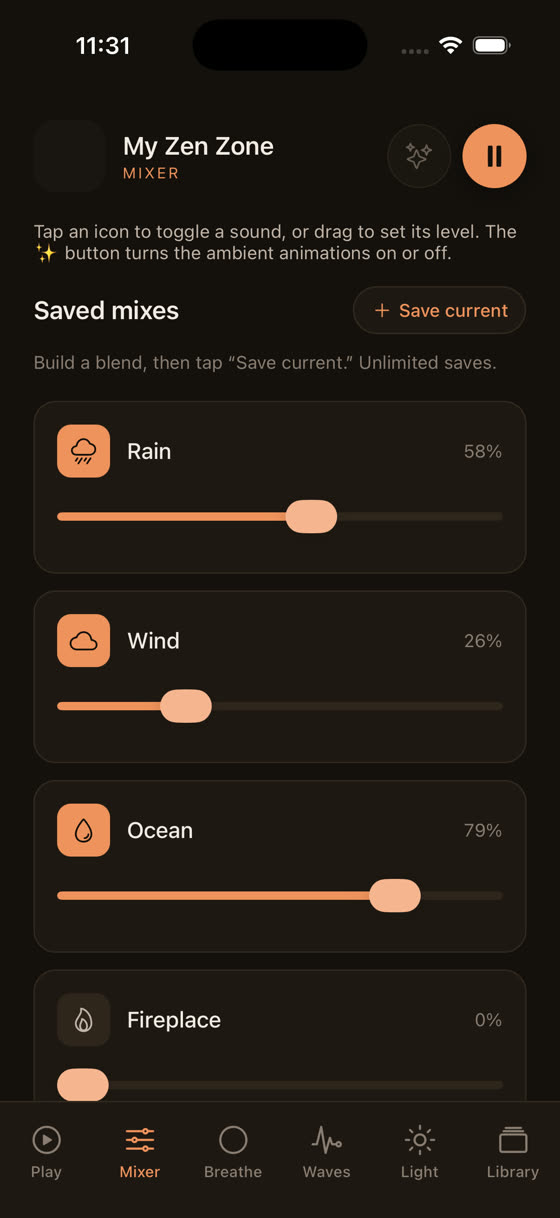
The mixer is the part that actually solves the noise-masking problem properly: three sounds, each with its own level, so you can put a study track at a moderate volume and a nature sound underneath at whatever level suits your specific room, rather than settling for one fixed mix someone else decided on. You can download sessions offline for a library or a train journey with no signal, and set a session timer if you only have forty minutes before a lecture and don't want to be checking the clock. New focus tracks land every two weeks, which matters more than it sounds: familiarity is part of what makes background music work, and a library that never changes gets used up fast. You can try the whole thing at myzenzone.app/get or have a look at the full library before committing to anything.
Common questions
Does classical music specifically help you study better than other genres?
No single genre has special powers. Classical music often works well because a lot of it is instrumental, steady in tempo, and predictable in structure, all traits that help. But ambient, solo piano, or non-lyrical electronic music can do the same job. The genre label matters less than whether the track has vocals and how much it varies dynamically.
Is it better to study in silence than with music?
For some people and some tasks, yes, particularly if you're highly sensitive to sound or the task demands intense verbal reasoning. Silence removes any risk of the music becoming a distraction. But true silence is rare in most study environments, and a steady instrumental track is often better at masking background noise than nothing is.
Can music actually improve memory or exam results?
There's no solid evidence for that specific claim. What research supports is that background instrumental music can reduce distraction and lower stress during study, which indirectly supports better focus. Treat it as a concentration aid, not a memory enhancer, and don't expect it to substitute for actual revision or sleep.
What tempo is best for studying?
Roughly 50-80 bpm works well for reading, writing, and problem-solving, since it's close to a resting heart rate and doesn't push arousal up. For repetitive, low-cognition tasks like filing or formatting, a faster tempo, even up to 100-120 bpm, can help you push through boredom without much downside.
Should I use the same study playlist every time?
Largely yes. Familiar music requires less attention to process, which is exactly what you want in the background. Rotate in new tracks occasionally so it doesn't get stale, but avoid switching to something completely new right before an intense study session, since novelty itself pulls at your attention for the first few minutes.