The short answer
No, the rain sound in a decent sleep or focus app is not a recording of chicken frying. But the joke persists for a good reason: acoustically, frying oil and falling rain are close cousins. Both are made of thousands of tiny random impulses layered over a broadband hiss, and a microphone genuinely struggles to tell them apart. If you've ever heard a frying pan on a video call and thought "is it raining in your kitchen," you weren't imagining it.
The meme almost certainly comes from old foley tricks. Radio drama sound effects crews have used frying food for decades to fake light rain on a window, because it's cheaper and more controllable than standing outside with a microphone during an actual storm. That's a real and sensible technique. It does not mean the rain sound on your phone is secretly bacon. It means someone, a long time ago, noticed the two sounds live in the same acoustic neighbourhood.
Why they sound so alike
Rain hitting leaves, pavement, or a window produces what's called broadband noise: energy spread across almost the whole audible spectrum, 20Hz up to nearly 20kHz, with no dominant pitch. Oil popping in a hot pan does the same thing. Each droplet, or each bubble bursting, is a tiny independent click. String enough of those clicks together and your ear stops hearing individual events and starts hearing a continuous texture, which is exactly what both rain and frying produce.
The other shared trait is randomness in timing and loudness. White noise, pink noise, and brown noise are all defined by how their energy is distributed across frequencies, but rain and frying also have random amplitude: some drops or pops are louder, some softer, with no regular rhythm. Your brain reads "random broadband texture with no pattern" as background, which is precisely the quality that makes it useful for masking a ticking clock or a partner's breathing at 1am. The mechanism that makes rain sound work for sleep is the same mechanism that makes frying sound similar in the first place.
What most articles get wrong
Most pieces that touch this topic either dismiss it as pure meme or treat the foley trivia as proof that all rain sound apps are faking it with kitchen audio. Neither is accurate. The foley trick is real but applies mostly to film and radio, where a sound effect only needs to pass for two or three seconds under dialogue. Nobody is trying to fall asleep to it for forty minutes.
A sleep app's rain track has a completely different job. It needs to loop cleanly for hours, stay stable in level, and avoid random spikes that would snap you out of light sleep. A pan of frying onions has pops loud enough to make you jump, and the sound changes character as the oil heats up. That's a disqualifying flaw for a sleep sound and a non-issue for a two-second film cue. So the test isn't "does this sound a bit like frying," it's "was this recorded and edited with hours of stillness in mind."
What actually makes a good rain recording
A rain track worth falling asleep to has a few specific qualities you can learn to listen for:
- Low-end weight. Real rain, especially on a roof or against leaves, carries a soft rumble below 200Hz. Thin, tinny rain recordings are usually close-mic'd indoors and lack this, which is one reason they feel more like static than weather.
- No obvious loop point. Cheap rain sounds often have a 10 or 20 second file looping on repeat. Your ear catches the seam even half asleep. A longer, properly edited source avoids that click of recognition.
- Consistent intensity. Real rain builds and fades with the storm. For sleep, you want a steady middle intensity that doesn't suddenly spike into a downpour and wake you.
- Stereo width that isn't gimmicky. Rain recorded outdoors has natural width from reflections off buildings, trees, and ground. Synthetic rain sometimes oversells the stereo effect, which reads as artificial once you've heard the real thing a few times.
None of this is complicated engineering. It's mostly patience: recording outside, choosing a steady stretch of weather, and editing with headphones rather than trusting it to sound right in a noisy room.
How this plays into actual sleep and focus use
The quality question matters because of what masking sound is doing for you. A steady, textured sound covers up the sharper, more attention-grabbing noises in a room, a door, traffic, a creaky floor, without itself being interesting enough to hold your attention. Frying sounds fail this test outright because they include irregular loud pops that your brain treats as novel events worth noticing. Good rain does the opposite: it gives your brain nothing new to track, which is the whole point.
This is also why layering more than one natural sound tends to work better than one alone. A single rain loop can start to feel thin after twenty minutes because your ear eventually learns its pattern, however subtle. Mixing in a second or third texture, distant thunder, wind in leaves, a low room tone, breaks that predictability without adding anything jarring.
That's the thinking behind the mixer in My Zen Zone: three nature sounds, each with its own level, so you can build a rain-and-wind combination that suits your room rather than accepting someone else's fixed mix. If you want more on building a stack like this, the piece on best music for sleep goes into how layering interacts with falling asleep specifically.
Where we actually record this stuff
Every track in the library, rain included, is composed or recorded in-house by one working musician rather than pulled from a stock effects pack. That matters for exactly the reasons above: it means the rain was recorded with hours of listening in mind, edited for a clean loop, and checked for the kind of low-end rumble that makes it feel like weather rather than static. New material, including nature recordings, gets added roughly every two weeks, so the rain options keep growing rather than sitting as the same three tired files most apps ship with.
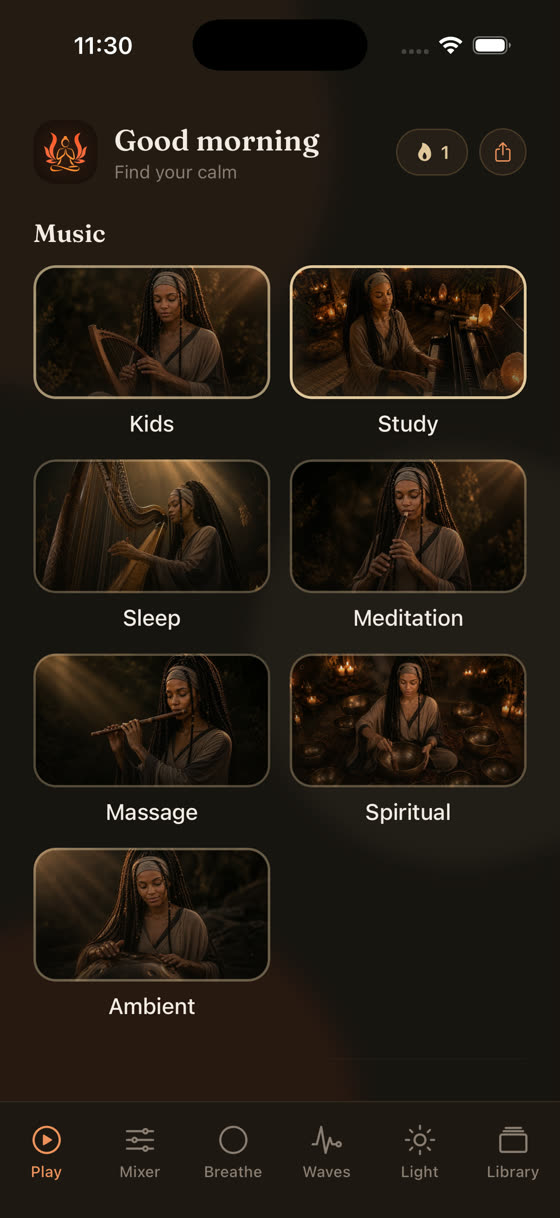
The home screen keeps rain and other nature sound inside its own space, separate from the composed sleep, focus, and meditation music, so you're not hunting through a single giant playlist to find a storm at midnight.
Building your own rain stack tonight
If you're sceptical of any single rain file, the fix isn't finding a