The short answer
Yes, if you actually use more than three or four tracks a month, and no, if you've found one 20-minute recording that works and you play it every night without wanting anything else. That second group is smaller than people think. Most listeners who tell me "I just need one good sleep track" are back within six weeks asking why the same piano loop suddenly feels grating. That's not a taste problem. It's habituation, and it's the whole argument for paying to unlock a full library rather than settling for whatever three free tracks an app dangles at you.
What "open" actually means here
Free meditation apps almost never give you the whole thing. You get a handful of intro tracks, one guided session, maybe a single ambient loop, and then a paywall dressed up as a "premium unlock." An open or all-access subscription flips that: every track, every guided session, every nature-sound layer, unlocked from day one, on your phone and in a browser. With My Zen Zone, that means hundreds of tracks composed and recorded by one working musician, not licensed stock loops, plus new material added every two weeks. Worth it isn't an abstract question when the alternative is six songs on repeat until you stop using the app entirely, which is what actually happens with most free tiers within a month.
The mechanism: why your ears need rotation
Sleep and focus music work partly through tempo entrainment, your body's tendency to sync toward the pulse it's hearing, typically 60-70 bpm for sleep, closer to a resting heart rate, and 50-90 bpm for calm focus work depending on the task. But entrainment only works if you're actually paying attention to the sound at some level, even a background level. Play the identical track every night for a month and your brain files it as wallpaper. It stops doing the job. This is why sleep music that rotates through different instrumentation, a felted piano one night, a slow synth pad the next, low strings after that, tends to keep working longer than a single loop. A library deep enough to rotate is the actual mechanism behind "worth it," not the marketing gloss of having "more content."
What most reviews get wrong
Nearly every app review compares monthly price against a free competitor and stops there. That's the wrong comparison. The real question is cost per week of actual use over a year, and most people underestimate how often their needs change. The track that gets you to sleep in January might feel wrong in July when you're winding down at 9pm instead of 11. Someone using an app for focus during study season needs something completely different three months later when they're using it to fall asleep after a stressful day. A narrow free library can't follow you through that. An open one can, because you're not stuck re-downloading a new app every time your use case shifts.
Guided sessions without stopping the music
Here's a specific gap in almost every meditation app: guided sessions stop your music. You press play on a ten-minute breathing exercise and the ambient track you had running just cuts out, replaced by a voice over silence or over generic stock backing. That's a strange design choice for something supposed to be calming. The fix is treating voice as a layer, not a takeover.
That's what a layered guided session actually looks like: voice, music, and nature sound each with their own play button and their own level, so a breathing session can sit gently under one of the composer's actual tracks instead of interrupting it. You can turn the guide down to a whisper and the music up, or the reverse, depending on whether you want instruction or just the presence of a calm voice in the room.
The mixer is the part competitors skip
Most relaxation apps give you one fixed sleep playlist and call it a day. The more useful question is whether you can shape the sound to the room you're actually in, not the room the app assumed you'd be in.
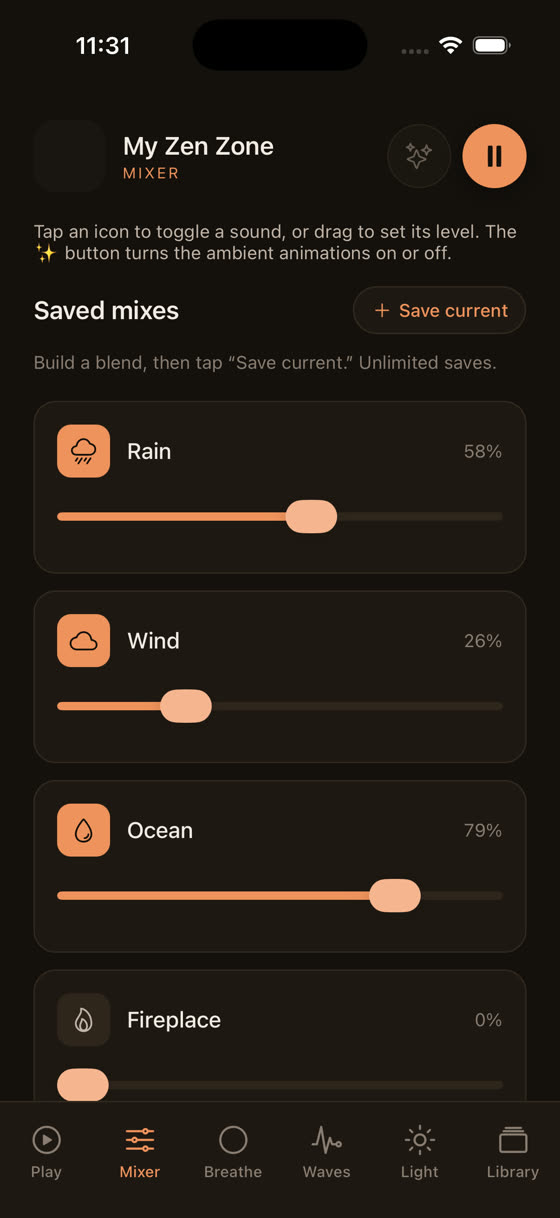
That's three nature sounds, rain, low wind, distant surf, each on its own independent level, blended under whatever music track you've chosen. Turn the rain up and the music down for a noisy street outside your window. Turn the surf off entirely and keep just the tone bed if you share a room. This kind of control is the clearest practical difference between paying for a real library and using whatever fixed loop a free app hands you, and it's worth testing before you decide the subscription is or isn't for you.
Where a paid library genuinely doesn't help
I'll be straight about the limits. If you already fall asleep in four minutes without any sound, you don't need this, full stop, and no amount of library depth changes that. If your main issue is a racing mind from something specific, an argument, a diagnosis, a financial worry, music can help you settle physically but it isn't treatment and it won't resolve the underlying thing. There's genuine research on tempo and heart rate synchronisation, but the evidence for music curing insomnia or anxiety outright is thin, and any app that claims otherwise is overselling it. What a good library actually offers is a lower-friction way to wind the body down at the end of a day, nothing more dramatic than that, and it's worth going in with that modest expectation rather than a cure-all one.
What to actually try tonight
Don't start by hunting for "the best sleep track." Start with the mixer.
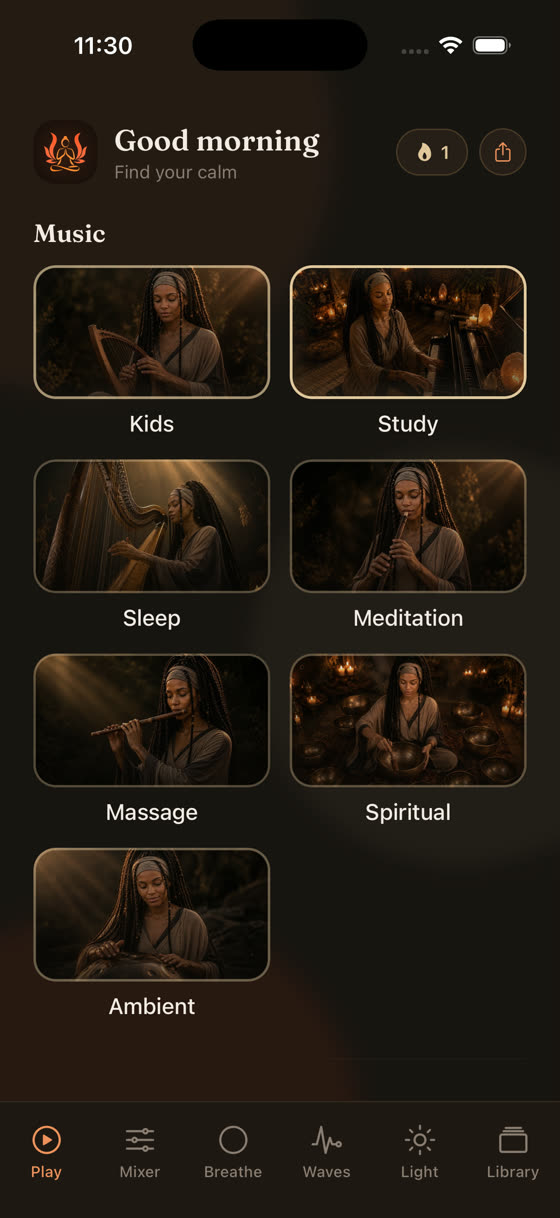
Pick a category, sleep, focus, or calm, and treat it as its own small world rather than one long playlist. Try the 4-6 breathing pattern for two minutes before you even put music on, four counts in, six counts out, which slows your exhale and does more for a racing heart than most people expect from something so simple. Then bring in one music track at a low level and one nature sound underneath it, adjust until it feels right for the actual room you're in tonight, not some generic ideal. If it doesn't land, change the track. That's the entire point of paying for an open library: the option to change your mind without running out of things to try.
The actual verdict
An open, all-access meditation and sleep music app is worth it for anyone who uses it more than a couple of times a week, whose needs shift across the year, or who's tired of one loop going stale after three weeks. It's not worth it for someone who sleeps fine already or is looking for it to solve a problem music was never going to solve. If you're in the first group, the fastest way to know is to actually put your hands on the mixer rather than reading about it, which you can do through the app itself before committing to anything long-term.
Common questions
Does a paid meditation app actually work better than a free one?
Not automatically, but a deeper library solves a real problem free tiers can't: habituation. Free apps usually give you a handful of tracks that go stale within weeks. A paid library with regular new releases lets you rotate sound, which keeps tempo-based calming effects working rather than turning into background noise you tune out.
Can I use a meditation app without headphones?
Yes. Nature sounds and low-tempo music work fine through a phone speaker or bedside speaker at low volume. Headphones give more precise layering, useful for guided sessions where you want the voice clearer than the music, but they're not required for basic sleep or focus listening.
How long should I listen before bed?
There's no fixed rule, but 20 to 40 minutes with a sleep timer set is a common and sensible range. Longer than that risks the music still playing loudly into a lighter sleep phase. Most apps, including this one, let you set a timer that fades out rather than cutting off abruptly.
Is background music actually proven to help you fall asleep?
The evidence is modest, not dramatic. Slow tempo music around a resting heart rate can support relaxation and mask disruptive noise, but it isn't a clinical treatment for insomnia. Treat it as one small tool among several, alongside consistent sleep timing and a dark, cool room, not a standalone fix.
What's the difference between a guided meditation and just playing calm music?
Guided sessions add spoken instruction, breathing counts or body scans, over a music bed. Music alone gives you no direction but more flexibility. Sessions that let you balance voice and music separately, rather than stopping the track for the voice, tend to feel less jarring and suit people who want structure without losing the calm underneath it.