The fastest way to relax the vagus nerve is to slow your exhale down past your inhale, for at least two minutes. Breathe in for four counts, out for six, and keep it going. That single change signals your nervous system to shift out of alert mode, because the vagus nerve runs straight from your brainstem to your heart and lungs and reads your breathing pattern as information about whether you're safe. Everything else in this post is detail and backup, but if you only take one thing away, make it that ratio: shorter in, longer out.
What the vagus nerve actually does
The vagus nerve is the main cable of your parasympathetic nervous system, the "rest and digest" side that counters the stress response. It runs from the base of your skull down through your neck, chest and abdomen, touching your heart rate, your digestion, your voice box and your breathing muscles along the way. When people talk about "vagal tone," they mean how responsive this system is — a nervous system with good vagal tone can shift from stressed to calm (and back) efficiently, rather than getting stuck in one gear.
It's worth saying plainly: you can't consciously "flex" the vagus nerve the way you flex a muscle. You influence it indirectly, through breath, sound, posture, cold, and movement, all of which send signals up the nerve that your body then interprets. This is why so much of the advice floating around — cold showers, specific humming frequencies, pressure on the neck — works for some people some of the time, and does very little for others. The nerve isn't a switch. It's more like a thermostat you're gently nudging over minutes, not seconds.
The breath is the fastest lever you have
Slow, extended exhalation is the single best-supported way to stimulate the vagus nerve quickly. Two patterns are worth knowing. The first is the physiological sigh: a double inhale through the nose (a normal breath, then a short top-up breath on top of it), followed by a long, slow exhale through the mouth. One or two of these can noticeably drop tension within thirty seconds. The second is sustained paced breathing, something like four seconds in and six seconds out, repeated for a few minutes rather than a few breaths.
The reason the exhale matters more than the inhale is mechanical. Your heart rate naturally speeds up slightly as you breathe in and slows as you breathe out, a pattern called respiratory sinus arrhythmia. Lengthening the exhale amplifies that slowing phase. Do it for long enough and your average heart rate drops, your blood pressure eases, and the vagus nerve gets more active in the ratio.
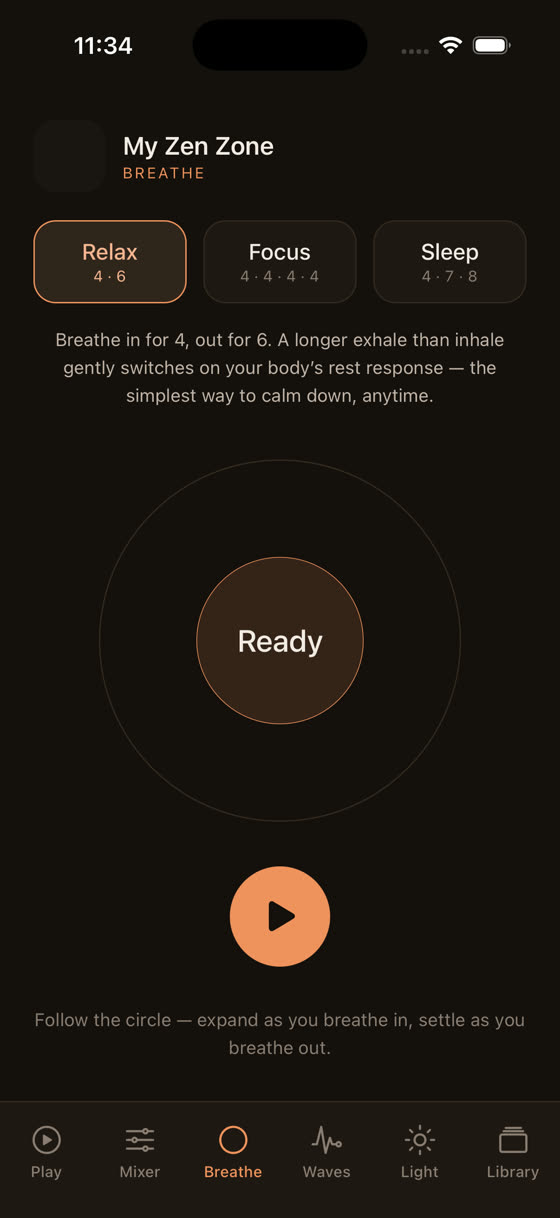
This is the exact logic behind the breathing screen in My Zen Zone — a visual 4-6 pattern you can follow with your eyes rather than counting in your head, which matters more than it sounds like it should. Counting silently is itself a small cognitive task, and anything that takes mental effort competes with the calming effect you're trying to produce.
Sound, humming, and why low frequencies help
The vagus nerve also connects to the muscles of your throat and middle ear, which is why humming, chanting, and gargling show up so often in this conversation. Vibrating your vocal cords activates those same pathways. You don't need a mantra for this to work — a low hum held for the length of an exhale does the same mechanical job.
Music works on a gentler, slower version of the same principle. Tempo around 60-70 bpm, close to a resting heart rate, gives your body something steady to entrain to, the way your breathing slows when you're next to someone sleeping. Lower, sustained tones — a cello line, a drone, a soft pad — tend to work better for this than anything with a sharp attack or a melody that keeps resolving upward, because sudden changes in pitch or volume are exactly the kind of thing your nervous system is built to notice and respond to.
This is where having control over layers rather than a fixed track matters. In the My Zen Zone mixer you can bring in rain or a low drone under a slow piano line and balance each one separately, instead of accepting whatever blend someone else decided was right. Turning down anything with a sudden edge — a bright string hit, a high bell — while keeping the steady low layers up is a small adjustment that makes a real difference to how settled the mix feels in your body, not just your ears.
What most articles on this get wrong
A lot of vagus nerve content treats it like a hack: do this one weird trick and you're calm. Two problems with that. First, there's no single universal technique — cold water on the face works well for some people and does almost nothing for others, and the research behind a lot of the more dramatic claims (specific frequencies, particular humming pitches) is thinner than the headlines suggest. Be sceptical of anything promising a guaranteed, instant reset.
Second, and more practically: a lot of these techniques are taught as one-off rescues for acute panic, when the bigger return comes from repetition. Two minutes of slow breathing every evening, for a few weeks, does more for your baseline than one dramatic cold plunge. Vagal tone responds to consistency the same way fitness does. Nobody gets fitter from a single hard workout; they get fitter from showing up regularly.
Building a wind-down routine around this
The evening is the easiest place to use all of this, because you're not fighting an adrenaline spike, just easing a day's accumulated tension. A workable order: dim the lights, do two minutes of 4-6 breathing, then let slow, low-tempo music carry you the rest of the way rather than trying to stay consciously relaxed. Trying too hard to relax is its own kind of effort, and it tends to backfire.
The light screen in the app exists for exactly this transition — a slow-shifting glow you can use alongside the breathing pattern or the music, so the room itself is part of the signal that the day is closing down. If you want the longer version of how to structure a full wind-down, including what kind of music actually helps you fall and stay asleep, that's covered in our guide to the best music for sleep. Set the sleep timer so the music fades out rather than playing all night, and download the tracks for offline use if your evenings happen somewhere your signal doesn't reach.
Daytime resets, not just nighttime ones
Vagal tone isn't only a bedtime concern. A short reset before a difficult call, after a tense email, or mid-afternoon when focus has collapsed into fidgeting, uses the same mechanism: slow the exhale, drop the shoulders, let a steady low layer of sound hold the room together while you work. This is a different brief than sleep music — you want something steady enough to calm you without pulling you toward drowsiness, which is a separate balance covered in our piece on music for focus and study.
Guided sessions, without losing the music
If you'd rather be talked through a reset than manage your own breathing, a guided session helps, but most apps make you choose between the voice and the music — pressing play on one stops the other. That's backwards for something built around a calm nervous system; an abrupt cut from music to silence to a spoken voice is itself a small jolt.
In My Zen Zone a guided vagus-nerve or breathing session plays as a separate voice layer over the music rather than instead of it, so you can bring the narration down low and let the music stay as the main thing you're actually listening to, or the other way around. It's a small structural difference, but it's the one that keeps a guided session feeling like part of the music rather than an interruption to it.
A realistic starting point for tonight
Don't try to run every technique in this post at once. Pick the breath pattern, run it for two minutes with something slow and low underneath it, and notice whether your shoulders have dropped by the end. Add the humming or the cold water later, once the breathing is automatic. The whole library, breathing screen, mixer and light screen included, is free to try through the app, and new tracks are added every two weeks if the slow pieces you start with don't stay interesting forever. You can also browse the full catalogue in a browser at myzenzone.app if you'd rather see what's there before downloading anything.
Common questions
How long does it take to feel the vagus nerve relaxing?
With slow breathing, many people notice a shift within one to two minutes — a dropped jaw, slower heart rate, looser shoulders. Longer-term vagal tone, the kind that makes you recover from stress faster in general, builds over weeks of regular practice, not from a single session.
Can music alone stimulate the vagus nerve without breathing exercises?
Music on its own, especially slow tempo around 60-70 bpm with low sustained tones, can lower heart rate and ease tension somewhat. But breathing with an extended exhale has the more direct, better-documented mechanical effect. Combining both, slow music while you consciously slow your exhale, tends to work better than either alone.
Is vagus nerve stimulation the same as polyvagal theory?
Related but not identical. Polyvagal theory is a broader framework about how the nervous system shifts between safety, fight-or-flight and shutdown states. Vagus nerve stimulation refers to specific techniques, like breathing or humming, that influence that nerve directly. The theory is more debated among researchers than the basic physiology of the nerve itself.
Are vagus nerve massage tools or devices worth it?
The evidence for handheld or wearable vagus nerve stimulators is still early and mixed, and most of the strong claims outpace the research. Free techniques — slow exhale breathing, humming, cold water on the face — have more consistent backing and cost nothing to try first.
Can a weak vagus nerve cause anxiety or poor sleep?
Low vagal tone is associated with higher baseline stress reactivity and can make it harder to settle for sleep, though it's one factor among many, not a diagnosis on its own. If anxiety or sleep problems are persistent or severe, it's worth speaking to a doctor rather than relying on breathing techniques alone.