Focus is not a personality trait. It is a skill you build the same way you build a habit of going to the gym: through repetition, in a controlled environment, with feedback. Most people who say they "can't focus" have never actually practiced focusing under conditions that make it possible. Fix the conditions first, then the skill develops on its own within a few weeks.
Why your attention keeps slipping
Attention is not infinite and it is not binary. It depletes with every decision you make, and it fractures every time you switch tasks. Researchers call this switching cost: when you move from writing an email to checking a message and back, your brain doesn't snap instantly to full engagement with the original task. It takes a stretch of reduced performance to get back up to speed, often several minutes. Do that twenty times in a morning and you've spent most of your cognitive budget on re-entry, not on the work itself.
This is why open-plan offices, phones on the desk, and background television all do more damage than people assume. It's not that noise or notifications are loud enough to consciously distract you. It's that each one triggers a small orienting response, a flicker of "what was that," and that flicker has a cost even when you don't look up.
The environment problem nobody fixes first
Most advice about focus jumps straight to techniques: Pomodoro timers, to-do lists, apps that block your phone. Those are fine, but they're second-order fixes. The first-order fix is your environment, and specifically your auditory environment, which almost nobody controls on purpose. Silence sounds like the obvious answer, but true silence is rare and, for a lot of people, strangely distracting, because any small sound (a chair creak, a door, traffic) becomes louder by contrast and pulls your attention with it.
What works better for most people is a steady, low-information sound bed: something consistent enough that your brain stops monitoring it for changes. This is the actual mechanism behind "focus music" and white noise alike. It's not that the sound is pleasant. It's that it's predictable, so your attention stops checking on it.
What tempo and instrumentation actually do
If you're choosing music for deep work, tempo matters more than genre. Somewhere in the 50-70 bpm range, close to a resting heart rate, tends to support sustained attention without pulling focus toward the music itself. Above roughly 100 bpm, most people start unconsciously tracking the rhythm, which competes with the task. Lyrics are the other variable: language processing and task-focused thinking use overlapping brain resources, so vocal tracks in a language you understand are harder to tune out than instrumental ones, even at low volume.
This is why the focus tracks in My Zen Zone lean on sustained pads, soft piano, and minimal percussion rather than anything with a strong beat or vocal line. It's not an aesthetic choice so much as a functional one. You can read more about the specific pairing of tempo and task in this piece on music for focus and study, which goes into the difference between music for reading versus music for repetitive admin work.
Build your own sound instead of accepting someone else's
Here's where most focus apps stop short: they give you one playlist and expect it to suit everyone. But the ideal sound bed for a noisy café is not the ideal sound bed for a quiet bedroom turned home office, and what helps you focus at 9am after coffee is not what helps at 4pm when you're flagging. A single fixed track can't account for that.
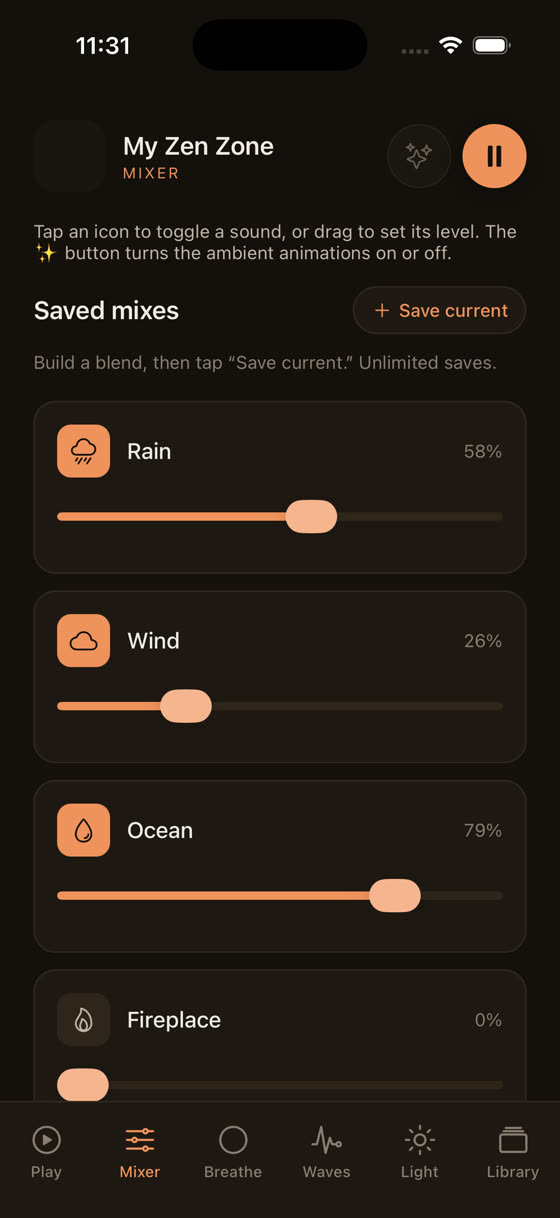
The mixer in the app lets you layer rain, a low drone, and a soft piano line, each on its own slider, so you can turn up the rain when the street outside gets loud and pull back the piano when you need something closer to silence. It takes ten seconds to adjust and it means the sound is actually built around your moment rather than a playlist someone else assembled.
<
Rituals beat willpower every time
The research on habit formation is clearer than the research on focus itself: a consistent cue, repeated daily, builds an automatic response faster than any amount of trying harder. If you want to focus better, the fastest route is not a better mindset. It's a ritual that your brain learns to associate with work mode. Same chair, same drink, same five minutes of sound before you start typing.
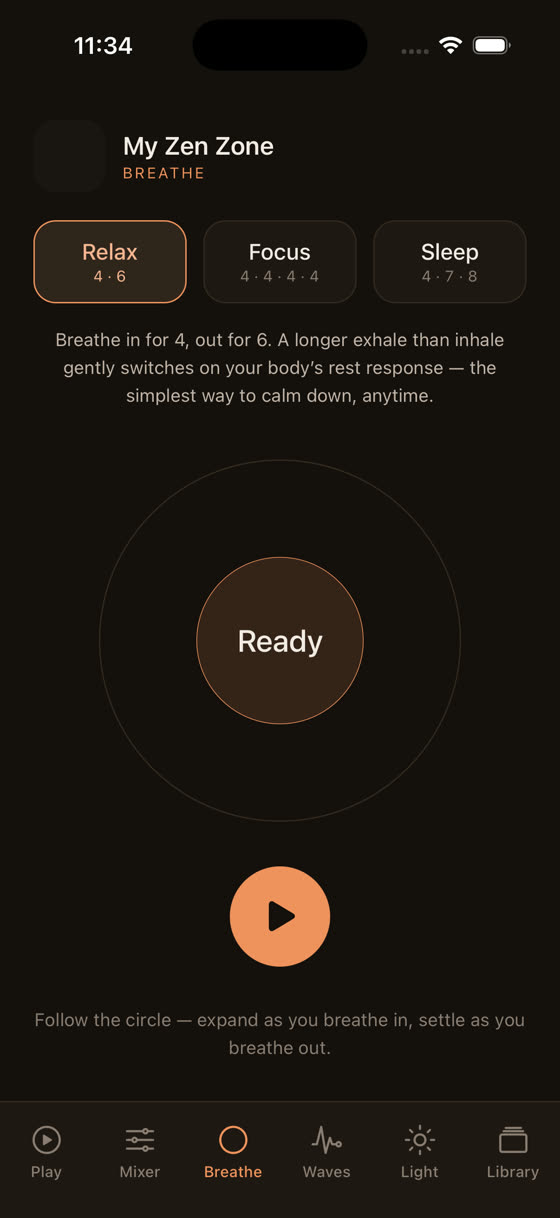
A simple version: two minutes of slow breathing before a work block, in through the nose for four counts, out for six, which nudges your nervous system down from scattered to settled before you've written a word. The breathing screen in the app runs a 4-6 pattern you can follow visually rather than counting in your head, which matters because counting is itself a small cognitive task competing for the same attention you're trying to free up.
What doesn't actually help
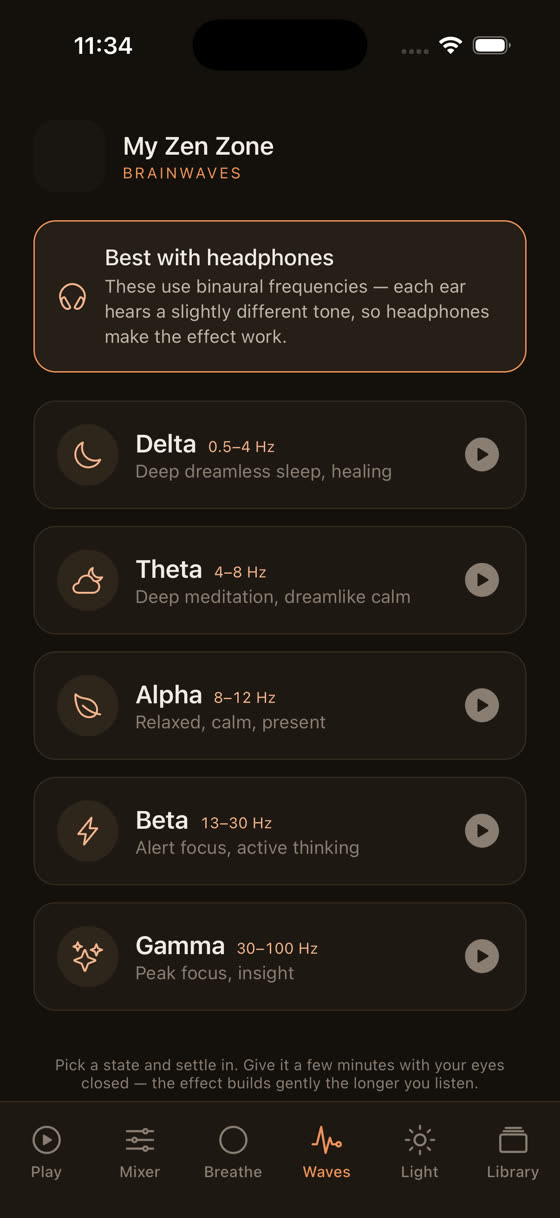
A few popular ideas deserve more scepticism than they get. Multitasking as a skill you can train is largely a myth; what improves with practice is task-switching speed, not the ability to genuinely do two cognitively demanding things at once. Binaural beats and brainwave entrainment have a devoted following, but the evidence for them reliably improving focus is thin and mixed, so treat any claim here, including ones from us, with caution rather than certainty. If you're curious, the app includes brainwave tone options alongside everything else, but we'd rather you try them and judge for yourself than take a marketing claim about them at face value.
Another myth: that you need total silence to do deep work. For most people, low information sound outperforms silence, because silence has nothing to stop you noticing every small interruption. And finally, working in long unbroken stretches is not inherently more productive. Most people's attention genuinely degrades after 45-90 minutes regardless of discipline, and a short break restores it more reliably than pushing through.
A plan for tonight and tomorrow morning
Tonight, pick one track or sound layer you'll use tomorrow, not five options to choose between in the moment when your willpower is already lowest. Decision fatigue is real and choosing your focus sound each time you sit down burns the same budget you need for the actual work.
Tomorrow, set a timer for a single block, something like 45 minutes, phone out of reach, the same sound bed each day this week. Don't judge the first few sessions. The skill builds over repetitions, not in one sitting. If you work across a desktop and a phone, a subscription unlocks the whole library in a browser too, so the same sound bed follows you from a laptop at your desk to your phone on a train, which matters more than it sounds like it should: consistency of cue is most of what makes a ritual stick.
Why the library keeps growing
One practical note worth mentioning: focus music that you've heard five hundred times stops being low-information background and starts being familiar enough to half-sing along to, which defeats the purpose. New tracks are added to the library every two weeks, composed and recorded by the same musician rather than licensed from a stock catalogue, so the sound stays consistent in character even as the specific pieces change. That rotation matters less for sleep, where familiarity can actually help, and more for focus, where you want your ear to keep treating the music as background rather than content.
Common questions
How long does it take to actually get better at focusing?
Most people notice a difference within two to three weeks of a consistent daily ritual, same time, same sound, same short work block. It's incremental, not a switch that flips. Expect the first few sessions to feel no different, and judge the practice over a fortnight rather than a single afternoon.
Is instrumental music really better than music with lyrics for focus?
For most task types, yes, particularly reading, writing, or anything involving language. Lyrics in a language you understand pull on the same mental resources as the work itself. Instrumental or wordless vocal tracks are less likely to compete, which is why focus-oriented tracks tend to avoid clear lyrics altogether.
Should I use the same focus track every day or mix it up?
Keep it mostly consistent. Familiarity is part of what makes a sound fade into the background rather than demand attention. A slowly rotating library, refreshed every couple of weeks rather than daily, gives you enough consistency to build a ritual without the music becoming stale.
Do brainwave or binaural tones actually improve focus?
The evidence here is genuinely mixed and nowhere near conclusive, so be sceptical of strong claims, including ours. Some people find tones helpful as part of a settling-in ritual; others notice nothing. Worth trying for yourself with low expectations rather than relying on it as a proven method.
What's the difference between music for focus and music for sleep?
Focus music stays steady and low-information so your attention doesn't track it, usually 50-70 bpm with minimal melodic movement. Sleep music can be slower still and often layers in natural sound. If you're curious about that side of it, this post on music for sleep covers the differences in more depth.