The short answer
Focus while driving comes down to reducing how many things are competing for your attention, not adding more stimulation to an already busy brain. The quickest fix most drivers skip is also the simplest: put a steady, predictable layer of sound under the road noise so your mind has something quiet to settle on instead of hunting for stimulation on its own. Total silence in a car is not restful. It is an invitation for your brain to fill the gap with whatever thought is loudest, and on a long drive that is rarely the road ahead.
Why driving drains focus faster than people expect
Driving looks passive from the outside but it is a genuinely demanding divided-attention task. You are tracking lane position, reading the speed and spacing of cars around you, scanning mirrors, anticipating brake lights three cars ahead, and doing it all while your foot and hands make tiny constant corrections. None of that happens in your conscious awareness most of the time, which is exactly the problem. The parts of your brain doing the driving run on autopilot, which frees up your conscious attention to wander off toward the argument you had this morning or the email you haven't sent. That wandering is not weakness. It is what an under-stimulated brain does on a motorway at 70mph with nothing else to track.
The silence myth
Most driving advice tells you to turn everything off and concentrate. In practice that backfires on long, monotonous stretches. A flat engine drone plus total silence is one of the known ingredients in what researchers and driving instructors sometimes call highway hypnosis, the glazed, time-skipping state where you arrive somewhere with no memory of the last ten minutes. The brain under-stimulated by monotony does not become more alert from silence. It drifts. The fix is not more noise, it is the right kind of noise, something steady enough to track without demanding conscious attention.
What kind of sound actually helps behind the wheel
For focus rather than sleep, you want a tempo closer to a brisk walking pace than a resting heartbeat, something in the 70-85bpm range, steady, with no lyrics and no sudden dynamic swings. A drum fill or a key change that is meant to delight you in a quiet room becomes a small jolt in a car, and small jolts pull attention away from the road for a second longer than they should. Soft pads, a slow-moving piano line, low string textures, anything with a flat dynamic range works better than anything written to surprise you. This is a different brief to the deep, slow material we make for sleep, which you can read more about in our piece on music for sleep, and it is closer to the tempo and texture discussion in our focus and study music guide.
Masking the right noise instead of adding to it
Road noise is not one sound, it is a shifting mix of tyre hum, wind, and whatever your particular engine does at motorway speed, and the ear notices the changes in that mix more than the mix itself. Nature sounds work well here because they give you a steady floor that absorbs those fluctuations without competing with them. A low layer of rain or distant train rumble can smooth out an uneven diesel rattle; a touch of wind can do the same on a windy motorway where your own wind noise would otherwise be the loudest, most variable thing in the car.
This is where having separate levels for each sound matters more than people expect. Watch how the layers move independently in that clip: rain up a little, a distant engine-like drone brought in low, birdsong pulled right down because birdsong is lovely at a desk and mildly comic at 70mph. Most driving playlists give you one fixed track. A mixer lets you build a sound floor that actually matches your car and your road, and you can save that exact blend for the next commute instead of rebuilding it every morning.
A ninety-second reset before you start the engine
The best moment to manage your focus for a drive is before you turn the key, not during it. A short breathing exercise while you are still parked, four seconds in and six seconds out, a pattern sometimes called 4-6 breathing, nudges your heart rate down and clears some of the mental noise you are carrying in from wherever you just left.
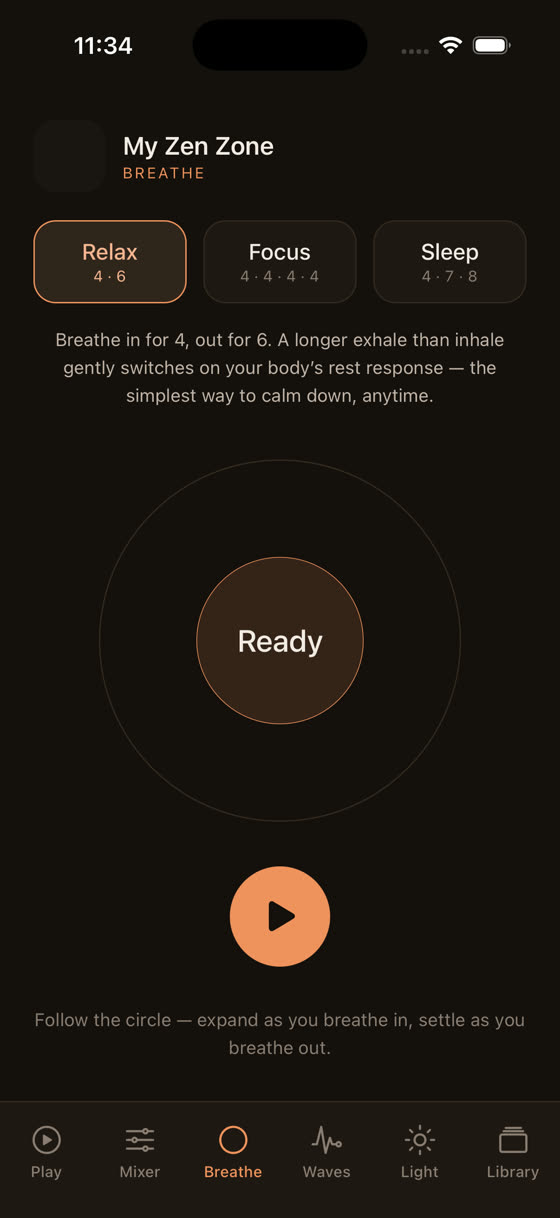
Ninety seconds of that pattern before you pull out of the driveway does more for your attention on the first ten minutes of a drive than anything you could play once you are moving. Do this parked. Never while the car is in motion, and never as something you are reaching for a phone to start once you are already on the road.
What to leave out of the car entirely
Not everything in a relaxation library belongs in a moving vehicle. Brainwave tones and binaural material are built to nudge the brain toward stillness, often toward states closer to sleep than alertness, and there is no good reason to introduce that while you are responsible for two tonnes of metal at speed. Save that category for the desk or the sofa. The same goes for guided meditation sessions where the voice is asking you to close your eyes or turn attention inward. Those sessions are genuinely good when the music and voice sit as separate layers you can balance, which is how ours work rather than stopping the music to play over it, but a driving seat is the one place that design is not the right fit. Keep the guided work for when you can actually follow it.
Building it into the actual commute
None of this is useful if it means fiddling with an app at a red light. Set your sound before you move, not after. Download the Focus category for offline playback if you drive through tunnels, countryside, or anywhere signal drops, so the music doesn't stutter exactly when you need it steady.
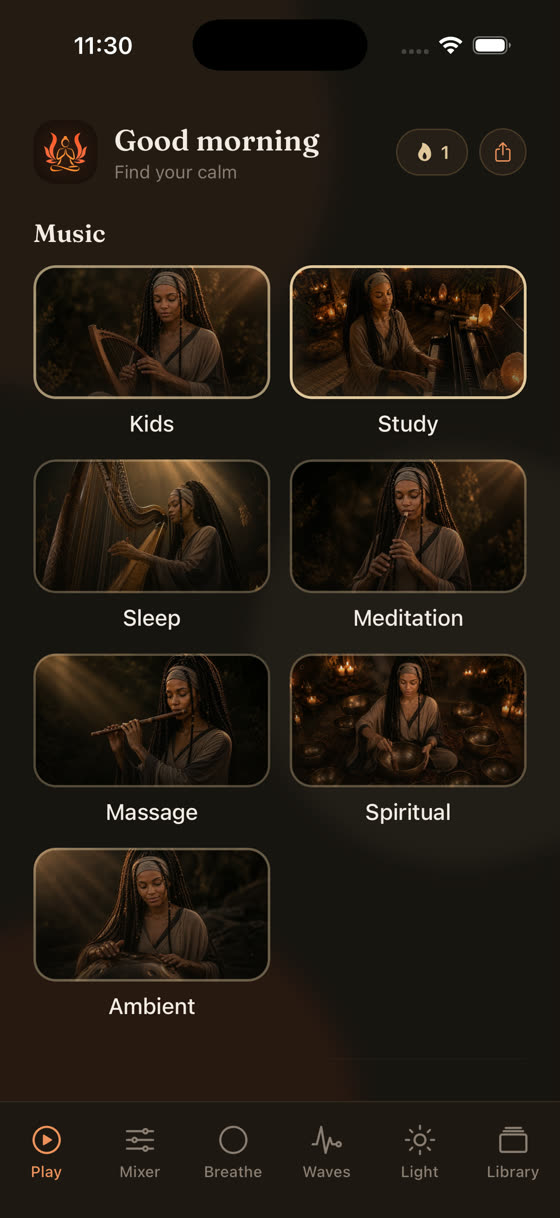
The library adds new tracks every two weeks, which matters more for a daily commute than it sounds. The same loop on repeat for six months gets duller every week, and a duller track gives your attention more room to wander than a fresh one does. If you want the full library in a browser as well as on iPhone and Android, a subscription opens all of it, which is handy on a laptop the night before a long drive when you want to queue something up properly instead of guessing on the way out the door.
The honest limits
Sound can help you stay present on a drive. It cannot fix being genuinely tired, and no music, however carefully composed, is a substitute for stopping the car when you need to. There isn't solid evidence that any particular genre of music prevents accidents, and we wouldn't claim otherwise. What a steady, well-chosen sound layer does is give an understimulated brain something to settle on instead of drifting, which is a small, honest thing, not a safety feature. Treat it as one part of a drive that also includes enough sleep, a break every couple of hours, and your phone put away before you start the engine. You can explore the rest of what we make, including the Calm and Meditation libraries for the moments after you've parked, at myzenzone.app.
Common questions
Does background music actually help you drive better or is it just a distraction?
Steady, predictable background sound tends to help on long, monotonous drives by giving an understimulated brain something to settle on, which can reduce mind-wandering. It becomes a distraction when it's unpredictable, lyric-heavy, or something you're actively adjusting while driving. The sound should sit in the background, not compete for attention.
What's the best tempo for driving music?
Something closer to 70-85 bpm, a brisk-but-calm pace rather than a resting heartbeat. That's faster than most sleep music, which sits around 60-70 bpm, because you want steady alertness, not drowsiness. Avoid sudden dynamic swings, key changes or drum fills that can pull your attention away from the road for a moment.
Can I use binaural beats or brainwave tones while driving?
We'd avoid it. Those tracks are built to nudge the brain toward stillness or states closer to sleep, which isn't what you want behind the wheel. Save brainwave tones and deep meditation tracks for when you're stationary and can give them your full attention, and stick to steady instrumental or nature-sound layers for actual driving.
Is driving in total silence bad for concentration?
It isn't dangerous, but on long, monotonous stretches it can make mind-wandering worse rather than better. A flat engine drone with nothing else to track is one of the conditions linked to 'highway hypnosis,' the glazed, time-skipping state some drivers describe. A steady, low-level sound layer gives your attention somewhere to rest instead.
How loud should background sound be while driving?
Quiet enough that you could hold a conversation over it without raising your voice, and quiet enough that indicators, horns and emergency vehicle sirens are never in question. Set the level before you start driving, not while moving, and treat it as a floor underneath the road noise rather than something you're actively listening to.