Ten to twenty minutes. That's the window sleep researchers call normal sleep latency, the gap between turning off the light and actually losing consciousness. If you're routinely dropping off in under five minutes, that's not a talent, it's usually a sign of sleep debt. If you're lying there past thirty minutes most nights, that's the threshold where clinicians start using the word insomnia.
What's happening in that window
Falling asleep isn't a light switch, it's a handoff between two systems working against each other. One is homeostatic sleep pressure: a chemical called adenosine builds up in your brain for every hour you're awake, and by bedtime it's pressing hard enough to make sleep feel heavy. The other is your circadian rhythm, the internal clock that expects darkness and a dropping core body temperature at a specific time each night, regardless of how tired you are.
When both line up, sleep comes in that ten to twenty minute window almost by default. Your heart rate slows toward resting, usually somewhere around 60 to 70 beats per minute. Your core temperature drops by a degree or two. Breathing lengthens. None of this needs effort from you, which is exactly why trying hard to fall asleep is the one thing that reliably stops it from happening.
Why the number moves around
Age changes it. Teenagers and people in their twenties often fall asleep faster than people in their fifties and sixties, partly because older adults produce less of the deep, pressure-driven sleep that pulls you under quickly. Caffeine after 2pm can push latency out by twenty minutes or more because its half-life is roughly five to six hours, so a 3pm coffee is still partly active at 9pm. A late, heavy meal does something similar by keeping digestion and core temperature elevated when they should be falling.
Anxiety and a racing mind are the other big variable, and they don't play by the clock at all. Someone can be exhausted and still take an hour to fall asleep because the body is tired while the mind is still running calculations about tomorrow. This is the gap most generic sleep advice misses: telling an anxious brain to "just relax" rarely works, because relaxation isn't a decision, it's a state you have to be walked into.
What most articles get wrong
A lot of sleep content treats fast onset as the goal and slow onset as a failure. Neither is quite right. Falling asleep in two or three minutes most nights usually means you're sleep deprived and your brain is seizing the first chance it gets, not that your sleep is especially good. A healthy range has some room in it. The real question isn't just the number of minutes, it's whether you wake up rested, how consistent the pattern is, and whether lying awake feels calm or frustrated.
Frustration matters more than people think. Lying awake for fifteen minutes while planning tomorrow's emails is a very different experience, physiologically, from lying awake for fifteen minutes with slow breathing and a quiet mind. The first keeps cortisol up. The second is basically pre-sleep, and your body treats it that way.
What to change tonight, not eventually
Most of the standard advice, no screens, cool room, consistent bedtime, is correct but slow to act on. What actually shifts things the same night is giving your nervous system a clear, repeatable signal that says the day is over. That's less about forcing calm and more about removing the ambiguity between being awake and winding down.
A dimming light, a slower soundtrack, a few minutes of paced breathing, these work because they're specific and repeatable, not because they're magical. The brain learns patterns fast. If the same ten-minute routine happens every night, it starts treating that routine as the cue to drop sleep pressure's resistance and let the circadian signal through.
Where sound actually helps
Music can't override sleep pressure or your body clock, but it can remove the noise, literal and mental, that keeps both systems from syncing up. Tempo matters here more than genre. Music sitting around 60 to 70 beats per minute, close to a resting heart rate, gives your body something steady to match rather than something to listen to actively. That's different from most streaming playlists, which are built for mood, not for bringing your heart rate down.
Layered sound does something playlists can't. Rain at a low level under a slow piano line isn't the same as either one alone; it masks the sharper, attention-grabbing sounds in a room, a door, traffic, a partner shifting, without being loud enough to notice on its own.
That's the idea behind the mixer in My Zen Zone: rain, a low drone, and a slow instrumental line, each on its own fader, so you build the exact mix that masks your room instead of accepting whatever ratio someone else chose. Every track is composed in-house for this purpose specifically, not licensed stock audio repurposed into a "sleep" category.
Winding down without overthinking it
The hardest part of a wind-down routine is usually remembering to start it before you're already too wired to begin. A visual cue helps more than people expect.
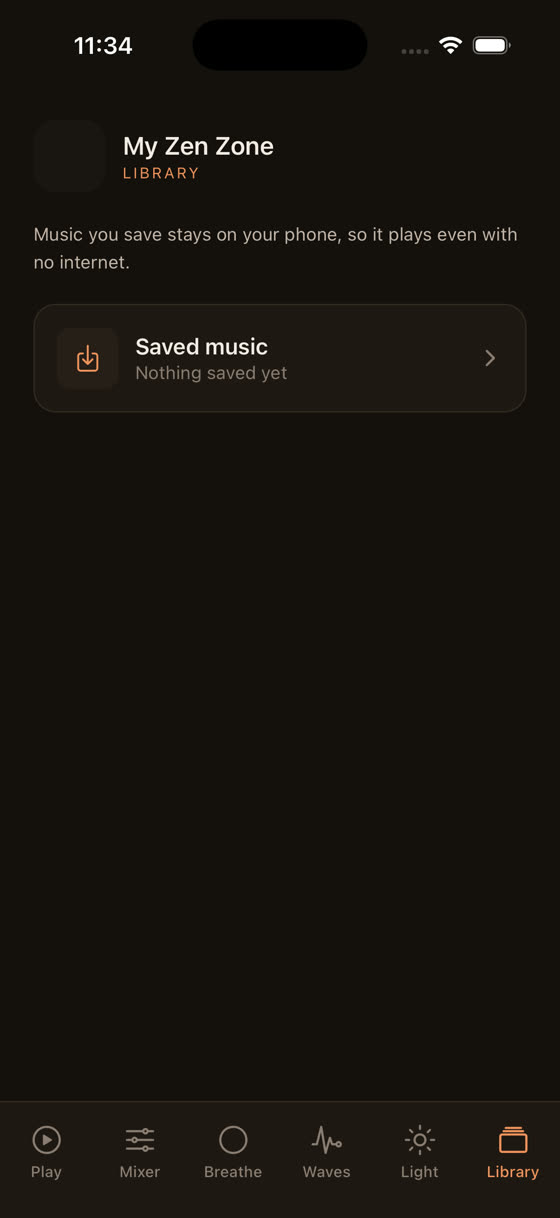
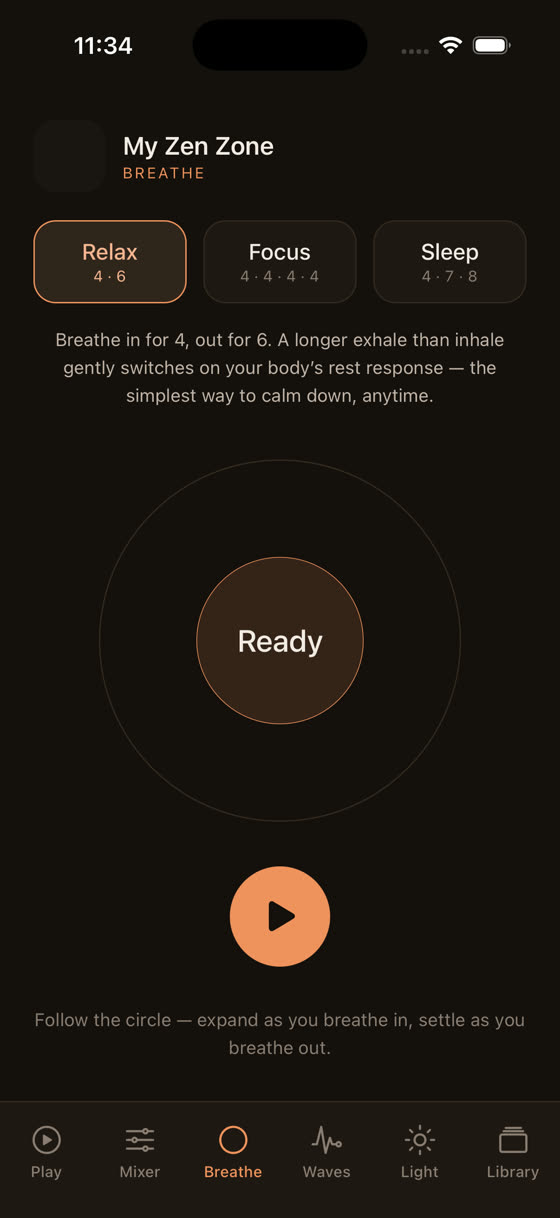
The light screen in the app is built for exactly that handoff: a slow, dimming visual paired with music, something to look at for two or three minutes that gives your eyes and your attention somewhere quiet to land before the lights actually go off. Paired with a few minutes of paced breathing, in for four counts, out for six, which nudges your nervous system toward the parasympathetic, "rest" state, it's a repeatable sequence rather than a vague suggestion to relax.
If racing thoughts are the main obstacle rather than physical restlessness, a guided session can work alongside the music instead of replacing it. Most apps stop the music to play a voice track, which resets the mood you'd just built.
Here, voice, music, and nature sound sit on separate levels you control, so a guided wind-down plays over the same soundscape you started with, not instead of it. The library adds new tracks and sessions every two weeks, so the options for this keep expanding rather than looping the same twelve tracks every app seems to ship with. For a longer look at what actually works for sleep specifically, see our guide to music for sleep, and if the issue is really daytime focus bleeding into a wired night, music for focus and study covers the other end of that problem.
When the number is worth worrying about
Occasional slow nights are normal and not worth analysing. A pattern worth paying attention to looks like consistently lying awake over thirty minutes, several nights a week, for a month or more, especially alongside daytime tiredness that doesn't match how long you slept. That's the point where it's worth talking to a doctor rather than troubleshooting further on your own. Sleep tools, music included, help the process along; they aren't a substitute for medical advice if something's genuinely off.
The practical takeaway
Ten to twenty minutes is the target, not a race to zero. If you're consistently outside that range, the fix usually isn't trying harder to fall asleep but building a short, repeatable signal, dimming light, slower sound, a few minutes of controlled breathing, that tells your body the day has actually ended. You can start that tonight with whatever's already on your phone; the app just makes the pieces easier to put together in one place.
Common questions
Is it bad to fall asleep too fast?
Falling asleep in under five minutes most nights usually points to sleep debt rather than good sleep. Your brain is grabbing the first opportunity it gets because it's running a deficit. It's not dangerous on its own, but if it's consistent, it's worth looking at whether you're simply not getting enough total sleep.
Why does it take me over an hour to fall asleep some nights?
The usual culprits are caffeine late in the day, a mind still running through tomorrow's problems, an inconsistent bedtime, or a room that's too warm. Anxiety is the most common cause that generic advice misses, since it keeps cortisol elevated even when the body itself is tired.
Does melatonin help you fall asleep faster?
Melatonin can shift the timing of your body's sleep signal, which helps more with jet lag or a shifted schedule than with insomnia caused by stress or noise. Evidence on how much it actually shortens sleep latency in otherwise healthy sleepers is mixed, so it's not a guaranteed fix. Check with a doctor before relying on it regularly.
Can music actually shorten the time it takes to fall asleep?
There's reasonable evidence that calm, slow-tempo music can help some people relax and fall asleep somewhat faster, mainly by masking disruptive noise and giving the body a steady rhythm to settle into. It won't override genuine insomnia or sleep debt, but as part of a consistent wind-down routine it's a low-risk tool worth trying.
How many times is it normal to wake up during the night?
Briefly waking one to three times a night, often without remembering it, is completely normal and happens between sleep cycles. It only becomes a concern if you're fully awake for long stretches, struggling to get back to sleep, or waking up feeling unrested despite a full night in bed.