The short answer
Yes, in the sense that matters most: every major religious tradition has its own form of meditation, and most actively encourage some version of it. Christianity has contemplative prayer and lectio divina. Judaism has hitbodedut. Islam has dhikr and muraqaba. Buddhism and Hinduism built entire philosophical systems around it. The real question isn't whether God approves of meditation in the abstract. It's which practice, aimed at which object, fits the faith you already hold. That distinction gets flattened in most articles on this topic, and it's worth slowing down on.
Why this question even gets asked
This worry has a history. In the 1970s and 80s, a wave of Western interest in Transcendental Meditation and yoga led some evangelical writers to warn that meditation meant emptying the mind and letting something else fill the vacuum. That concern wasn't baseless as a critique of one specific technique marketed as spiritually neutral. But it got generalised into a blanket suspicion of anything called meditation, which doesn't match what monks, rabbis, imams and contemplatives have been doing for centuries inside their own traditions. If you've typed this question into Google at 11pm because a mindfulness app felt oddly spiritual to you, that instinct is worth examining rather than ignoring.
What the traditions actually say
A quick, honest survey, without pretending any one tradition speaks for all of them:
- Christianity: Psalm 46:10, "Be still, and know that I am God," is the verse most often cited for contemplative stillness. Desert Fathers, Ignatian examen, and centuries of monastic silence all treat quiet, focused attention as a form of prayer, not a replacement for it.
- Judaism: Hitbodedut, a practice associated with Rebbe Nachman of Breslov, involves solitary, spoken meditation directed at God. Meditation on Torah text has a long history in Jewish mysticism too.
- Islam: Dhikr, the rhythmic remembrance of God through repeated phrases, and muraqaba, a watchful inward attentiveness, are both established practices. The five daily prayers already impose a structured rhythm of stillness and focus.
- Buddhism and Hinduism: Meditation isn't an add-on here, it's close to the centre of the path itself, whether the goal is insight, compassion, or liberation.
None of these traditions describe meditation the same way, and that's the point. The word covers a wide family of practices, not one technique with a single theology attached.
The real distinction: emptying versus directing
Most of the genuine theological concern isn't about stillness itself, it's about what the mind is doing during that stillness. "Emptying the mind" as an end in itself, with no object of attention, sits uneasily for some traditions, because it implies openness to whatever fills that space. Directing attention toward something, a verse, a name of God, the breath as a gift rather than an accident, a feeling of gratitude, sits far more comfortably, because the mind is occupied rather than vacant. If you're uneasy about a meditation practice, this is usually the actual question underneath: what am I focusing on, and why? That's a much more answerable question than "does God approve of meditation," and it's one you can settle for yourself in five minutes of honest thought.
What most answers online get wrong
Search results on this tend to split into two unhelpful camps. One says meditation is universally fine, full stop, citing wellness research and ignoring that some traditions have specific objections to specific methods. The other says meditation is spiritually dangerous, citing isolated warnings from one denomination as though they applied to everyone. Neither is honest. There is no single verse, ruling, or teacher that settles this question for all traditions, and denominations disagree even within themselves. The practical, defensible version is this: quiet, focused attention has deep roots across world religions, and the details of how you practise it, not the fact that you practise it, are what matters to most faith traditions that have weighed in.
A practical way to start tonight, whatever you believe
Set a timer for five minutes. Sit upright, breathe in for four counts, hold for a beat, breathe out for six. That ratio, a longer exhale than inhale, slows the heart rate and nudges the body out of alert mode without requiring any particular belief system to work. If you want to anchor the practice in your own faith, pair each exhale with a word: a name, a verse fragment, a single word of gratitude. If you'd rather keep it secular, just count the breath. Either way, the mechanism is the same: attention on one slow, repeating thing, instead of attention scattered across six open tabs in your head.
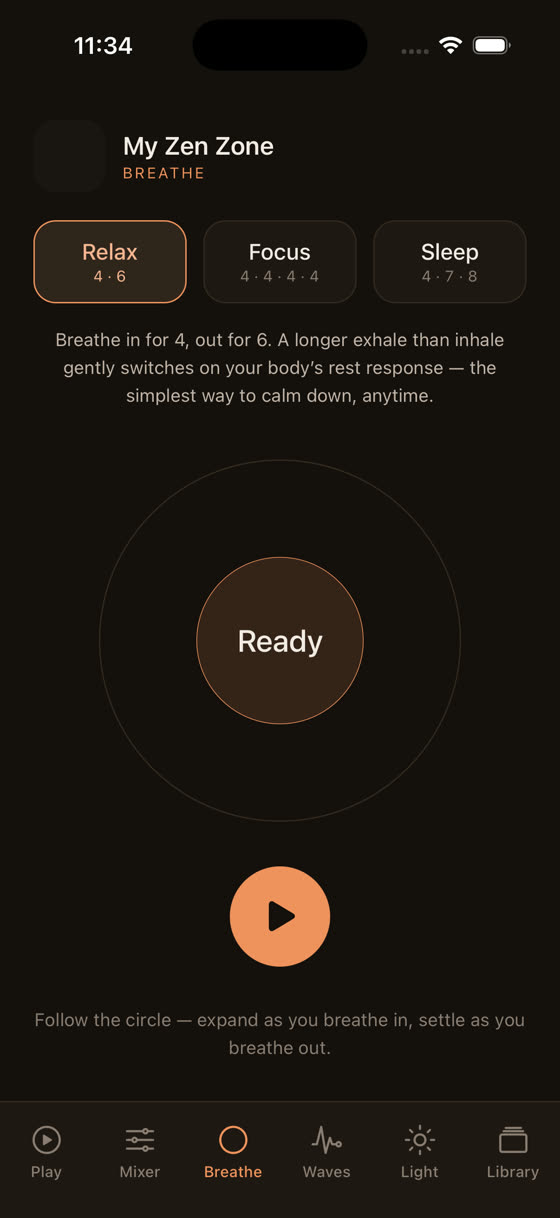
A visual breathing guide with a 4-6 pattern built in removes the need to count in your head, which is where most five-minute attempts at this fall apart by minute two.
Where music fits in, with or without a creed
Instrumental music carries no doctrine. A slow piano and strings piece at 60 to 70 beats per minute, roughly a resting heart rate, doesn't argue for or against anything theologically. That's exactly why it works as a backdrop for prayer, scripture reading, or secular stillness without anyone needing to agree on what's happening spiritually in the room. Where it gets more interesting is guided sessions, because a spoken voice does carry content, and that content might not match what you believe.
This is the part worth watching rather than reading about: a guided session here plays as a separate voice layer over the music, not instead of it, and each layer, voice, music, nature sound, has its own level you control. If the script of a particular session doesn't sit right with your beliefs, you mute the voice and keep the music as a plain backdrop for your own prayer or silent attention. Most apps give you a fixed, all-or-nothing recording. Here you build the mix yourself.
How this actually works day to day
My Zen Zone is a library of original instrumental music, composed and recorded by one musician rather than licensed stock tracks, organised into sleep, focus, meditation and calm. Nothing in the library is doctrinally neutral by accident, it was written with no religious framing attached at all, which means it sits quietly underneath whatever you bring to it, a rosary, a Psalm, a breath count, or nothing but silence. The mixer lets you set your own balance of music and nature sound, the sleep timer closes things down after your session rather than running all night, and the whole library, hundreds of tracks with new ones added every two weeks, is downloadable for offline use so a patchy signal in a quiet chapel or a bedroom with the wifi off doesn't interrupt anything. You can start from the app or go straight to the download if you already know what you're after.
What to actually do with this
If you belong to a specific tradition and this question genuinely troubles you, the honest next step is to ask your own clergy or teacher, because they'll know the specific concerns and permissions within your own community far better than a general article can. But as a baseline: quiet stillness, breath focused on something rather than nothing, and attention directed toward God, scripture, or simple gratitude has centuries of precedent across faiths. If you're building this into a nightly habit rather than a one-off experiment, it's worth reading about what actually helps you wind down before bed, since meditation and sleep preparation overlap more than people expect.
Common questions
Is meditation mentioned in the Bible?
Not using that exact word, but related concepts appear often, meditating on God's law in Psalm 1 and Psalm 119, and "be still" in Psalm 46:10. Christian contemplative prayer traditions, including lectio divina and the Desert Fathers, trace their roots to these passages rather than to any Eastern practice.
Can Muslims practise meditation without it conflicting with Islam?
Yes. Dhikr, the repeated remembrance of God, and muraqaba, watchful inward attentiveness, are established Islamic practices with a long history. The five daily prayers already build structured stillness into the day. Specific concerns usually involve adopting foreign religious content, not the act of quiet focused attention itself.
What's the difference between prayer and meditation?
Prayer is typically addressed to God, often with words, requests, or praise. Meditation is usually a method, a way of directing attention, that can be used within prayer or separately from it. Many contemplative traditions treat meditation as a form or preparation for prayer rather than a competing activity.
Is it okay to use a meditation app if I'm religious?
Generally yes, especially if the music or sounds carry no religious content of their own and you control what's layered on top. Check whether any guided voice sessions match your beliefs, and if they don't, look for an app that lets you mute the voice and keep just the music, which sidesteps the issue entirely.
Does meditating with music count as real meditation?
There's no fixed rule here. Music can help by giving the mind something slow and repetitive to settle around, similar to how a chant or steady breath works. If your tradition values silence specifically, instrumental background music at a low level is a reasonable middle ground worth trying before ruling it out.