Yes. Calm has guided meditation as one of its main features — a Daily Calm session released every day, longer programs on anxiety or sleep, and a library of Sleep Stories narrated over soft music. If you're asking because you want to know whether that app does guided sessions at all, the answer is simply yes, it's built around them.
But that's the easy part of the question. The more useful question is what guided meditation actually does for you, and whether the way it's delivered — a fixed recording, voice and music locked together at one ratio, start to finish — suits how you actually want to use it. That's where most comparisons stop short, and it's worth fifteen minutes of your attention.
What guided meditation is actually doing
A guided session is a voice walking you through a specific technique: noticing the breath, scanning the body, naming a feeling without chasing it. The music underneath isn't decoration. It's there to hold a steady tempo, usually slow and without much melodic movement, so your attention has somewhere quiet to rest between instructions. The narration gives your mind a job. The music gives it a floor.
This combination works well for people who find silent meditation hard to sit with — the mind wanders, then wanders further, then gives up. A voice interrupting that drift every twenty or thirty seconds keeps you anchored. For beginners especially, this is genuinely more useful than being told to "just breathe" with no scaffolding at all.
Where the format falls short
Here's what most articles comparing meditation apps don't mention: in almost every app, including Calm, the voice and the music are baked into one audio file at a fixed mix. You can't turn the music up and the voice down. You can't drop the voice out halfway through and keep the music going once you've settled. If the narrator's pace doesn't match your evening, or the music underneath is a touch too bright for 11pm, your only option is to pick a different track and hope.
That's a real limitation, not a nitpick. The right ratio of voice to music changes depending on the night. Some evenings you want a lot of guidance because your mind is loud. Other evenings three sentences in you're ready to let the voice go and just sit in the sound. A locked-together file can't do that for you.
A different way to build a guided session
This is the piece we built My Zen Zone around. A guided session in the app isn't one audio file — it's three separate layers, Voice, Music, and a nature sound if you want one, each with its own level you control while it plays.
Watch what happens there: the voice plays over the music rather than instead of it, and you can pull the narration down to almost nothing once you've found your footing, leaving the music to carry you the rest of the way. Or you can bring the voice back up if your attention slips. Nobody has to commit to one fixed version of a session before they've even started listening.
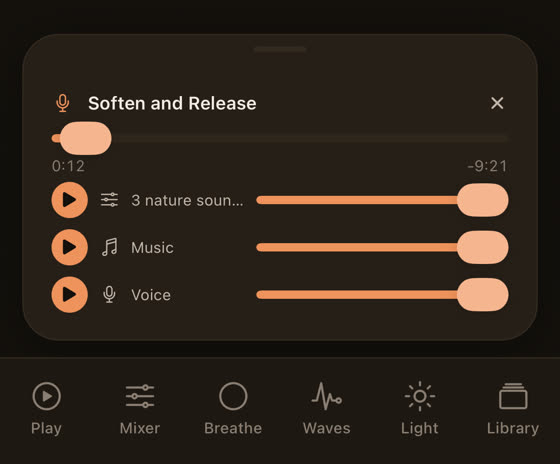
It sounds like a small technical difference. In practice it changes how a session feels three minutes in, when most people decide whether they're actually going to stay with it or reach for their phone.
What most comparisons between apps get wrong
Articles that rank meditation apps tend to count features — number of sessions, number of voices, whether there's a sleep timer — as if guided meditation were a checklist item you either have or don't. That's how you end up with a post that just confirms "yes, Calm has this" and stops there.
The thing worth asking isn't whether an app has guided meditation. Nearly all the big ones do now. It's whether the guidance adapts to you, or whether you adapt to it. A library of fixed recordings, however well produced, asks you to find the one that happens to fit your mood tonight. A mixer-based approach asks you to shape what's playing until it fits.
When a voice helps, and when it gets in the way
Be honest with yourself about which kind of night this is. If you're anxious, scattered, or new to any of this, a voice giving you something concrete to do — count the breath, notice the chair under you — is more useful than ambient sound alone. The instruction interrupts the spiral.
If you already know how to sit with your own breath and what you actually want is quiet, a narrated session can feel like being talked at. This is the case for a lot of experienced meditators who tried an app, found the voice intrusive, and gave up on guided sessions entirely rather than just turning the voice down. That's a shame, because the voice was never the point — it was a tool, and tools should be adjustable.
There's also a simple breathing exercise worth trying with no narration at all, just a visual pattern to follow with your eyes closed or half-closed.
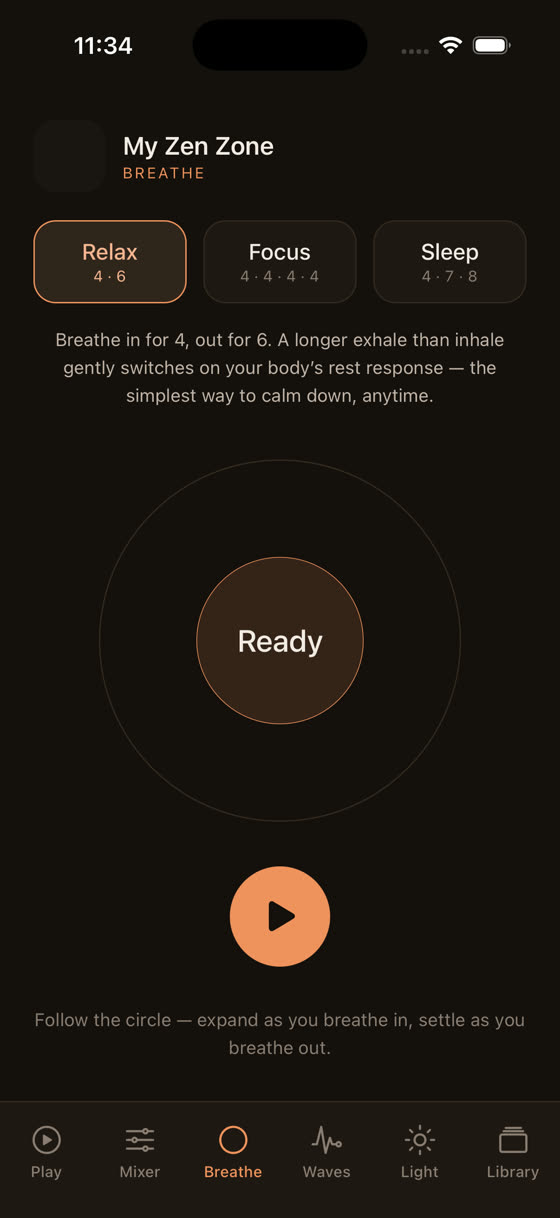
A 4-6 pattern — four counts in, six counts out — is a longer exhale than inhale, which is the part that tends to slow things down. No voice required, no music required either if you don't want it. Some nights that's genuinely enough.
Building your own version for tonight
If you want to try the layered approach rather than a fixed track, here's a reasonable starting point. Pick a guided session on a topic that matches your evening — unwinding after a hard day, or just getting to sleep. Start all three layers roughly even. After a minute or two, once the instructions have done their job of settling your attention, pull the voice down by half. By the end you may have it at zero and just the music and a quiet layer of rain or ocean left running.
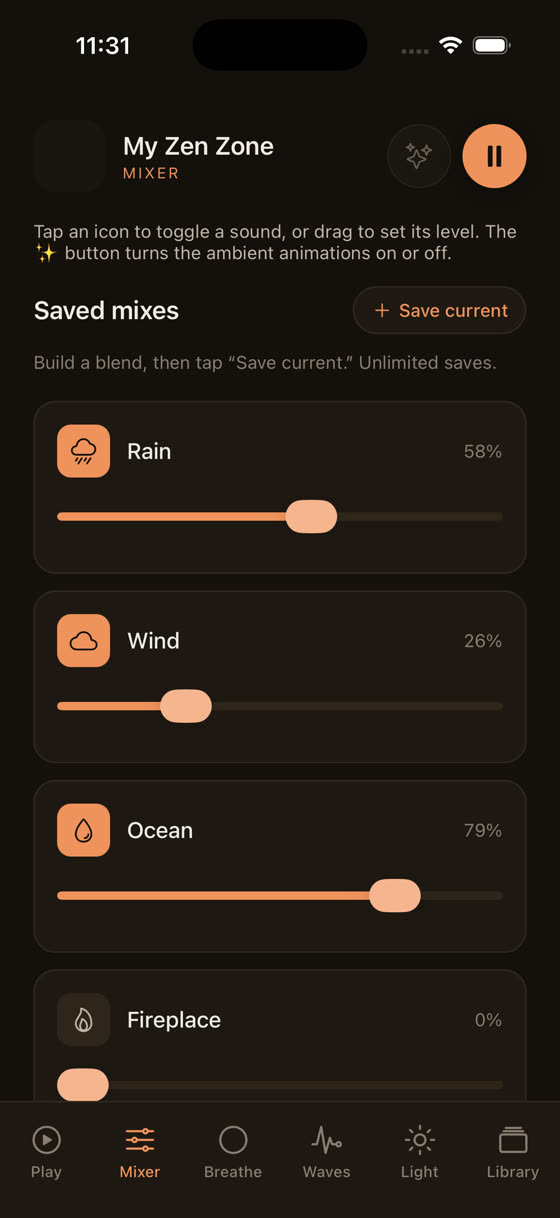
This same mixer is the one you'd use outside guided sessions too — three nature sounds at three different levels, built around whatever's actually playing, which is a different question from guided meditation but the same underlying idea: a track is a starting point, not a finished product you have to accept as-is. We wrote more about building a sound bed like this in our piece on the best music for sleep, which covers tempo and instrumentation if you want to go further into the mechanics.
Beyond guided sessions
If spoken guidance isn't for you at all tonight, the same library has other tools built for the hour before sleep. A light screen with a slow, dimming visual for when you want something to look at while you settle rather than listen to.
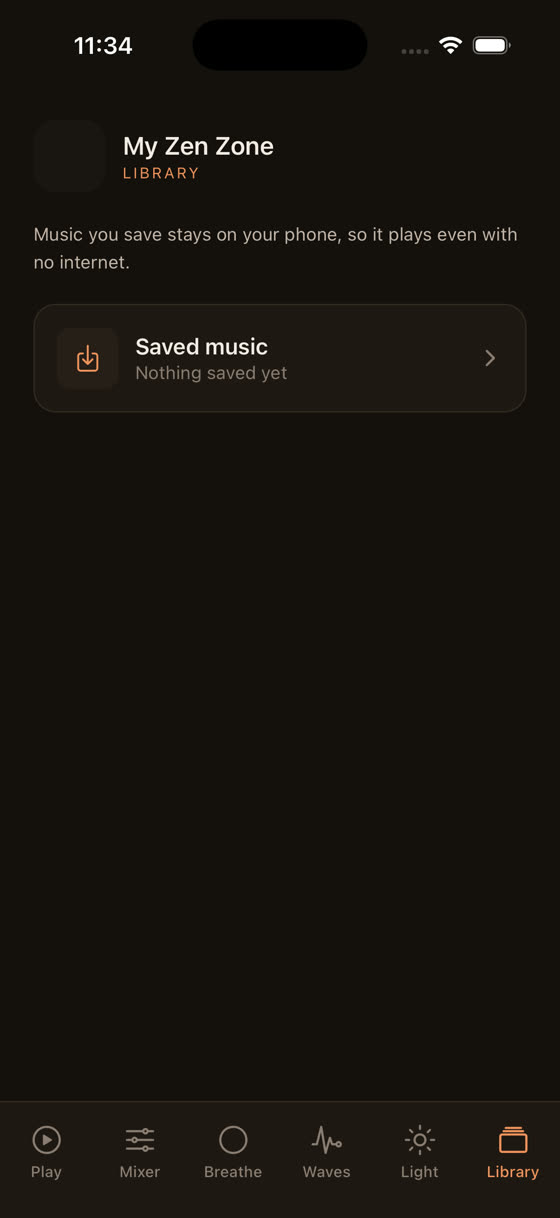
There are also plain brainwave tones if you'd rather have no narration and no melody, just a steady low frequency in the background, and a home screen organised so sleep, focus, meditation, and calm each feel like their own separate space rather than one long undifferentiated list.
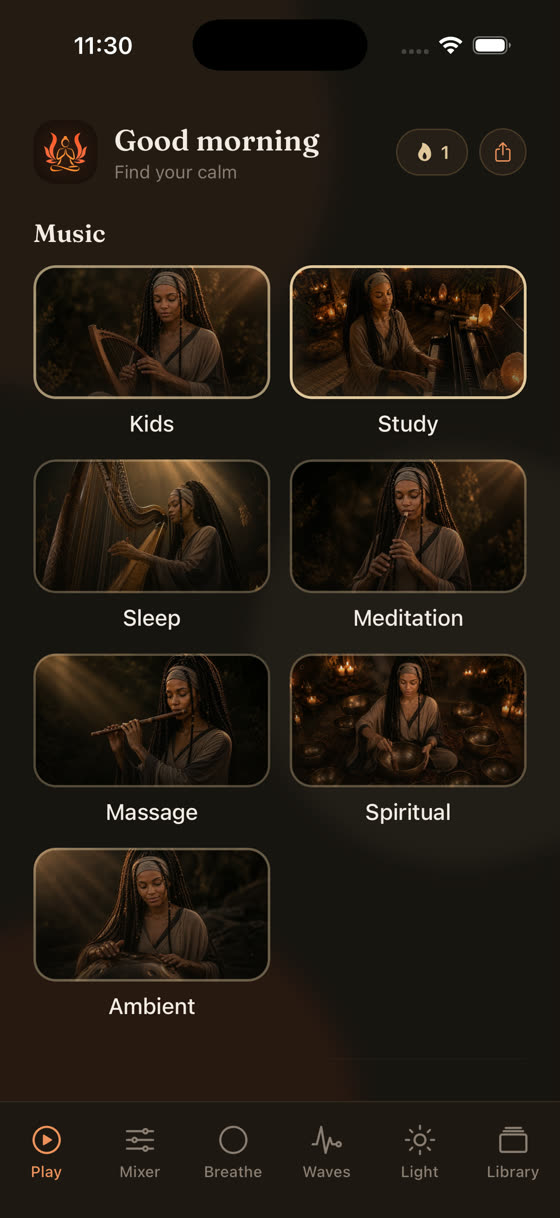
Every track and every guided session in the library is composed and recorded by one person, not licensed from a stock catalogue, and new sessions get added roughly every two weeks — so if guided meditation doesn't click for you this month, there's reason to check back rather than assume you've seen everything the format has to offer. You can look through the current library or start a trial at myzenzone.app/get, or read more generally about the whole approach at myzenzone.app.
The honest summary
Calm has guided meditation, and so does nearly everything else in this category now. That part of the question has a quick yes. The slower, more useful question is what you actually want from the voice on a given night — more guidance, less, or none — and whether the app you're using lets you change your mind about that once the session has already started. Most don't. That gap is worth noticing before you settle on one app for good, especially if you're also using it for focus during the day, where the same logic about adjustable layers applies just as much — something we go into in our post on music for focus and study.
Common questions
Is Calm's guided meditation free or paid?
Calm offers a handful of free sessions, including a version of the Daily Calm, but most of the library — Sleep Stories, full programs, and the broader meditation catalogue — sits behind a subscription. This is standard across most meditation and sleep apps, including ours; a small free tier, then a paid library behind it.
Can I turn the guided voice off partway through a session?
In most apps, no, because voice and music are mixed into a single audio file. In My Zen Zone's guided sessions, Voice, Music, and nature sound are separate layers with their own volume controls, so you can lower or mute the narration at any point while the music keeps playing underneath it.
Is guided meditation better than music alone for sleep?
Neither is universally better. Guided sessions help if your mind needs a specific instruction to settle; plain music or nature sound helps if narration feels intrusive once you're already relaxed. Many people use guidance for the first few minutes and prefer quiet instrumental sound for the rest of the night.
How often does new guided content get added?
In our library, new tracks and sessions are added roughly every two weeks, all composed and recorded in-house by the same musician rather than licensed stock audio. That steady pace matters if you meditate often enough to notice repetition in a fixed catalogue.
What's a simple alternative if I don't like guided meditation at all?
Try the breathing screen's 4-6 pattern — four counts in, six out — with no narration, just a visual pace to follow. Pair it with a plain nature sound or brainwave tone at a low level in the mixer. It gives your attention a job without a voice doing the talking.