The short answer
Balance, the meditation app that won Apple's App of the Year in 2021, describes itself as personalized rather than AI-powered in the generative sense. Publicly, the company talks about a system that adapts your daily plan based on check-ins: you rate how you're feeling, rate sessions afterwards, and the app adjusts what it suggests next. That's a recommendation engine, and whether you call a recommendation engine "AI" depends on how loosely you use the word. It is not, as far as anything published shows, an app where a language model writes your meditation script on the fly or a synthetic voice reads it to you. The guided sessions are recorded by human teachers.
So if you searched this because you pictured a chatbot generating a meditation for you in real time, that's not what's happening. If you searched because you wondered whether the "personalization" is just marketing language for a fairly ordinary if-this-then-that system, that's closer to the truth, though without an engineering breakdown from the company itself, nobody outside Balance can say exactly how the adaptation works under the hood.
What people actually mean by "AI meditation app"
The phrase gets used for at least three very different things, and conflating them is where most confusion starts.
- Personalization algorithms — sorting existing, human-made content based on your inputs. Most established meditation apps do some version of this. It's closer to a music streaming service's "recommended for you" than to anything resembling artificial intelligence in the popular imagination.
- Generative audio — music or ambient soundscapes created by a model rather than a musician, sometimes rendered fresh each time you press play. This is a real and growing category, but it's a specific technical choice, and companies that do it tend to say so, because it's a selling point for them.
- Synthetic voice — narration read by a cloned or text-to-speech voice instead of a recorded human. Cheaper to scale, but it changes the pacing and warmth of a session in ways a lot of listeners notice even if they can't name why.
Balance, based on what it publishes about itself, sits in the first category. No AI-composed music, no synthetic narrator. That distinction matters more than the marketing copy on any app store listing usually suggests.
Why the distinction actually matters for your practice
A recommendation algorithm deciding which of 40 existing sessions to show you tonight is a low-stakes use of AI. It doesn't touch the content itself. Generative music and synthetic voice are a different matter, because they touch the thing you're actually listening to for ten or twenty minutes with your eyes closed.
Generative ambient tracks can drift. Some are genuinely pleasant; others have a subtly repetitive quality once you've heard a few, because the model is working from patterns rather than musical intention. A composer chooses when a phrase resolves and when it doesn't. A model predicts what's statistically likely to come next. For background music you're only half-listening to, that gap might not matter. For something meant to slow your breathing or hold your attention through a focus session, it often does.
Synthetic voice has a related problem: pacing. A good meditation teacher leaves a pause exactly as long as it needs to be, breathes audibly before a cue, lets a sentence trail rather than clipping it. That's timing built from doing the thing thousands of times, not from a text-to-speech engine reading punctuation.
How My Zen Zone does it, for comparison
Everything in this library is composed and recorded by one musician, working track by track, in-house. No model generating audio, no synthetic narration. Hundreds of tracks now, with new ones added every two weeks, which is slower than a generative system could churn out content but means every track was actually made by someone who thought about tempo, key, and how long a phrase should sit before it changes.
That matters practically. A 60-70 bpm piece for sleep, roughly a resting heart rate, was built to be that tempo on purpose, not because a model landed there statistically. A focus track built around a steady, unchanging low end so your attention doesn't get pulled by a key change halfway through an essay — that's a compositional decision, not an accident of training data.
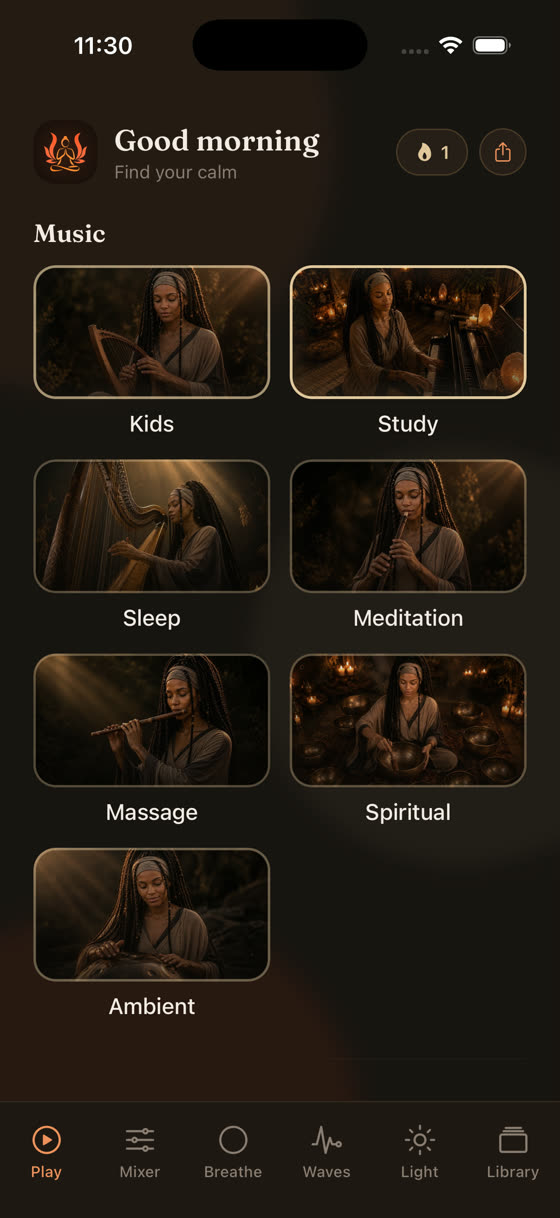
The guided sessions work the same way: real narration, layered over music rather than replacing it, and you control the balance yourself.
The mixer is the part most apps, AI-powered or not, don't have
Most meditation apps, whatever's happening behind the scenes, give you one fixed track per session. Ours gives you separate levels for voice, music, and nature sound, so a guided session isn't a single locked file — it's three layers you balance to taste. Turn the voice down and let the music carry more if you know the script already. Add rain under a sleep session at a level that suits your room, not a level some algorithm or composer guessed at for you.
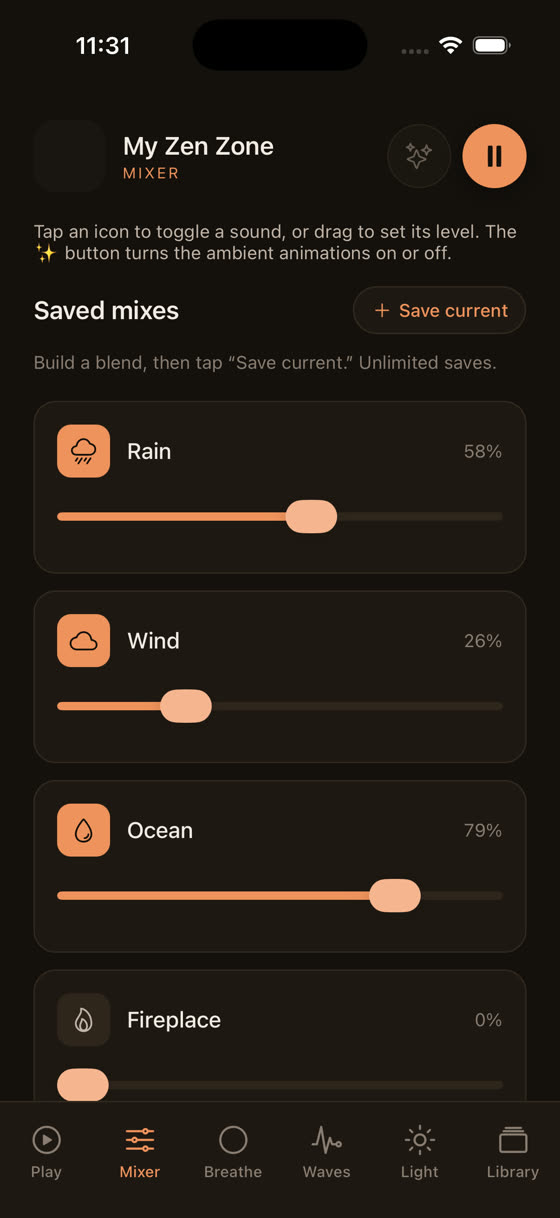
This is a genuinely different design decision from either a fixed AI-generated track or a fixed human-recorded one. It's not about which was more advanced to build. It's about handing the final mix to the person actually listening.
How to check any app's AI claims yourself
If you want to know whether an app you're using or considering actually uses AI, and in which of the three senses above, a few places are worth checking before you take a marketing headline at face value.
- Look for composer or teacher credits. Apps built on human-made content usually name the people, because it's a selling point for them too.
- Read the privacy policy or an "about" page rather than the app store description — that's where companies are more likely to be specific, since app store copy is written to sell, not disclose.
- Notice the vocabulary. "Personalized" and "adaptive" usually mean recommendation logic. "AI-generated" or "AI-composed" usually means exactly that, stated plainly, because it's currently a differentiator worth advertising.
- Listen for repetition. Generative audio, however good, often has a loop-like quality after a few listens that human composition, built around verse-and-variation, tends not to have.
What actually matters more than the AI question
Whether a track was written by a person or a model is a fair thing to ask, but it's not the only thing worth checking before you commit ten minutes of your evening to a session. Pacing matters more. Whether the app lets you set a sleep timer so it doesn't run all night matters more. Whether you can download tracks for a flight or a commute with no signal matters more. Whether the guided session plays over music you actually like, at a level you control, matters more than the label on the box.
If you're choosing music specifically for winding down at night, the tempo and instrumentation questions are worth more of your attention than the AI question — we've written more on that in our guide to music for sleep. And if what you actually need is something to hold attention during study or deep work rather than something to meditate to, the considerations are different again, covered in our piece on focus music.
Where this leaves you
Balance, based on everything it publishes about itself, uses a personalization system to decide what to recommend, not a generative model to write your meditation or a synthetic voice to read it. That's worth knowing, but it's a smaller claim than "AI meditation app" tends to suggest. The more useful question, for any app including this one, is whether the music and narration were made by someone who understood what a body needs at 60-70 bpm, or assembled by a system optimizing for something else entirely. You can usually tell within a few listens which one you're hearing.
Try the mixer and the guided sessions for yourself over at myzenzone.app, or head straight to the download page if you'd rather just listen.
Common questions
Do any meditation apps actually use AI to generate music?
Yes, a small but growing number of apps use generative models to produce ambient background audio, sometimes rendered fresh each session rather than as a fixed track. Companies doing this typically advertise it, since it's currently a selling point. Most established meditation apps, including the big names, still use human-composed and recorded music.
Is AI-generated music as good as human-composed music for meditation or sleep?
It varies. Some generative ambient tracks are pleasant on first listen but can feel subtly repetitive over time, since the model is predicting statistically likely patterns rather than making a deliberate compositional choice about when a phrase resolves. For background listening that's often fine; for something meant to guide breathing or hold attention, the difference tends to be more noticeable.
Does My Zen Zone use AI to make its music?
No. Every track is composed and recorded by one musician working in-house, and the guided sessions use real recorded narration, not synthetic voice. The library runs to hundreds of tracks with new ones added every two weeks, built by a person rather than generated by a model.
How can I tell if a meditation app's content is AI-generated?
Check for composer or teacher credits, since human-made content is usually named as a selling point. Read the privacy or about page rather than the app store listing, where marketing language is looser. And listen for repetition: generative audio, however polished, often has a loop-like quality that composed music built around verse and variation tends not to have.
What should I actually look for in a meditation or sleep app instead of worrying about AI?
Pacing, tempo, and control matter more day to day. Look for a sleep timer so audio doesn't run all night, offline downloads for flights or dead zones, and ideally a mixer that lets you balance voice, music, and nature sound yourself rather than handing you one fixed file.