The short answer
Yes, sort of. Every iPhone running a recent version of iOS has a Mindfulness app built into the Health app ecosystem. It used to be called Breathe on Apple Watch, and Apple folded it into a proper app around iOS 14. It walks you through a breathing animation, lets you log how you're feeling, and sends the occasional reminder on your watch. That's it. There's no library, no sleep tracks, no guided sessions beyond the one breathing exercise. If you were hoping Apple ships something like Calm or Headspace pre-installed, it doesn't.
What it does ship is a utility. A well-designed one, but a utility, not a practice. The distinction matters more than it sounds like it should, and it's the reason so many people download the built-in app, use it twice, and forget it exists.
What the built-in Mindfulness app actually does
Open it and you get two main things. The first is a breathing session: a shape expands and contracts on screen for however long you set, usually one to five minutes, at a fixed pace somewhere around five to six breaths a minute. That's slower than resting breathing for most adults, which sits closer to twelve to sixteen breaths a minute, and the slowdown is the entire mechanism. The second is a reflection feature, where you log a word or two about your state of mind and it gets stored alongside your other health data.
On Apple Watch this shows up as a nudge, a tap on the wrist a few times a day suggesting you take a minute. Useful if you genuinely forget to pause. Not much use if you're trying to wind down at 11pm with a specific problem, like a mind that won't stop replaying the day's meetings.
Where it falls short if you're trying to build an actual practice
The gap shows up fast once you use it more than a handful of times. There's no variety: one breathing pattern, one pace, no option to layer in sound. There's no library to grow into, no progression from a two-minute check-in to a twenty-minute session. There's nothing for sleep specifically, nothing for focus while working, and nothing that adapts to the actual situation you're in, which changes night to night far more than a single fixed exercise accounts for.
Compare that with a dedicated breathing screen built for the job, where you can choose a pattern like 4-6 for relaxation, watch the timing visually, and have real music underneath rather than silence or a generic chime.
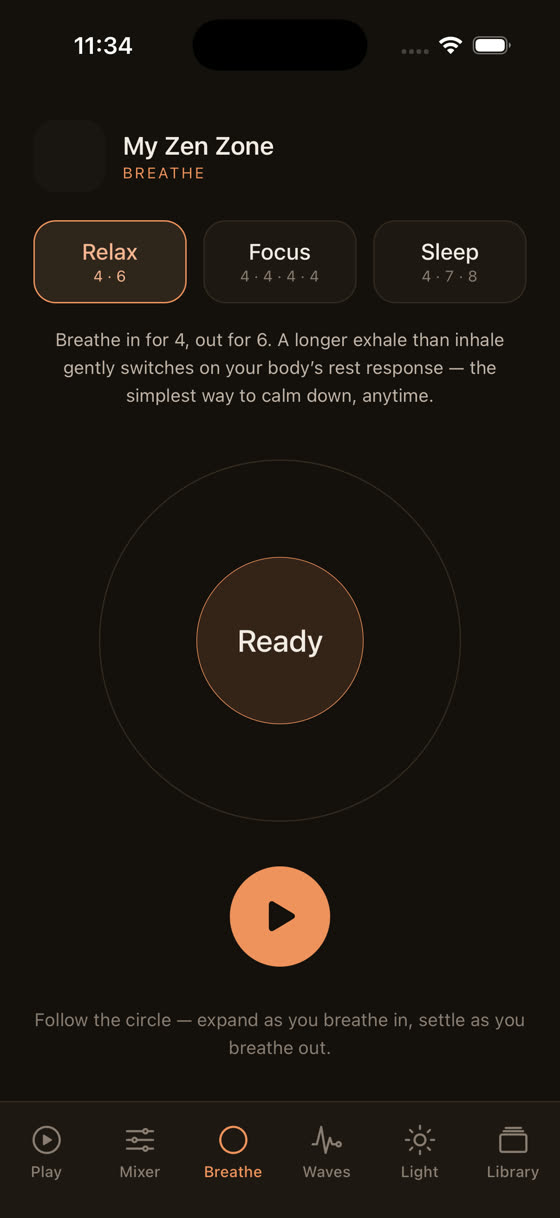
That combination, a visual pace guide plus actual composed music at a matching tempo, is a small thing but it changes whether people stick with it. Silence with an animation is fine once. Music underneath it, timed properly, is what turns a technique into a habit.
The Apple Watch angle, and why the naming keeps changing
Apple has renamed this feature more than once, from Breathe to Mindfulness, partly because the scope kept shifting slightly. It's part of the health-tracking suite alongside heart rate, sleep stages, and activity rings, not part of an entertainment or content library. That's a deliberate design choice on Apple's part: it's meant to be a light daily nudge, not a destination you open when you specifically want twenty minutes of guided meditation before bed. If you're searching for the latter, the built-in app was never trying to be that.
Apple Fitness+ and the subscription confusion
This is where the question gets murkier. Apple Fitness+, the paid fitness subscription, does include some mindfulness and meditation-style content, usually short sessions led by a trainer, filmed like the workout videos. It's real content, but it sits inside a fitness subscription built around workouts, and the meditation portion is a small slice of a much bigger catalogue aimed at exercise. If meditation and sleep are the actual goal rather than a side note to a workout plan, that's a lot of subscription to buy for a small piece of what you want.
What separates a system utility from a purpose-built practice tool
Apple's tools are built to be universal defaults, something that works reasonably for almost everyone with zero setup. That's a fine goal for a phone maker. It's a limiting one for meditation and sleep, because what actually helps someone unwind is specific: the right sound for their environment, a session length that fits their evening, control over how loud a voice is against the music behind it. A single fixed breathing animation can't flex to that. A library and a mixer can.
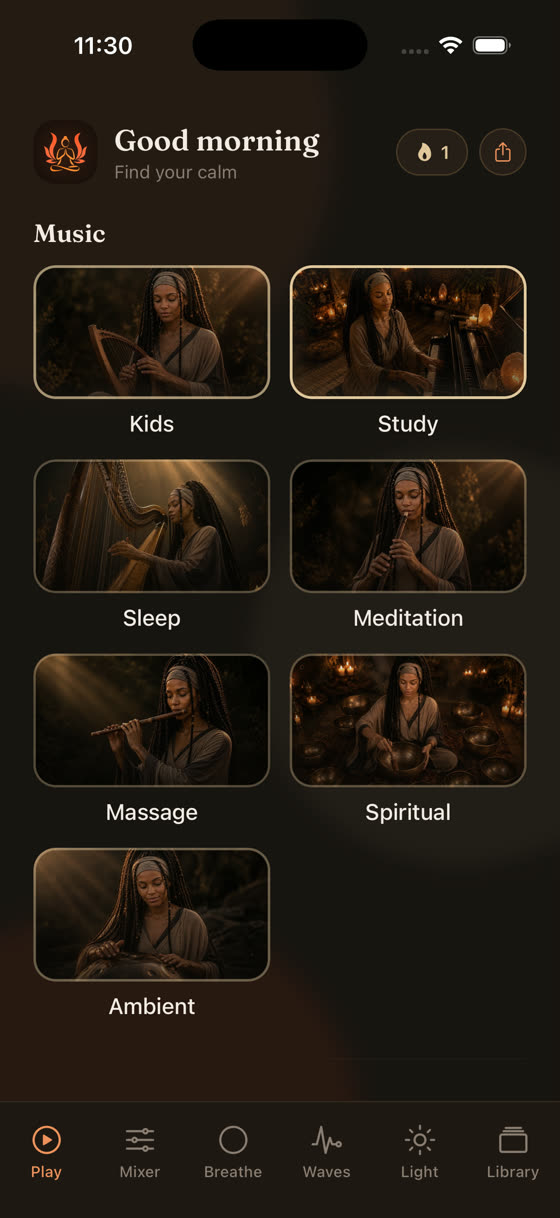
That's the practical difference between an app that's meditation-adjacent, bundled into a bigger product, and one built around sleep and calm as the entire point.
How guided meditation works differently when it's built for this
Most meditation apps, Apple's included, play a voice track that has the music baked in underneath it at a fixed level. If the narration feels too quiet, or the music too loud, or you'd rather have more nature sound and less voice, you're stuck with what the producer chose. My Zen Zone treats a guided session as separate layers instead of one flattened file: voice, music, and nature sound each get their own slider, so you can bring the voice up while you're falling asleep and let it fade while the music continues underneath.
That's the difference between a session playing at you and a session you actually shape around your own night. It sounds like a small feature until you've tried adjusting a narrator who's too loud for 2am and realised most apps simply won't let you.
What to actually try tonight
If you've been relying on the built-in Mindfulness app and it hasn't stuck, don't blame yourself for not using it enough. Try swapping in something with more range for one week. Pick a specific situation, not a generic goal: winding down after a late work call, or needing quiet focus for an hour of admin, or actually falling asleep rather than just relaxing. Match the tool to that, not to a vague idea of
Yes, it comes free with iOS on any recent iPhone and pairs with Apple Watch if you have one. There's no in-app purchase or subscription for the basic breathing exercise and reflection log. The paid tier, Apple Fitness+, is a separate subscription and includes some short mindfulness videos alongside its main workout content. Mostly yes for the breathing exercise itself, since the watch can run it standalone and prompt you with haptic taps. But logging, session history, and any richer content still route back through the Health app on your phone, so you're not fully independent of the phone if you want the full picture. Scope. Apple's version is one breathing exercise plus a mood log, built as a health utility. Dedicated apps offer full libraries: sleep tracks, focus music, guided sessions of varying lengths, nature sound mixing, and new content added regularly, which is what turns an occasional check-in into an actual nightly or daily habit. It includes short mindfulness sessions led on video, similar in style to its workout content, but they're a small part of a subscription built primarily around exercise. If meditation and sleep are your main goal rather than a bonus alongside workouts, a dedicated app will generally offer more depth for less cost. Not if the app supports offline downloads. Download the tracks or sessions you want over Wi-Fi during the day, then use them at night with your phone in airplane mode, which also avoids notifications interrupting a session right when you're trying to fall asleep.Common questions
Is Apple's Mindfulness app free?
Can I meditate using just my Apple Watch, no phone needed?
What's the real difference between Apple's app and something like Calm, Headspace, or My Zen Zone?
Does Apple Fitness+ include real guided meditation?
Do I need Wi-Fi or data to use a meditation app at night?