Yes, you can — and it's a real, well-worn path
You can study music at university, and it's one of the oldest subjects a university offers. You'll find it under a few different names depending on the institution: a Bachelor of Music, a Bachelor of Arts in Music, a joint honours degree combining music with something else, or a conservatoire diploma that sits alongside university-level academic study. Entry usually asks for some combination of a practical audition, grade exams on your main instrument, and evidence you can already read notation and hear intervals. Some courses want you composing before you arrive. Others will teach you from closer to scratch if your theory is weak but your playing is strong.
What surprises people is how little of a music degree is just "playing your instrument in a room." A typical year splits across performance, written theory, aural skills, music history, and usually some composition or technology module. By year two or three you're choosing a direction — some students go almost entirely performance-focused, others drift into composition, musicology, or production and barely touch their instrument after first year.
What a performance-focused degree looks like week to week
If you specialise in performance, expect weekly one-to-one lessons with a principal study teacher, regular performance classes where you play in front of peers and get picked apart kindly but honestly, and a recital at the end of most years that counts for a serious chunk of your final mark. Practice isn't optional or vague — most programmes expect two to four hours a day on your instrument, on top of lectures. Ensemble work is mandatory almost everywhere: orchestra, choir, chamber groups, big band, whatever fits your instrument. You learn to play in time with other people, which is a different skill entirely from playing alone, and arguably the more useful one long-term.
The hours are long and the feedback is constant. You get used to being critiqued on tone, intonation, phrasing, and interpretation on a weekly basis. That's not comfortable, but it's the thing that actually improves playing fastest — faster than solitary practice ever does.
Composition, theory, and the scaffolding nobody notices
The part of a music degree that changes how you listen forever is theory and aural training. Four-part harmony exercises, species counterpoint, figured bass, dictation where you have to write down a melody or chord progression after hearing it twice. It feels dry in first year. By third year it's the reason you can hear why a chord progression resolves the way it does, or why a particular interval feels unsettled until it's answered.
Composition modules, where they exist, teach you to write for instruments you don't play — string quartet writing if you're a pianist, orchestration for woodwind if you're a guitarist. You learn ranges, what's playable, what sits well on each instrument, and how texture changes when you double a line an octave down versus adding a second voice in thirds. This is unglamorous, technical work, and it's exactly the knowledge that later lets a composer write something as apparently simple as a six-minute piano piece at 60 bpm that still holds a listener's attention without demanding it.
Conservatoire, university department, or production school — they're not the same thing
A conservatoire (Juilliard, the Royal College of Music, Berklee and similar) is built around performance and professional practice, often with smaller cohorts and more contact hours with your principal teacher. A university music department usually sits inside a broader academic faculty, with more musicology, more essay-writing, and a curriculum that treats music as a humanities subject as much as a craft. Production and audio schools are a third, newer option — less theory and history, much more time in a DAW, learning signal flow, mixing, mastering, and increasingly, writing music for media rather than the concert hall.
None of these is objectively better. A conservatoire graduate who's never opened a DAW and a production-school graduate who can't sight-read are both, in a very real sense, trained musicians — just trained for different rooms.
What the open days don't mention
Grades in a music degree are often more subjective than in other subjects, and that can be frustrating if you're used to maths or sciences where an answer is simply right. A performance mark depends partly on taste. Composition marks depend on a panel's reaction on a given afternoon. You learn to live with that, or you don't finish the degree.
It's also worth knowing that a music degree, on its own, doesn't lead directly to a job the way a nursing or engineering degree does. Most working musicians piece together income from several directions — teaching, session work, writing for media, performing, sometimes something unrelated entirely. The degree gives you the technical grounding and the discipline of regular deadlines; it doesn't hand you a career.
Where the training actually ends up
A lot of people picture a music degree leading to the concert hall or a conservatory teaching post, and for some it does. But a huge amount of working musicians with exactly this training end up writing functional music — for film, games, adverts, and increasingly for apps built around sleep, focus, and calm. The skills transfer almost exactly: knowing what a suspended chord does to tension, knowing that 60-70 bpm sits close to a resting heart rate and reads as calming, knowing how much reverb turns a piano from "present" into "distant and soft." That's theory and ear training doing quiet, practical work.
Every track in this app is composed and recorded by one musician with exactly that kind of background, which is part of why the library has a consistent voice across hundreds of tracks rather than feeling like a stitched-together stock library. If you want to hear what deliberately slow, low-tension composition sounds like in practice, our piece on music for sleep breaks down the tempo and instrumentation choices in more detail, and this one on music for focus covers the opposite end — music built to support concentration rather than switch it off.
The one skill from music school that shows up in the app itself
Mixing is a university module in its own right at most production-leaning courses, and it's the part that most changes how you listen. Once you've learned to isolate a single instrument in a mix, you stop hearing music as one block and start hearing it as layers you can balance against each other.
That's the thinking behind the app's sound mixer, where you set your own level for the music track against separate nature sounds rather than accepting one fixed blend. It's a small thing, but it comes directly from studio training: the idea that the "right" mix depends on the room, the listener, and the moment, not on a single master version everyone has to accept.
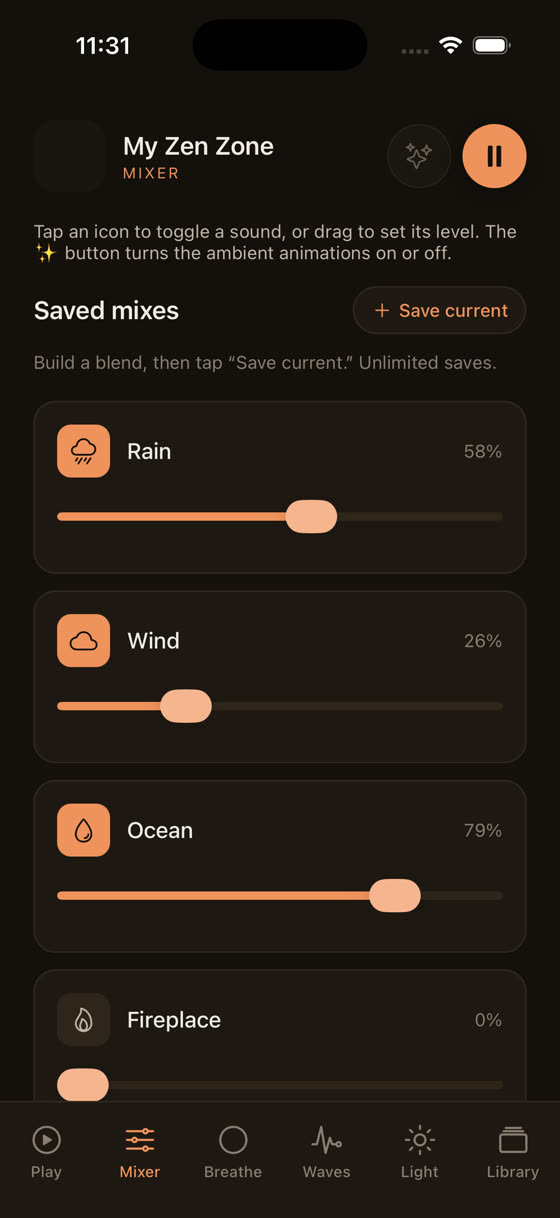
The same principle shows up in guided sessions. Most apps stop the music and play a voice instead. Here, voice, music, and nature sound are three separate layers you control yourself, so a guided breathing session plays over the music rather than replacing it.
If you're not sure a full degree is worth it
A degree isn't the only route in. Plenty of working composers are self-taught or came up through private lessons, grade exams, and home-studio production rather than a three-or-four-year course. If what you actually want is to write music — for yourself, for media, for an app, for anything — you can get a long way with private composition lessons, online theory courses, and simply writing a lot of music and getting it critiqued by people better than you. A degree compresses that process and gives you a structured, graded version of it, with ensembles and deadlines you wouldn't otherwise have. It's a genuinely good option for a lot of people. It's just not the only one.
If composing or arranging is the part that interests you specifically — rather than performing — it's worth testing that before committing three or four years to it. Try writing sixteen bars for two instruments. Try scoring a two-minute piece of calm, slow music and see if you still want to do it after the tenth revision. That's closer to the daily reality than any open day will tell you.
Common questions
Is a music degree worth it if I just want to write music, not perform?
It can be, especially if you pick a course weighted toward composition or production rather than performance. You'll get structured feedback and deadlines you wouldn't set yourself. But plenty of working composers skip the degree entirely and build skills through private lessons, online theory courses, and writing a large volume of music that gets critiqued directly.
Do I need to already play an instrument well to study music at university?
For most performance-focused courses, yes — auditions typically expect several years of grade exams on your main instrument. Composition, musicology, or production-leaning courses are usually more flexible, sometimes accepting students with weaker performance skills but strong theory, technology, or writing ability instead.
What's the difference between a conservatoire and a university music degree?
A conservatoire centres almost entirely on performance and professional practice, often with intensive one-to-one teaching. A university music department treats music more as an academic humanities subject, with more musicology, essays, and historical study alongside performance and composition modules.
Can music theory from a degree actually help with relaxation or focus music?
Yes, in a practical way. Understanding tempo, harmony, and voicing lets a composer deliberately build music around a slower pulse, fewer dissonances, and simpler textures, which is the technical basis behind most music written for sleep or focus rather than performance or emotional intensity.