Yes, the right music can measurably improve how quickly you fall asleep and how restful that sleep feels, though not for the reasons most playlists assume. It works by nudging your autonomic nervous system toward rest before you're consciously relaxed at all, through tempo, predictability and the absence of lyrics rather than through genre or mood alone.
The mistake most people make is treating "sleep music" as a vibe rather than a specification. A gentle acoustic album, a lo-fi playlist, a film score you love at 9pm on a Sunday drive - none of these were built for the specific job of lowering arousal in a dark room at 11pm, and some of them work against it without you noticing.
How music changes your body before you're even relaxed
There's a real mechanism here, and it's physical before it's psychological. Slow, steady music can encourage your breathing and heart rate to drift toward its pace, a loose form of entrainment rather than a precise lock-step sync. Tracks built around 60-70 bpm, roughly a resting heart rate, give your body something unhurried to settle alongside. Compare that to most commercial music, which sits at 100-130 bpm even in its "chill" versions, and the difference in effect on your nervous system is not subtle.
Structure matters as much as speed. Sleep music generally avoids crescendos, drum hits, or sudden shifts in volume, because each of those is a small alert signal to a brain that's trying to power down. The instruments do a lot of the work too: soft piano with a long sustain pedal, warm synth pads, a cello held on a single note for eight bars, nothing with a sharp attack. And it's almost always instrumental, because lyrics get processed by the language centres of your brain whether you're paying attention or not, which keeps a thin layer of alertness running underneath.
What most "relaxing" playlists get wrong
Algorithmic sleep playlists are usually a grab-bag: a slow guitar instrumental next to a piano piece next to an ambient synth drone, each mastered at a different loudness, each ending abruptly before the next one starts. That mismatch is itself disruptive. Worse is the playlist that simply ends, dropping you from sound into total silence thirty minutes in, often exactly when you're in a lighter sleep stage and more easily disturbed by the change.
What actually helps is continuity: a track or combination of sounds that holds steady without hard edges, and ideally one you can layer rather than just press play on. This is the whole idea behind building your own mix instead of trusting someone else's.
Watch how a single piano piece changes completely once you bring in rain at a low level and drop a faint drone underneath it, each on its own slider rather than baked into one fixed recording. That's the difference between a track that was mixed for a general audience and one built for your room, tonight, at the volume your house actually needs.
Repetition beats novelty after dark
Here's something most sleep advice skips: your brain learns to associate a specific sound with sleep onset, the same way a white noise machine works for a baby after a few nights of consistent use. That conditioning takes repetition, not variety. Browsing a huge library at 11pm looking for the "right" track is itself a wakeful, decision-making activity, which is the opposite of what you want.
Our library grows by dozens of new tracks every fortnight, and that's genuinely useful - but mostly for daytime listening, where fresh material keeps focus work from going stale (the same logic covered in music for focus and study). At night, pick one or two tracks, or one fixed mix of track plus nature sound, and stay with it for a week or two before you decide whether to change anything. Consistency is doing more of the work than you'd think.
Why silence isn't actually the neutral option
People assume silence is the gold standard and background sound is a compromise. In practice, most bedrooms aren't silent at all: a radiator ticks, a car passes, a partner shifts in bed, a pipe knocks. Against true silence, each of these is a sharp, unpredictable event that can pull you out of light sleep. A steady, unchanging layer of sound underneath masks those spikes so they don't register as a disturbance.
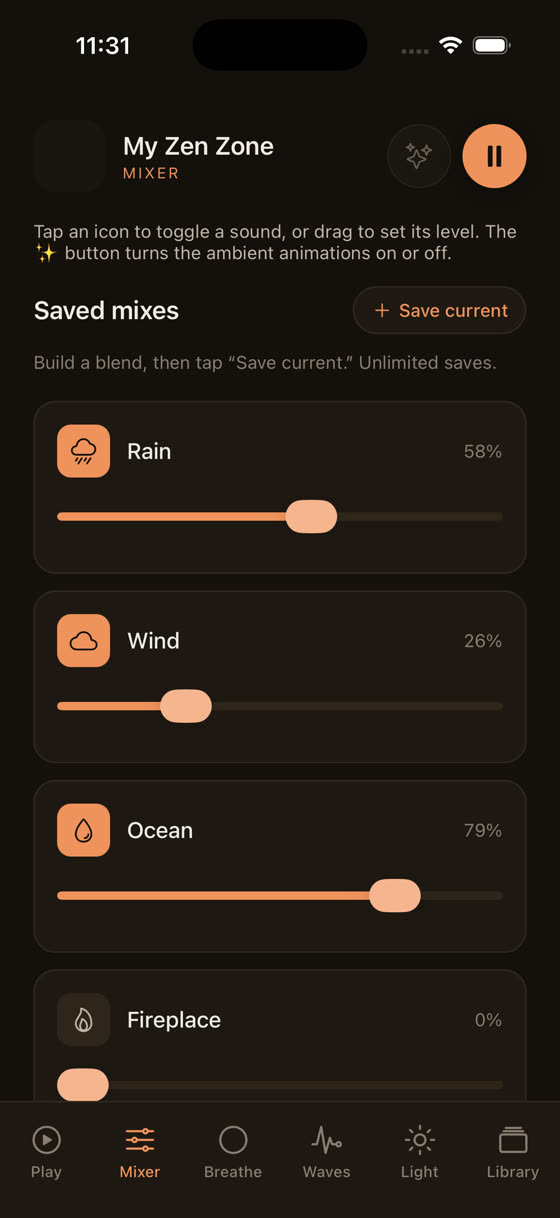
This is why the mixer sets three nature sounds at three different levels rather than offering one fixed "rain sound" file. A little rain, a touch of low wind, and the faintest hum underneath mask inconsistent household noise far better than any one of them alone, and you can hear the difference the moment you nudge a level up or down.
Where the evidence is solid, and where it has limits
It's worth being straightforward about this: the research on music and sleep is real but modest. Most studies are small, rely on people's own reports of how rested they felt, and show a consistent but moderate improvement rather than a dramatic one. That's a reasonable basis for trying it, not a guarantee.
Music also isn't a treatment for diagnosed insomnia, sleep apnoea, or an anxiety disorder keeping you awake. If falling or staying asleep has been a genuine struggle for weeks, that's a conversation for a doctor, not a playlist. What music can do, reliably, is lower the everyday friction of winding down on an ordinary night, the kind where your mind is just busier than you'd like it to be at 11pm.
Building the routine, not just picking a track
The track matters less than people think if the routine around it is weak. Start your music 30 to 45 minutes before you actually intend to be asleep, not the second you lie down, so your body has time to follow it down rather than being asked to drop off instantly. Set a sleep timer rather than letting anything loop all night; your phone screen staying lit, or the device warming up under a pillow, undoes a lot of the good the music is doing. Download tracks for offline playback so the phone can go into airplane mode or do-not-disturb and stop lighting up with notifications at 1am.
Dimming the room matters more than people give it credit for, and it works as a cue, not just a comfort - a gradually darkening screen tells your nervous system the day is ending in a way that's hard to argue with consciously. That's what the light screen is built around: something to look at for two or three minutes while the room, and you, settle before the music takes over properly.
What to actually try tonight
Pick something slow and instrumental, somewhere around 60-70 bpm, built on piano or a soft pad rather than anything with a beat. Layer a low level of rain or a distant drone underneath it using the mixer rather than relying on one fixed recording. Set a 45-minute sleep timer rather than an all-night loop. Dim the room. Then repeat exactly that combination for at least five or six nights before deciding whether it's working, because a single night tells you very little.
If you want somewhere to start rather than building from scratch, there's a curated list at best music for sleep worth working through. And if this is the first time you're hearing about any of this, it costs nothing to try a session tonight through the app or at myzenzone.app and see what a properly built wind-down actually feels like compared to whatever's currently in your playlist.
Common questions
What's the best genre of music for sleep?
Genre matters less than tempo and structure. Classical, ambient, lo-fi and film score pieces can all work if they sit around 60-70 bpm, avoid lyrics, and stay free of sudden volume changes or crescendos. A slow piano piece and a quiet ambient drone can do the same job despite sounding completely different.
Should sleep music play all night or just while falling asleep?
Use a sleep timer rather than letting it run all night. Thirty to forty-five minutes is usually enough to get you from awake to asleep. Music playing continuously for eight hours can interfere with the lighter sleep stages later in the night, and a phone left playing also tends to light up with notifications.
Is white noise better than music for sleep?
Neither is strictly better; they solve slightly different problems. White or brown noise is excellent at masking sudden household sounds. Music adds the entrainment effect of a slow, steady tempo. Combining a low layer of nature sound under a slow track, which you can do with a mixer, often works better than either alone.
Can music actually treat insomnia?
No. Music can reduce the everyday friction of winding down on an ordinary night, but it isn't a treatment for diagnosed insomnia, sleep apnoea, or anxiety-driven sleeplessness. If trouble sleeping has lasted more than a few weeks, that's worth raising with a doctor rather than solving with a playlist.
Does it matter if I use headphones or a speaker?
A speaker at low volume is usually safer and more comfortable for most sleepers, especially side sleepers who find headphones uncomfortable overnight. If you do use headphones, flat sleep-designed ones reduce pressure on the ear. Either way, keep the volume low enough that it sits in the background rather than demanding attention.