The short answer
There is no single Spotify playlist that will reliably help you study, and if you have already tried a dozen of them you have probably noticed why. The best study music is instrumental, sits around 60-70 bpm, avoids sudden dynamic shifts, and keeps playing without ads, skips, or an algorithm dragging you toward whatever is trending. Spotify's playlists get some of that right some of the time. They rarely get all of it right for the length of an actual study session, because that was never really the job they were built to do.
Why Spotify playlists work against you
Playlists like "Deep Focus" or "Lo-Fi Beats" are curated for streaming numbers, not attention span. That shapes them in ways you feel but might not name. On the free tier, an ad every fifteen or twenty minutes breaks concentration exactly when you were settling in. Even on premium, autoplay kicks in once the playlist ends and starts pulling in "related" tracks that drift toward vocals, key changes, or a different tempo entirely, because the algorithm is optimising for continued listening, not continued studying.
Crowdsourced curation adds a second problem. A track earns its place on a study playlist by being popular, not by being functional. That means you get vinyl crackle for atmosphere, jazzy chord changes for interest, the odd vocal sample dropped in for texture. All of it is pleasant. None of it is neutral. And mastering is inconsistent from track to track, so the volume jumps a little every few minutes, which is a small thing that adds up to a lot of low-grade distraction over a three-hour library session.
What actually makes music good for studying
The mechanism is fairly simple, even if the research behind it is thinner than most blog posts admit. Music around a resting heart rate, roughly 60 to 70 beats per minute, does not compete with your own internal pacing the way a 128 bpm track does. Lyrics are the bigger issue: reading and writing both use the brain's language processing, and a vocal track asks that same system to do two jobs at once. Instrumental music sidesteps the conflict entirely, which is one reason wordless piano, ambient pads, and drone-based textures show up again and again in anything designed for concentration rather than mood.
Repetition matters too, and it is usually treated as a flaw rather than a feature. A pop song builds tension and releases it, verse to chorus, because that arc is what keeps a casual listener engaged. Study music should do the opposite: no build, no drop, nothing that pulls your attention back to the speaker. The tracks that work best are often the ones that barely seem to be doing anything at all.
Where most study playlists go wrong
Genre chasing is the biggest mistake. "Lo-fi hip hop" and "coffee shop jazz" are aesthetics, not functions, and they carry a lot of surface noise that has nothing to do with focus: vocal chops, tape hiss, clattering percussion, the murmur of a fake café. It sounds studious. It is not the same thing as being quiet enough to think in. The second mistake is track length. Most streaming tracks are written to a three-and-a-half-minute pop structure, which means a ninety-minute study block forces you through twenty-five separate beginnings and endings, each one a tiny re-engagement with the music instead of a disappearance into the background.
Building your own layer instead of hoping a playlist works
The fix is not a better playlist. It is control over the layers, so the sound matches the moment rather than the other way round. This is the actual difference between a fixed stream and a proper focus tool: instead of accepting whatever a curator or algorithm hands you, you set an instrumental track underneath a low layer of rain or static, and adjust each one on its own slider until the balance disappears into the background rather than sitting on top of your attention.
That short clip shows what this looks like in practice: the music pulled down, a thin layer of rain brought up just enough to mask a noisy street outside, nothing competing for your ear. Most apps give you one fader, if that. Ours gives you one per sound, which sounds like a small detail until you have spent a week using it and gone back to a single-track stream and felt how much you were missing.
Matching the music to the actual task
Not all studying is the same, and treating it as one activity is another place playlists fall short. Deep reading or writing wants the plainest possible bed: a single sustained pad, or slow solo piano with a lot of space between phrases, nothing rhythmic enough to pull your foot along with it. Repetitive work like flashcards or problem sets can take a bit more structure, a gentle pulse under the surface, since the task itself is already providing some of the rhythm. Revision under a countdown, the night before an exam, is different again: a steady, slightly more present track paired with a timer can help mark out blocks of thirty or fifty minutes without you watching the clock every four.
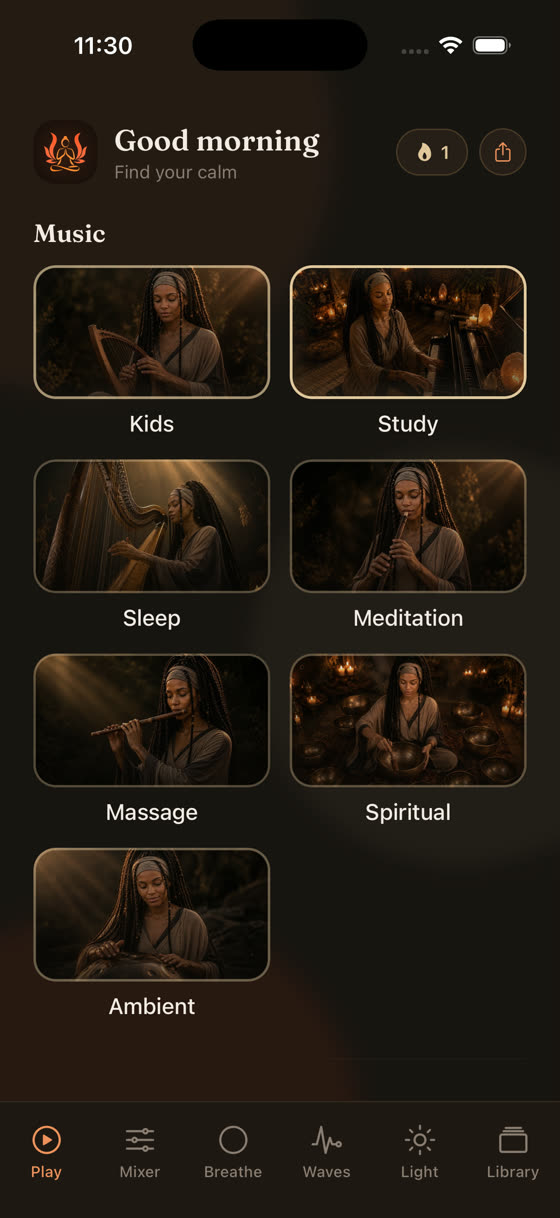
That's the home screen split into its own worlds rather than one long undifferentiated list. Focus, sleep, calm, and meditation each get separate libraries built for their own job, so you are choosing a track meant for concentration rather than fishing it out of a playlist that also contains something meant to wind you down for bed.
A practical setup for tonight
If you are studying tonight, this is the version worth trying instead of another search for "study playlist 2024": pick one instrumental track without vocals, set a session length with a timer rather than an open-ended stream, and if your environment is noisy, add one low layer of rain or static underneath rather than turning the music up to compete with it. Download the session offline if you are heading to a library with patchy signal, so you are not relying on a connection to hold the sound steady for the next two hours. None of this requires a subscription to figure out, but having the tools built in rather than improvised from three different apps is the actual time saved.
When Spotify is genuinely fine
To be fair to it: if the music is just background hum while you tidy notes or do something low-stakes, none of this matters much and a decent playlist will do the job. The distinction worth drawing is between background noise and a study aid. The moment you are trying to hold a difficult idea in your head for twenty minutes straight, the small frictions, an ad, a vocal track sliding in, a sudden volume jump, stop being minor and start costing you the thread you were following. For more on the tempo and structure side of this, our piece on music for focus and study goes into the specifics track by track, and if you're building an evening routine around the same principles, best music for sleep covers the overlap between the two. The library itself, built by one composer and added to every two weeks so it never turns into the same six tracks on repeat, is at myzenzone.app, and you can see the full mixer and focus library for yourself at /get.
Common questions
Is lo-fi hip hop actually good for studying?
It can work as background noise, but the vocal chops, tape hiss, and loose swing rhythm add texture that competes for attention more than plain instrumental music does. If you're doing light admin it's probably fine. For deep reading or writing, a plainer, steadier track will usually cause less friction.
Does music with no words really help more than music with lyrics?
For most people doing verbal tasks like reading or writing, yes, because lyrics use the same language-processing system you're trying to use for the work. The effect is smaller for repetitive tasks like data entry. It's not a guarantee, just a pattern worth testing on yourself over a few sessions.
What tempo should study music actually be?
Somewhere around 60-70 beats per minute tends to sit closest to a resting heart rate, which is why it shows up so often in music built for concentration rather than energy. Faster tracks aren't wrong, they just tend to suit lighter, more repetitive tasks rather than sustained deep focus.
Should I use the same study track every time or keep it varied?
Both approaches work for different people. Repetition can help because the track stops registering as new information once it's familiar. Others find the same track for weeks starts to feel like a cue for boredom rather than focus, which is one reason a library that adds new material regularly is worth having on hand.