The short answer
Rain loops, brown noise, box fans, and those 10-hour ambient videos work for a lot of people, and there's no mystery why: steady, low-frequency sound masks the sharp noises that pull you out of light sleep — a door, a car, a partner turning over. But YouTube wasn't built to help you sleep. It was built to keep you watching, and that single fact causes more disrupted nights than most "best sleep sounds" lists ever mention. You can get the same masking effect without the platform working against you, and it's worth understanding why before you queue up another video tonight.
Why steady sound actually helps you fall asleep
The mechanism is simple: sound doesn't need to be pleasant, it needs to be predictable. Brown noise and rain both sit in a fairly narrow frequency band with no sudden peaks, so your brain stops flagging every little variation as something to check on. This is masking, not sedation — the sound isn't putting you to sleep, it's covering up the things that would otherwise wake you. The same logic applies to music. Anything built around a tempo close to a resting heart rate, roughly 60 to 70 beats per minute, with no dynamic swings or sudden instrument changes, tends to work the same way rain does. It's why a lot of the tracks made for sleep are deliberately uneventful. That's not a lack of imagination, it's the point.
Where YouTube quietly gets in the way
Here's what the "top 10 sleep sounds" videos rarely say out loud. First, ads. Even with a subscription, a pre-roll or mid-roll ad at 1am is a genuinely bad experience — bright, loud, and exactly the kind of unpredictable spike that undoes twenty minutes of settling down. Second, autoplay. Fall asleep during a rain video and YouTube's algorithm will happily hand the next hour to whatever it thinks keeps you watching, which is sometimes another ambient track and sometimes a jump-scare compilation because you didn't touch the phone to stop it. Third, the screen itself stays lit, sometimes for hours, next to your head. Fourth, there's no proper offline mode built for this — streaming a video all night on data or patchy hotel wifi is a real, common complaint. None of these are edge cases. They're the normal experience of using a video platform for something it wasn't designed for.
What most sleep sound lists get wrong
Most of these lists treat sound as one choice: rain, or ocean, or brown noise, or lo-fi piano. In practice, one sound rarely does the whole job. Rain alone can feel thin. Ocean alone can feel too rhythmic if the waves are looping obviously, which most 10-hour loops do every few minutes once you notice the seam. What actually settles a room is layering — a little rain, a little low drone, maybe a distant fan hum, each at its own quiet level, so no single element is doing all the work and none of them draws attention to itself.
This is the one thing a YouTube video genuinely can't do: you get whatever mix the creator baked into that file, at whatever balance they chose, and that's it.
In My Zen Zone the mixer lets you bring in three or four sounds and set each one's level yourself, live, until the combination disappears into the background rather than sitting on top of it. It sounds like a small difference. At 2am, it isn't.
The light problem nobody mentions
Even a black screen with a still image is still a screen, and it's still emitting light a few inches from your face. If you're winding down rather than already asleep, that matters more than the sound choice does. A short, dim visual that actually supports the wind-down — rather than a frozen thumbnail of a lake — does more for the ten minutes before sleep than people give it credit for.
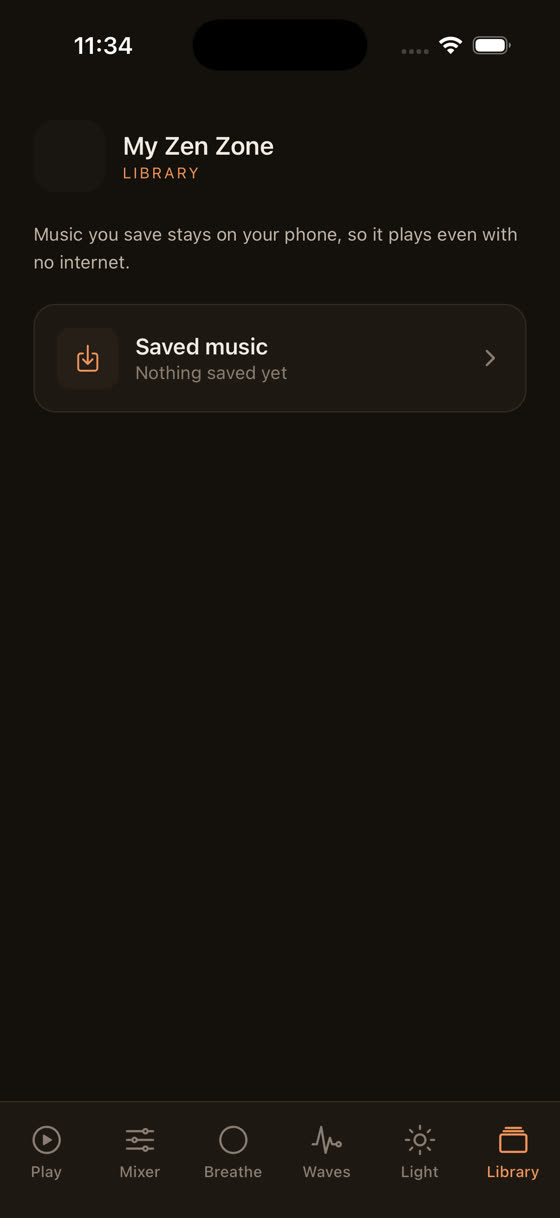
The light screen in the app is built for exactly that window: slow, low, warm, designed to be looked at for a minute or two while your breathing slows, not to be a video you're half-watching. It's a small piece of the picture, but it's one YouTube has no answer for, since every video defaults to visual content designed to hold attention, not release it.
Building your own mix instead of hunting for the right video
The better approach, if you're going to spend ten minutes tonight choosing sleep sound, isn't to search for the "best" single video. It's to build a mix you control.
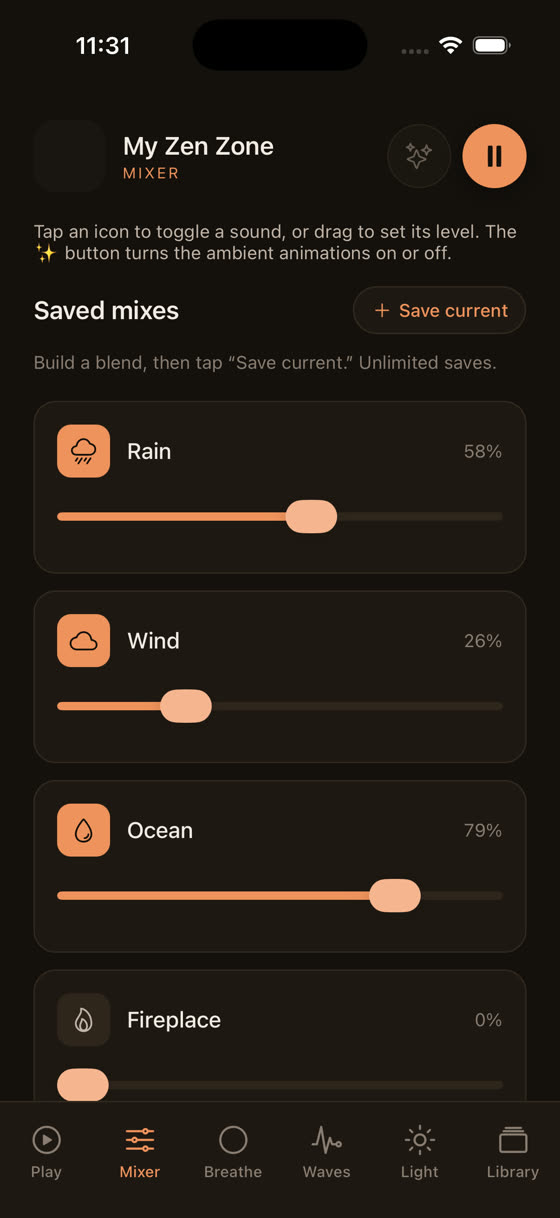
Picture three nature sounds — rain, a low wind, a soft brown noise bed — each at a different level, sitting under a slow piece of music at 60 bpm rather than instead of it. That combination changes slightly every night depending on how alert you feel, which is something no fixed YouTube video, however well produced, can do. If you're curious about the music side of this specifically, we've gone deeper into tempo, instrumentation and what to avoid in our piece on the best music for sleep.
Timers, downloads, and not needing to babysit your phone
A video playing all night is either looping forever, chewing through data, or cutting off mid-track when the app backgrounds. None of those are good. A proper sleep timer that fades out rather than stopping abruptly, and a library you can download once and never stream again, solves a problem that YouTube sleep videos create by default. It also means no wifi anxiety on a plane, in a hotel with bad signal, or camping somewhere with no bars at all — the sound is already on the phone.
What to try tonight instead
You don't need to abandon the idea that got you searching in the first place — rain, brown noise, slow music all still work, that part of the advice is sound. What's worth changing is where you get it from. Try building a two- or three-layer mix instead of picking one fixed video, keep the screen dark or on the light screen rather than a bright thumbnail, and set a timer that fades rather than cuts. If focus during the day is also a struggle, the same layering logic shows up there too, and it's worth reading how it applies to focus and study. The whole library, sleep included, is available through the app, with new tracks added every fortnight, or explore it first at myzenzone.app.
A quick honesty check
None of this is backed by strong clinical research specific to ambient sound and sleep onset — the evidence base is thin and mostly self-reported, so treat any claim of guaranteed results, including ours, with a healthy amount of scepticism. What's reasonably well established is the general idea of masking: steady, unremarkable sound can reduce how often small noises wake you. Beyond that, it's genuinely about what settles your particular nervous system, and that takes a few nights of actually testing a mix, not just reading about one.
Common questions
Is brown noise better than rain sounds for sleep?
Neither is objectively better; it's about which frequency range your ear finds least intrusive. Brown noise sits lower and can feel more like a constant hum, while rain has more texture and variation. Try both at a low, layered level rather than full volume, and notice which one you stop consciously hearing faster.
Why does autoplay on YouTube sometimes wake me up at night?
YouTube's algorithm optimises for watch time, not sleep. Once your chosen video ends, it queues whatever it predicts will keep you engaged, which can be louder, brighter, or completely unrelated content. Without a proper sleep timer that fades and stops, there's nothing to prevent this from interrupting you mid-sleep-cycle.
Can I download sleep sounds to use without wifi?
Yes, that's one of the main gaps YouTube leaves. A dedicated app with offline downloads lets you save a mix once and play it anywhere, no data or signal needed, which matters for flights, hotels, or anywhere with unreliable connectivity.
How loud should sleep sounds actually be?
Quiet enough that you'd struggle to describe the sound if asked five minutes later. If you can clearly pick out individual details like raindrops or a wave breaking, it's probably too loud. The goal is a steady bed of sound sitting just under conscious attention, not something you're actively listening to.