The best music for focus is instrumental, sits around 60-90 beats per minute, and stays predictable enough that your brain stops listening to it within a few minutes. That's the whole answer. The interesting part is why, and why so many "focus playlists" quietly fail at it.
Why lyrics are the real problem
Most advice about focus music talks about genre, as if lo-fi is inherently better than ambient or classical. The genre matters less than one specific thing: words. Your brain's language centres can't fully ignore spoken or sung words, even in a language you don't speak well, because the auditory system is wired to check incoming speech for meaning. That's a tiny but constant tax on attention. It's why an email notification sound is more distracting than a quiet hum, and why a song with lyrics pulls at a part of your mind that a cello line doesn't. If you're writing, coding, or doing anything that involves forming sentences in your head, lyrics compete directly with that work. Instrumental music doesn't ask anything of the part of your brain doing the thinking.
The tempo question, and why 60-90bpm isn't a myth
Resting heart rate for most adults sits somewhere between 60 and 100 beats per minute. Music in that range doesn't force your body to speed up or slow down to match it, so it tends to fade into the background rather than becoming something you track. Faster tempos, above about 110bpm, start to feel urgent, which is useful for a workout and unhelpful for proofreading a report. Much slower than 60bpm and music starts to feel like it's dragging, which works for winding down at night but not for staying alert at 3pm. This isn't a strict law, more a starting point: a lot of what we compose for the Focus category in the app sits deliberately in that middle band, with enough movement to keep the brain mildly engaged without ever demanding attention.
What most focus-music advice gets wrong
The common mistake is treating a "focus playlist" as just a list of songs that sound calm. Streaming playlists built from different artists, different productions, different mastering levels, mean the volume and tone shift every three or four minutes. Every shift is a tiny interruption, a reason for your ear to check in. A loud drop after a quiet verse, a sudden change in instrumentation, a track that fades out and leaves two seconds of silence before the next one starts — these are all small resets of attention you don't notice consciously but that add up over a two-hour work block. The second mistake is novelty. New, interesting music is good for a run or a party and bad for deep work, because interesting is the opposite of what you want from background sound. You want familiar, or at least consistent, so your brain can file it as unimportant.
Different work needs different sound
Not all focus is the same kind of focus, and it's worth being specific about this instead of reaching for one generic playlist. Deep, single-task work — writing, analysis, anything where you're holding a thread of logic — tends to do best with the simplest arrangements: a single sustained pad, soft piano, minimal percussion if any. Admin work, answering emails, sorting spreadsheets, tolerates more texture and can even benefit from a slightly busier track, since the task itself doesn't require much working memory. Creative work is the odd one out: some people focus better with near-silence or just room tone, others want something with a bit of rhythmic pull to keep momentum going. There's no single study that settles this cleanly, so the honest answer is to notice what you reach for without thinking, on the days you actually get through your list, and build from there.
Why background texture matters as much as the music
A detail that gets left out of most advice: the music itself is only half the environment. Office noise, a ticking clock, traffic outside, all compete with whatever you're listening to. This is where layering helps more than picking a louder track. Instead of music at full volume trying to mask everything else, you can run a quiet instrumental track underneath a steady layer of rain or distant static, each at a level that covers the specific noise you're dealing with rather than drowning it out entirely.
That's the thinking behind the mixer in My Zen Zone: three nature sounds and a music track, each with its own level, so you're not stuck with someone else's balance. A office with footsteps and chatter needs a different mix than a flat with a humming fridge. Get the balance right once and you stop noticing any of it, which is the actual goal.
Building a routine instead of a playlist
The people who get the most out of focus music aren't the ones with the best playlist, they're the ones who use the same one at the same time most days, until the music itself becomes a cue to start working. This is closer to how a kettle boiling or a specific chair signals the start of a task than it is to entertainment. Consistency does more here than quality. If you switch genres daily chasing something new, you lose that cueing effect entirely.
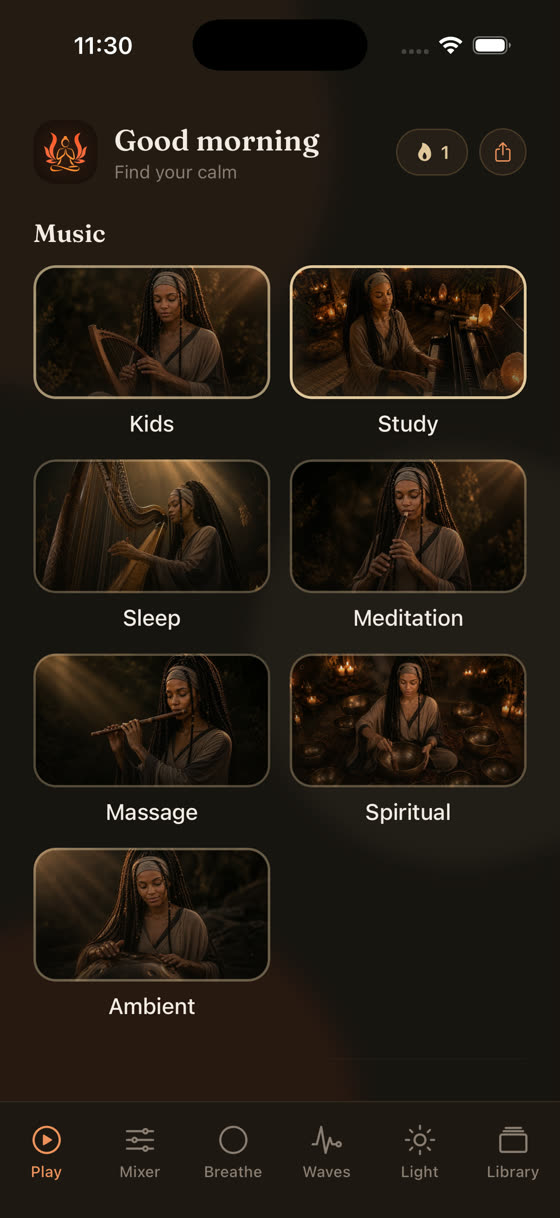
Having focus as its own space, separate from sleep or calm music, helps with this. You're not scrolling past a sleep playlist to find something to work to. Offline downloads matter here too, for anyone working somewhere with patchy wifi or who doesn't want a dead zone mid-deadline to break the whole session. A fortnightly drop of new tracks also means the library doesn't go stale the way a fixed set of twenty songs does after the fortieth listen, though for the cueing effect to work you still want to settle into one or two tracks for a stretch of weeks rather than chasing every new release the day it lands.
What to actually do differently
Stop building playlists from mixed sources and pick one instrumental track or album you can return to for at least two weeks before judging it. Keep the tempo in that 60-90bpm range for anything requiring sustained thought, and save faster or more textured music for repetitive admin tasks. Use a mixer rather than a single volume slider if your space has background noise you can't control, layering something steady underneath the music instead of just turning everything up. And treat the sleep timer or session length as part of the tool, not an afterthought — a 50-minute block matched to a work sprint does more for follow-through than an open-ended playlist that runs out halfway through and leaves you in silence, reaching for your phone.
If you want the same logic applied to winding down instead of winding up, the ideas overlap more than you'd expect — see our piece on music for sleep for how tempo and predictability work in the opposite direction. And if study sessions are the specific problem, this one on focus and study goes further into exam and revision blocks specifically. You can hear the difference between a mixed playlist and a purpose-built focus track for yourself at myzenzone.app, or just get the app and try the mixer on whatever's making noise around you right now.
Common questions
Does focus music actually work or is it placebo?
The honest answer is the research is thin and mostly small-scale, so be wary of strong claims. What's reasonably well supported is that lyrics compete with language-based tasks, and that sudden volume or tone changes interrupt attention. Beyond that, a lot comes down to personal habit and what you've trained yourself to associate with working.
Is white noise better than music for focus?
For some people, yes, particularly in loud or unpredictable environments where any melody becomes another thing to notice. Others find pure noise grating over long stretches. A middle option is a quiet instrumental track layered with a steady nature sound, which covers background noise without the flatness of white noise alone.
Should I use the same focus music every day?
Largely, yes. The value of focus music comes partly from it fading into the background, which happens faster with familiar material. Rotating wildly between genres keeps your brain evaluating the music instead of ignoring it. Settle on one or two tracks for a few weeks before switching, rather than picking something new each session.
What tempo is best for studying versus deep work writing?
Both tend to do well in the 60-90bpm range, but writing and analysis usually want simpler arrangements with less rhythmic movement, since you're holding a logical thread. Studying that involves memorisation or repetition can tolerate slightly busier textures, since the task itself occupies less working memory.