The short answer: music with a steady tempo around 60-70 beats per minute, minimal melody, no lyrics, and no sudden dynamic shifts. That range sits close to a resting heart rate, and music without words leaves your brain nothing to parse, which is exactly what an anxious mind needs less of. Pair it with low-register instruments (piano, cello, soft pads) rather than bright, high ones, and you have the basic recipe. Everything else in this post is detail and exceptions.
Why Tempo Matters More Than Genre
People ask for "calming genres" as if ambient or lo-fi or piano music is automatically soothing. It isn't. A lo-fi track at 90 bpm with a chopped vocal sample can be more agitating than a string arrangement at 65 bpm, because your nervous system responds to rhythm and predictability before it responds to style. There's a rough principle called entrainment: your heart rate and breathing tend to drift toward the tempo of what you're hearing. It's not exact or guaranteed, and the research behind it is more suggestive than settled, but composers have used it for decades because it works often enough to matter. Write at 60-70 bpm, keep the pulse steady, and the body tends to follow.
This is also why a workout playlist at 140 bpm, even an instrumental one, is the wrong choice before bed. Tempo is the first filter. Everything else is refinement.
The Mistake Most "Calm" Playlists Make
Streaming playlists labelled "anxiety relief" or "deep sleep" are usually just a pile of unrelated tracks from different artists, stitched together by an algorithm that only knows the tags. One track fades out, the next comes in a different key, a different tempo, sometimes with a vocal where the last one had none. Your brain notices the seam even if you're half asleep. That small jolt of novelty is enough to pull you back toward alertness, which defeats the purpose.
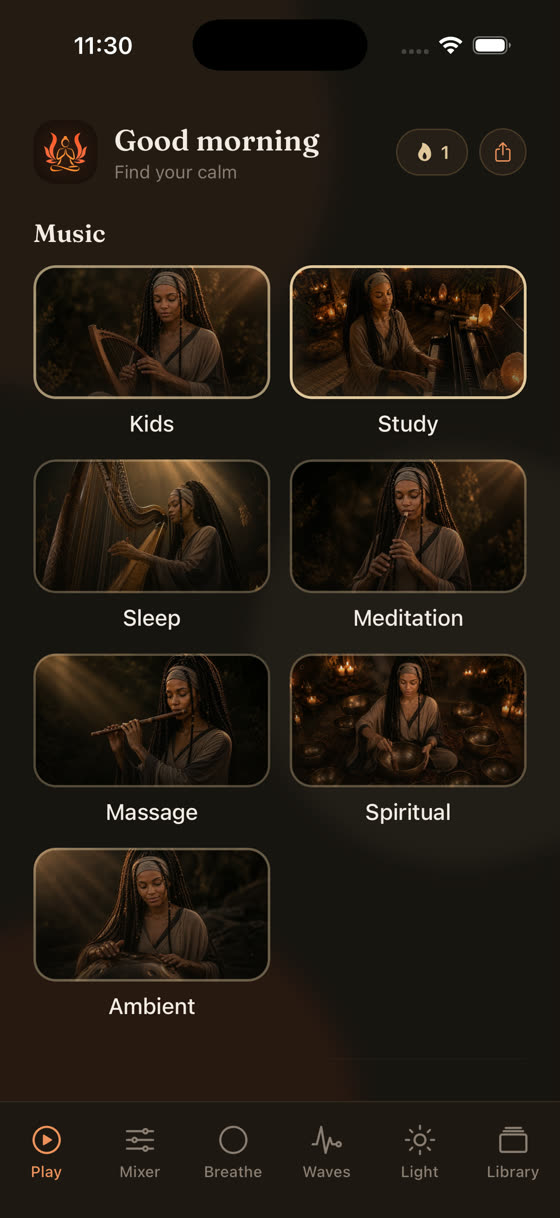
The fix isn't finding a better playlist. It's finding music built as a continuous world rather than a collection of singles. That's the whole premise behind how we structure the library at My Zen Zone: every track in the Sleep or Calm sections is written by the same person, in the same sonic palette, specifically so nothing jars you awake at 2am.
Anxiety and Sleep Are Related, Not Identical
It's worth separating the two, because the music that helps most isn't always the same. Anxiety during the day often needs something active: a few minutes of music with a clear breathing cue, something that gives your attention a job so it stops circling. Anxiety at night, the kind that shows up as racing thoughts the moment your head hits the pillow, needs something closer to nothing at all. Long tones, very little movement, almost no melodic information to hold onto.
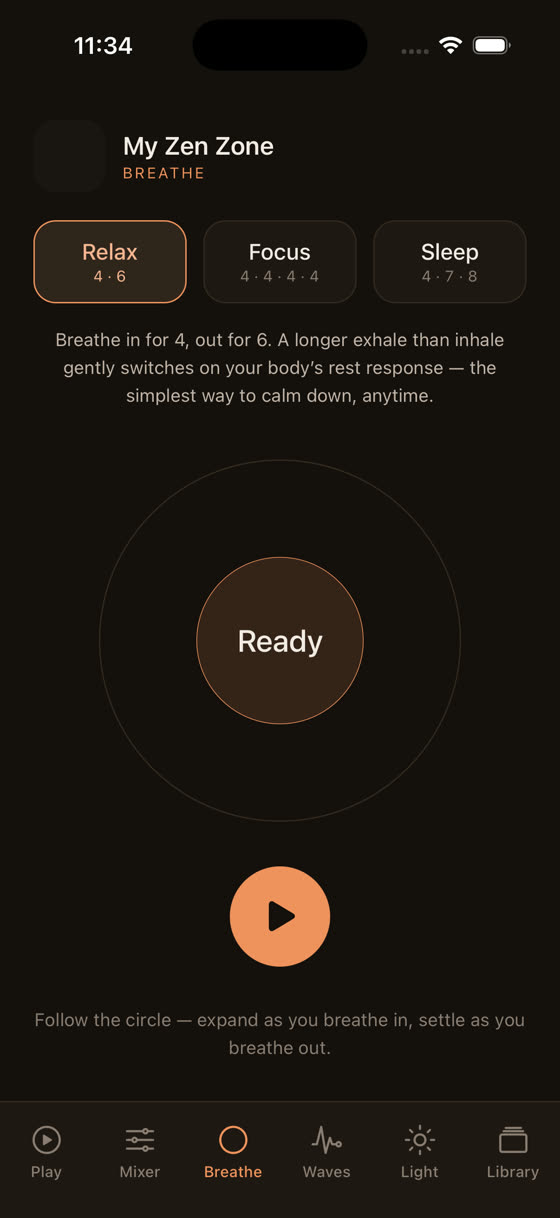
If you're dealing with daytime anxiety, pairing music with a paced breathing pattern tends to help faster than music alone. We built a breathing screen for exactly this, with a 4-6 pattern (four counts in, six counts out) that runs under a track and gives your exhale somewhere to go.
At night the approach flips. You don't want a breathing exercise keeping you engaged, you want the opposite: material forgettable enough that your attention has nothing to hold onto and slides off into sleep. That's a different writing job entirely, and it's why we keep sleep tracks and focus or calm tracks in separate sections rather than one blended "relaxing music" pile.
Instruments and Textures Worth Knowing
Some textures do more work than others. Low piano, played sparsely, with long pedal and no fast runs, is one of the most reliable. Felt or una corda piano (the soft pedal muting the hammers) is even gentler, because it removes the brightness that a regular piano strike has. Cello and double bass sustained notes work well under piano for the same reason strings have always been used in film to signal "something slow is happening." Synth pads, the kind with a slow attack so the note fades in rather than hitting, are useful because there's no transient to startle the ear.
What to avoid: anything with a clear backbeat, even a quiet one. Anything in a major key with a strong melodic hook, because hooks are designed to be remembered, and memorable is the opposite of what you want at midnight. And layered white noise or rain sound dumped in at full volume over the music, which masks detail rather than supporting it.
Layering Your Own Mix Instead of Picking One Track
The single most useful tool for anxiety and sleep isn't a specific track, it's control over the layers. A steady low piano piece at a low volume, with a thin layer of rain and an even thinner layer of distant thunder underneath, tends to outperform any one of those three sounds on its own, because the ear has texture to settle into without any one element being loud enough to catch attention. This is the actual argument for a mixer instead of a playlist.
In the app this is literal: every sleep and calm track sits alongside three nature sound sliders, so you can bring rain up and the music down, or mute the music entirely and keep just a thread of white noise if that's what your ear wants tonight. Nobody has the same tolerance for density, and a fixed stereo mix assumes everyone does.
What Most Advice Gets Wrong
A lot of anxiety-and-sleep content recommends binaural beats or brainwave tones as if they're a settled solution. The honest position is that the evidence for specific frequencies producing specific states is weak and mixed, not proven. Some people find low-frequency tones genuinely settling, in the same way some people find a fan noise settling: as texture, not as a precise neurological lever. We include brainwave tones in the app for exactly that reason, as one more texture to try, not as a guaranteed mechanism.
The other common error is volume. Calming music played too loud is still stimulating, full stop. Most people need it quieter than feels natural at first, closer to the volume of a conversation in another room than anything you'd call "listening" to.
What To Actually Do Tonight
Pick one track from a sleep-specific collection, not a general relaxation playlist. Set it quiet enough that you could fall asleep and miss the ending. Add one nature layer at low volume if you find total silence of the music itself too exposed, which many anxious sleepers do. Use a sleep timer so the audio doesn't run all night and disturb a lighter sleep phase later on, something worth doing regardless of which app you use. If you're downloading tracks for offline listening, so your phone isn't pulling data or lighting up with notifications at 3am, that matters more than people think.
If anxiety shows up before you're even in bed, a short session with a breathing pattern first, then music after, tends to work better than music trying to do both jobs at once. The full library grows every two weeks, and the newest additions tend to be the first place we try different instrument combinations, so it's worth checking back rather than looping the same three tracks indefinitely.
A Note on Evidence
None of this is medical treatment and nobody composing this music is claiming it is. The research on music and anxiety is real but modest: studies tend to show small, short-term reductions in reported anxiety and heart rate during listening, not long-term cures. Sleep research on music is similarly modest, mostly showing people fall asleep somewhat faster with calm, low-tempo audio than with silence or stimulating audio, not that it fixes insomnia. Treat it as one tool among several, useful on its own merits, worth combining with the basics (consistent bedtime, less screen light, a cooler room) rather than instead of them. If anxiety is persistent or severe, that's a conversation for a GP, not a playlist.
If you want to try building your own mix rather than reading about it, the app is free to start with, and the sleep and calm sections are the obvious place to begin. For daytime anxiety that shows up as an inability to concentrate rather than racing thoughts at night, our piece on music for focus covers the opposite end of the same problem.
Common questions
Is it better to listen with headphones or speakers for anxiety?
Speakers, generally, especially at night. Headphones can feel isolating and sometimes amplify awareness of your own breathing or heartbeat, which can backfire for anxious listeners. A small speaker at low volume across the room tends to feel more like ambient presence than something demanding attention.
Can music replace anxiety medication or therapy?
No, and nobody should treat it that way. Music can ease the moment-to-moment feeling of anxiety and support a wind-down routine, but it isn't a clinical treatment. If anxiety is frequent, severe, or affecting daily life, speak to a GP or therapist. Use music alongside proper support, not as a substitute for it.
How long should I listen before bed?
There's no fixed rule, but 20-40 minutes is a reasonable window for most people, with a sleep timer so playback stops rather than running all night. Some people sleep better falling asleep to silence after a short wind-down track; others want quiet audio through the whole night. Experiment and notice what your own sleep feels like after.
Why does the same calming track work some nights and not others?
Your nervous system's baseline arousal changes night to night, depending on caffeine, stress, screen exposure, and plenty you can't control. A track that felt settling on a calm Tuesday might feel too present on a wired Friday. That's the actual reason a mixer with adjustable layers helps more than a single fixed track, you can turn things down rather than switching tracks entirely.
Do nature sounds alone work as well as music?
For some people, yes, particularly rain or distant thunder, which have no melody to track. Others find pure nature sound too empty and drift toward intrusive thoughts without something to settle on. A thin layer of low piano under rain often suits anxious listeners better than either alone, since it gives the ear just enough to rest on.