The short answer
Search "meditation music no ads long" or "432hz meditation music 1 hour" and you'll find something usable within a minute. Tracks built around a single sustained drone, 60-70 bpm or no clear pulse at all, minimal melody, run 30 minutes to several hours. That's the format that works. But if you meditate more than a few times a week, YouTube itself becomes the problem, not the music on it.
I say this as someone who records meditation tracks for a living, not as someone selling against YouTube out of spite. It's a genuinely good discovery tool. It is a genuinely bad meditation tool, for reasons that have nothing to do with the quality of what's uploaded there.
Why the platform works against the practice
Three things happen on YouTube that undermine sitting still with your eyes closed. First, autoplay. The moment your chosen track ends, the algorithm picks the next one based on what keeps people watching, not what keeps people calm. You'll open your eyes twenty minutes later to a compilation of ocean sounds with a thumbnail of a beach at 4x brightness, or worse, an ad.
Second, ads themselves. A pre-roll or mid-roll spot with a jump cut and a raised volume level is a genuine physiological event. Your nervous system doesn't know the difference between a real interruption and a scheduled one. If you've spent ten minutes bringing your breathing rate down, a 15-second ad for car insurance undoes more of that than people give it credit for.
Third, the screen. Even with your eyes closed, a phone or tablet open to YouTube is a device waiting for a notification, and most people know that, which keeps a small part of attention on alert. None of this is a knock on the music itself. It's a mismatch between what meditation needs, which is an uninterrupted, undemanding sound environment, and what a video platform is built to do, which is hold your attention and monetise it.
What actually makes meditation music work
The mechanism is simpler than most people assume. Meditation music isn't there to be listened to, it's there to give the mind something soft to rest against so it has less reason to wander into planning or replaying the day. That means it needs a few specific qualities: no strong beat to follow, no melodic hook that resolves and demands attention when it doesn't resolve, and no sudden dynamic changes. A drone, a slow pad, a single instrument played without repetition, these work because there's nothing to track.
Tempo matters less here than in sleep or focus music, because most meditation tracks don't have a pulse at all. What matters more is harmonic stillness, chords that don't move much, or move so slowly the ear stops predicting where they're going. This is different from the mechanism behind, say, music built for sleep, which leans on a steady low tempo to slow breathing and heart rate over time. Meditation music is closer to silence with texture than it is to a song.
What most guides get wrong
Most "best meditation music" roundups just link ten YouTube videos sorted by view count, without saying why any of them work or what to actually do with them. A few specific errors show up constantly. One is recommending anything with lyrics, which almost always pulls attention toward language processing, the opposite of what you want. Another is recommending music with big dynamic swings, tracks that build to a swell and drop, because it sounds impressive in a video thumbnail but breaks the stillness partway through a sit. A third is ignoring length entirely, so people end up restarting a 10-minute video three times during a 25-minute session, which is its own small disruption.
Guided meditation adds another layer of the same problem
If you're using guided meditation rather than music alone, YouTube has a specific weakness: the voice and the music are baked together into one file. You can't turn the music down if the voice is too quiet, or the voice down if you just want the music. You get whatever ratio the uploader chose, and it's rarely right for your ears or your room.
This is worth watching happen rather than reading about: a guided session where the voice, the music, and a nature layer each have their own level, moved independently while it plays. Most apps, and every YouTube upload, stop the music when the guidance starts, or mix it so low it's an afterthought. Here the voice sits over the music as a genuine layer, which means a session at 2pm with the music higher and the voice lower can feel completely different from the same session at night with the voice up front and the music barely there.
Building a mix that actually holds attention
The other thing a single YouTube track can't do is combine sound sources the way your own attention actually shifts through a sit. Some people want rain and a drone. Some want a low hum and nothing else. Some want a single soft instrument with a touch of room tone underneath it so the silence doesn't feel too stark.
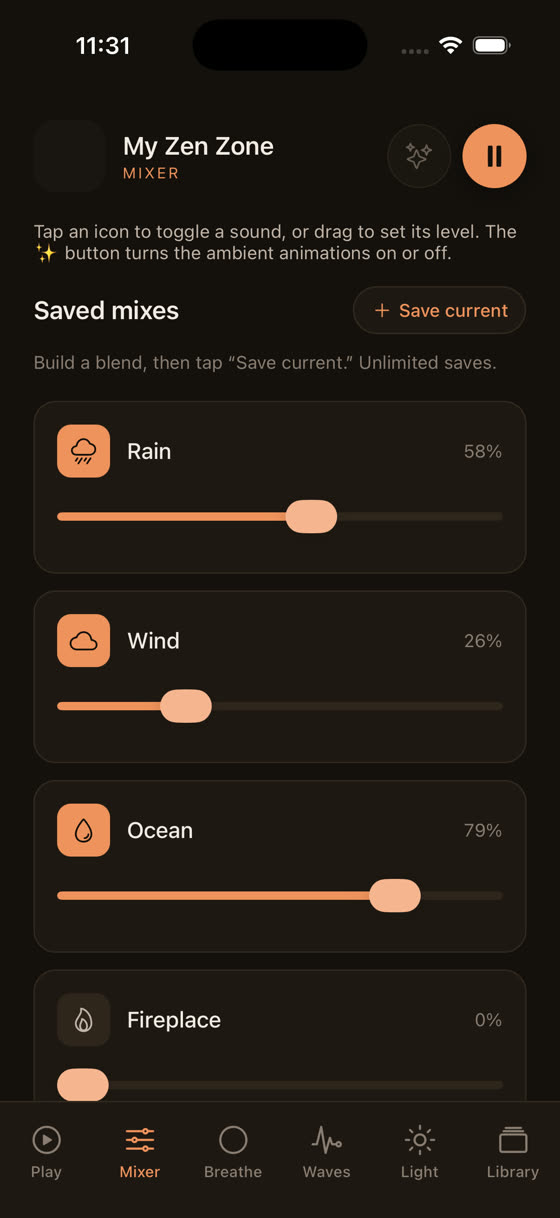
This is the mixer screen, three nature sounds each set at its own level rather than one fixed track. You can bring rain up and a drone down, or drop everything but a distant tone, and adjust it mid-session without leaving the screen or hunting for a different video. It's a small thing that changes a lot, because the right mix for a stressed Tuesday afternoon is rarely the right mix for a slow Sunday morning.
What we do differently, plainly stated
Every track in the library is composed and recorded by one musician working specifically for sleep, focus, meditation and calm, not licensed from a stock catalogue and not uploaded by whoever got there first. New material is added every two weeks, so the library keeps growing rather than sitting static once you've worked through it. There's no autoplay pulling you into unrelated content, no ads, and no algorithm deciding what plays next.
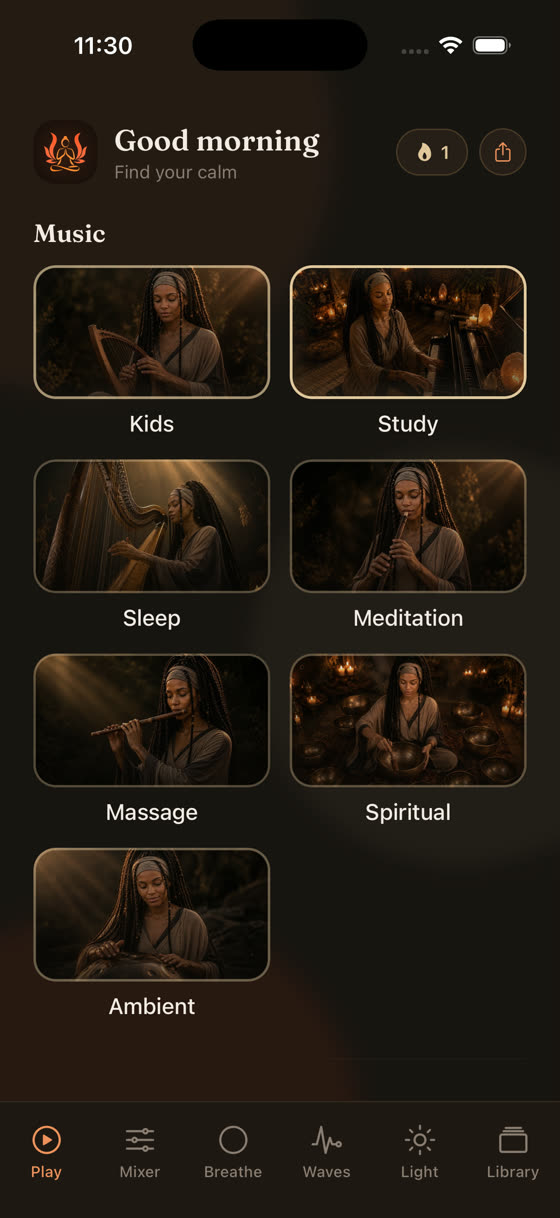
The home screen splits everything into its own world, meditation separate from sleep separate from focus, so you're not scrolling past a workout playlist to find a ten-minute sit. If you're using this for a wind-down before bed rather than mid-day meditation, the sleep music guide covers how tempo and repetition differ for that specific use. And if meditation is really about narrowing focus before deep work, the piece on focus and study music gets into tempo ranges that support concentration rather than stillness, which is a related but distinct goal.
What to actually do tonight
Pick one thing before you sit down, not during. Decide if you want silence-adjacent music, a guided voice, or a specific nature texture, rather than opening an app and browsing for five minutes, which is its own form of restlessness. Set a timer rather than trusting a video length to match your session, so you're not glancing at a progress bar near the end. If you're on a phone, put it in airplane mode or do-not-disturb before you start, regardless of what you're using to play the sound, because the interruption risk is about the device as much as the platform.
If you want to try this properly rather than read about it, the app is free to download on iPhone and Android, with a subscription unlocking the full library including on a browser at myzenzone.app. Offline downloads mean a session doesn't depend on a signal, which matters more than people expect once they're actually sitting still with their eyes closed and a train goes into a tunnel.
Common questions
Is meditation music actually backed by research?
There's reasonable evidence that slow, repetitive, low-complexity sound can support a calmer physiological state, largely through reduced demand on attention rather than any specific frequency doing something special. Claims about exact tunings or guaranteed effects go beyond what's actually been shown, so treat those claims cautiously and judge by how a track feels to you.
What's better for meditation, music or silence?
Neither is universally better. Silence suits people whose minds are already fairly quiet; low, textural music suits people whose minds need something soft to settle against so they're less likely to drift into planning or worry. Try both across a few sessions and notice which one leaves you calmer rather than assuming one is correct.
How long should meditation music sessions be?
Ten to twenty minutes covers most people's practical attention span for a seated session, though some prefer five-minute resets during a busy day. Match the music length to the session length using a timer rather than letting an unrelated video length dictate how long you sit, which avoids the awkward moment of a track ending mid-session.
Can I use the same music for meditation and sleep?
You can, but they're built for slightly different jobs. Meditation music tends to stay static, holding one texture throughout, while sleep music often shifts very gradually to support the transition into rest. Using meditation tracks at bedtime works fine; the reverse can feel too eventless for an active sit.