What Makes Meditation Music Actually Relaxing
The best meditation music for relaxation has three things most people never think to check: a steady tempo around 50-70 beats per minute, no lyrics, and no moments designed to grab your attention. That's it. Not pan flutes, not whale sounds, not a specific genre. A track can be piano, strings, or a single synth drone and still do the job, as long as it stops trying to go anywhere. Meditation music isn't supposed to tell a story. It's supposed to give your nervous system permission to stop listening for the next thing.
This matters more than people assume because most music, even music marketed as calming, is built on tension and release. A chord progression wants to resolve. A melody wants to climb somewhere and come back down. That's fine for a drive or a dinner party. It's the opposite of what you want when you're trying to sit still with your eyes closed.
The Mistake Most "Relaxing" Playlists Make
Open any generic relaxation playlist and you'll usually find the same problem: inconsistency. A soft piano piece is followed by an ambient pad, which is followed by a track with a swelling string section that peaks right around minute three, just as you were starting to settle. Nature-sound compilations have their own version of this, where a looped recording suddenly includes a bird call loud enough to make you open your eyes.
None of this is anyone's fault exactly. These playlists are usually assembled from stock libraries by people optimising for mood tags, not for what happens in your body over twenty minutes of listening. The result is music that sounds relaxing in a ten-second preview and works against you in practice, because your brain stays on alert for the next shift in dynamics.
This is the actual case for a purpose-built library over a scraped playlist. When every track in a category is composed with the same intent, by the same person, you don't get those jolts. We've written more about this specific failure mode over in our piece on music for sleep, where the stakes for a sudden swell are even higher.
Tempo, Breath, and Why Slower Isn't Always Better
There's a real mechanism behind tempo and relaxation, and it's worth understanding rather than just taking on faith. Music at 60 to 70 beats per minute sits close to a resting heart rate, and there's reasonable evidence that rhythm can nudge breathing and heart rate toward it, a loose version of entrainment. This is why so much meditation music hovers in that range rather than going dramatically slower.
Going slower isn't automatically better. Drop much below 50 bpm and a track can start to feel unmoored rather than calm, especially if there's no clear pulse at all. Total stillness in music can read as unsettling in the same way a silent room sometimes feels louder than a quiet one. The useful middle ground is a slow, steady pulse you're not consciously aware of, paired with harmony that doesn't resolve too neatly. That combination lets attention settle without giving it nothing to rest on.
Instruments and Textures That Hold Attention Without Demanding It
Certain instruments do this work more naturally than others. Sustained pads and drones are the backbone of most good meditation music because they have no attack and no clear ending, so there's nothing for the ear to track. Singing bowls and soft mallet percussion add texture without introducing melody you'd hum later. Piano works when it's played sparsely, with long gaps and soft dynamics, rather than as a continuous melodic line.
What tends not to work: anything with lyrics, even wordless vocals if they carry a strong melodic shape, and anything built around a hook, a chorus, a moment the composer clearly wants you to notice. Those are good qualities in almost every other kind of music. They're liabilities here, because they pull your attention outward right when the point is to let it rest.
Guided Meditation or Just Music? You Don't Have to Choose
A lot of people assume guided meditation and relaxing music are two separate categories, and in most apps they are, because the guided session simply replaces the music track while someone talks. That's a real limitation. The voice carries the session but the music underneath often gets thin, generic, or cut entirely, which leaves the whole thing feeling less immersive than either element on its own.
Our guided sessions work differently. The voice plays as its own layer over a full music track, and you control the level of each independently, so you can bring the voice forward while you're learning a technique and fade it back once you know the session well enough to drop into the music alone. It's a small structural difference that changes how a session actually feels to repeat.
Building Your Own Mix for the Moment
Not every situation calls for the same thing. Meditating at your desk during a stressful afternoon is a different problem from meditating before bed, and a fixed track rarely covers both well. This is where layering nature sounds under music earns its place, rather than being a gimmick.
Being able to set rain at a low level, a drone a bit higher, and a single soft bell occasionally in the background, each on its own slider, means you're not stuck with whatever ratio a sound designer picked for you. Turn the rain up on a day when traffic noise outside is a problem. Drop the bell entirely if you find it intrusive rather than grounding. The mixer is the single feature that separates a static playlist from something you can actually tune to your own nervous system.
When and How Long to Listen
Session length matters less than people assume, but timing does. Ten minutes of still, unchanging music before a stressful meeting does real work. The same music for three hours as background noise while you work is a different use case entirely, closer to what we cover in our focus and study piece, where a slight sense of forward motion actually helps rather than hinders.
For an evening meditation that's meant to ease you toward sleep rather than just calm you mid-day, pairing the music with a short breathing pattern can help settle the pace before you even start.
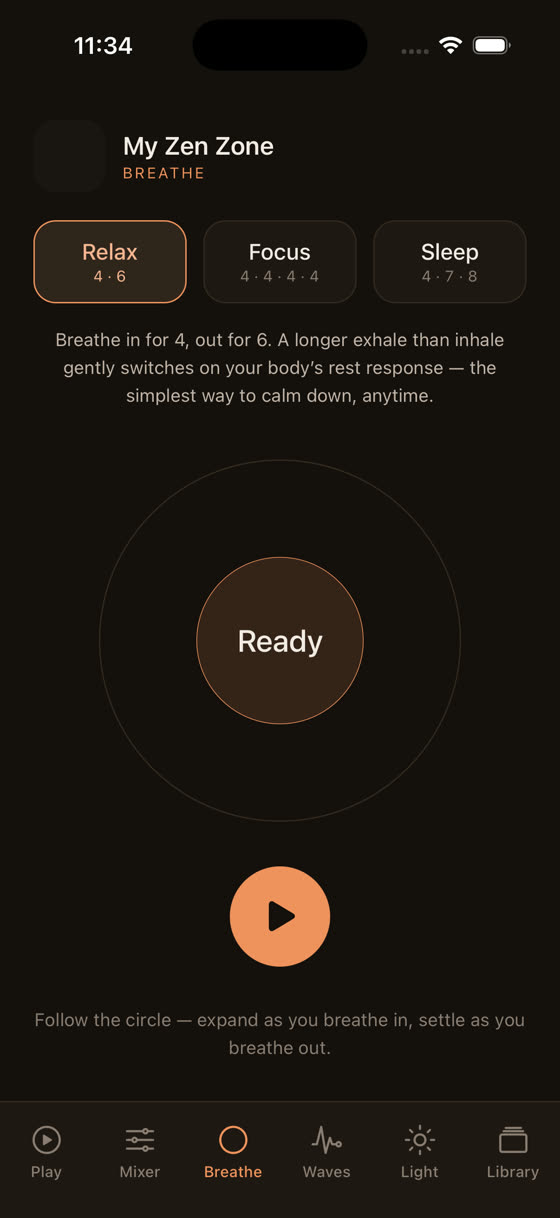
A simple 4-6 pattern, four counts in and six counts out, run for even two or three minutes before a session, tends to do more than people expect given how little effort it takes.
What to Actually Do Tonight
If you're trying this for the first time, skip the search and skip the shuffle. Pick one unbroken track rather than a playlist, somewhere in that 50-70 bpm range, ideally one you haven't heard enough times to anticipate every change. Sit or lie down, set a timer so you're not checking the clock, and let the first few minutes feel slightly too slow. That's normal. The dishabituation period, where the music still feels mildly active to you, is part of the process and usually passes within a few minutes.
If falling asleep partway through is a risk you don't mind, a sleep timer that fades the track out rather than cutting it off abruptly is worth using, and downloading tracks for offline listening removes the temptation to check your phone mid-session. Both are small mechanical details, but they're the kind of thing that makes a daily habit easier to keep than a dramatic one you try once.
Being Honest About What the Research Actually Shows
It's worth saying plainly that the evidence on music and relaxation is suggestive, not settled. There's reasonable research on tempo and heart rate entrainment, and on slow music reducing self-reported stress in lab settings, but a lot of it is small-scale and doesn't always hold up across different people and contexts. Nobody should promise you a specific physiological outcome from a playlist. What we can say with more confidence is simpler: music without lyrics, sudden dynamics, or demands on your attention is easier to meditate to than music that has those things. That's a design principle, not a medical claim, and it's the one we build every track in the meditation library around. You can hear the difference across the whole collection, which grows every two weeks, at myzenzone.app or by starting with the free trial at /get.
Common questions
How long should a meditation music session be?
There's no fixed rule. Ten minutes is enough to notice a difference before a stressful task, while twenty to thirty minutes suits a longer sitting practice. What matters more than duration is consistency: the same unbroken track daily tends to work better than a different, longer playlist each time.
Is instrumental music better than nature sounds for meditation?
Neither is objectively better, but they solve different problems. Instrumental drones and pads give structure without distraction. Nature sounds, especially layered under music at a low level, help mask outside noise like traffic. Many people find a thin layer of both, with nature sounds well below the music, works better than either alone.
Can I use the same music for meditation and sleep?
Often yes, since both benefit from slow tempo and no lyrics, but sleep music usually needs even fewer dynamic changes since you won't be awake to adjust to them. If a track works for meditating in the evening but keeps you alert, try something built specifically for sleep instead.
Does meditation music actually reduce stress, or is that just marketing?
The honest answer is that evidence is suggestive rather than conclusive. Some studies show slow, lyric-free music lowering self-reported stress and nudging heart rate toward a resting pace, but results vary by person and setting. Nobody should market it as a guaranteed effect, only as a tool worth trying.